

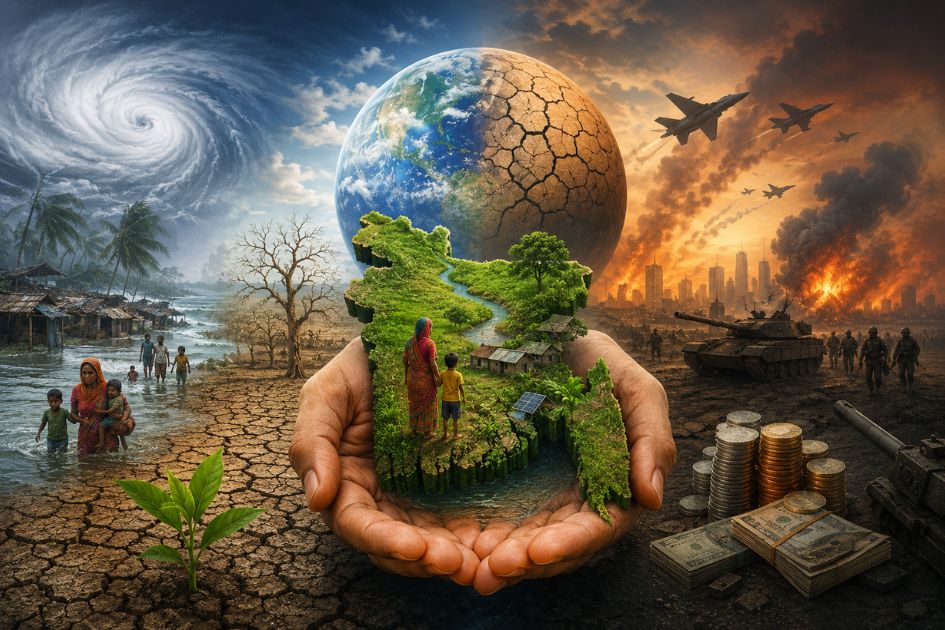



Bangladesh must rethink climate finance and strengthen domestic resilience as global conflicts, rising military spending, and shrinking grants deepen uncertainty for vulnerable economies facing escalating climate shocks.
The definition of climate finance has not yet been finalized. We have witnessed a shift in climate finance from grants to loans. The Independent High-Level Expert Group on Climate Finance (IHLEG) indicated a target of USD 1 trillion annually by 2030 and USD 1.3 trillion per year by 2035 for mitigation adaptation and addressing loss and damage. A shadow report by Oxfam and CARE asserted that developed nations have failed to meet their commitments despite their claims of providing USD 116 billion in 2022. The shadow report stated that the actual amount was between USD 25 billion and USD 28 billion, significantly lower than the figures reported by the OECD, with 70% of this amount being loans, which further exacerbates the debt burden on climate-vulnerable countries. Furthermore, developed nations are emphasizing the need to engage the private sector in transferring their responsibilities, while globally the private sector is contributing only 3% toward adaptation requirements.
According to the National Adaptation Plan, Bangladesh requires USD 230 billion for adaptation by 2050 along with an annual requirement of USD 8.5 billion. Furthermore, the country requires approximately USD 29 billion each year to fulfill its integrated adaptation and mitigation objectives. However, it is presently able to mobilize less than USD 3 billion, resulting in a financing gap of USD 26.5 billion, equivalent to about 6% of its GDP. Financial assistance from developed nations is neglecting adaptation efforts and instead prioritizing mitigation, even though adaptation remains the foremost concern for vulnerable countries. Surprisingly, with a few exceptions, an increase in greenhouse gas emissions was observed in the European Commission’s report for the period from 2023 to 2024. Developed countries are directing loans to developing nations, least developed countries (LDCs) and small island developing states (SIDS) while simultaneously increasing their contributions to global greenhouse gas emissions. Is this not a contradiction in global climate action?
A report by the European Commission in 2025 indicates that China and the United States are the largest and second-largest greenhouse gas emitters globally, contributing 29.2% and 11.1% of global emissions in 2024 respectively. These figures increased compared to 2023, which is alarming for the world. Furthermore, the United States ranked first in per capita greenhouse gas emissions in 2024, reflecting a pattern of high consumption. Only a few countries, namely Japan, Germany and the European Union, managed to reduce their emissions compared to 2023. Additionally, the ongoing conflict in the Middle East is contributing to greenhouse gas emissions. The Guardian reported that the climate cost of this conflict resulted in 5 million tonnes of greenhouse gas emissions within the first 14 days. Conversely, Earth.Org reported that emissions during the first three years of the Russia-Ukraine war amounted to 230 million tonnes of carbon dioxide equivalent.

Influential global leader Donald Trump rejected the concept of climate change and withdrew the United States from the Paris Agreement for the second time in 2025, while the country experienced 20 hurricanes since 2019, three of which were classified as Category 5: Milton in 2024, Ian in 2022 and Dorian in 2019. Nevertheless, this situation may not significantly impact a country with a strong economy.
We are witnessing a rising trend in military spending due to conflicts involving Israel and American allies against Iran as well as Russia and its allies in Ukraine. Escalating military expenditures linked to these global conflicts are threatening climate finance and contributing to increased greenhouse gas emissions. Russian military spending surged from USD 66 billion in 2021 to USD 149 billion in 2024. In contrast, the Pentagon reported that the cost of the war involving Iran had risen to USD 29 billion since the second week of May. The current global geopolitical landscape and the shifting attitudes of leaders from the global north regarding their historical responsibilities are creating greater uncertainty in accessing grant-based climate finance.
Bangladesh, a country with a vulnerable economy and ranked as the thirteenth most climate-vulnerable country, needs to rethink its financing strategy for climate action. According to a recent analysis by the World Bank, nearly half of Bangladesh’s non-poor population stands on the brink of poverty. Additionally, the Power and Participation Research Centre (PPRC) reported a worrying rise in the national poverty rate, which increased from 18.7% in 2022 to 27.93% in 2025. Extreme poverty also surged during this period, climbing from 5.6% to 9.35%. Compounding these challenges, the Climate Debt Risk Index (CDRI-2025) highlighted the alarming state of climate debt, revealing that Bangladesh bears one of the highest per capita climate debts at USD 79.6.
As Bangladesh approaches its anticipated graduation from Least Developed Country (LDC) status in 2026, the country faces the prospect of taking on new loans that may come with higher interest rates. Is the country truly prepared to shoulder a greater debt burden to finance climate solutions, especially as global climate negotiations shift from the Common but Differentiated Responsibilities and Respective Capabilities (CBDR-RC) framework toward a more business-oriented approach?
Bangladesh must reconsider the functioning of its own climate fund to address climate shocks, making it essential to reshape the governance and management of the Bangladesh Climate Change Trust Fund (BCCTF). Integrating climate change and gender considerations into all development efforts is vital through enhancing the capacity of personnel, ensuring proper resource allocation and utilization, and improving coordination among agencies. Furthermore, it is important to strengthen alliances with developing countries that share similar economic conditions and vulnerabilities in order to advocate for climate justice.
The writer is a climate activist.




