

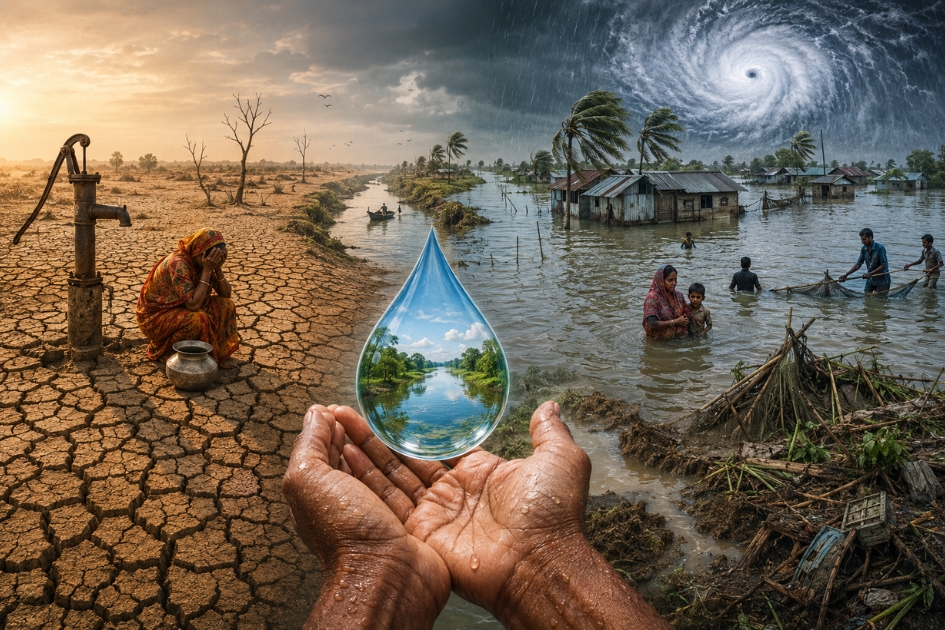



Climate change is intensifying Bangladesh’s water crisis through floods, droughts, salinity and groundwater depletion, threatening livelihoods, biodiversity, agriculture and public health while exposing urgent gaps in water governance and climate resilience.
Life cannot be imagined without water. Water is embedded in the rhythm of life, whether in the flow of rivers or the cascading fountains of isolated forests. All flora and fauna directly depend on water at every stage of their lifecycle. The essentiality of water lies in its existence in every form, including vapour, liquid and solid. From the beginning of the day until the dead of night, humans and all other living beings cannot survive without water.
However, it is unfortunate that Bangladesh, a country of rivers, is suffering from water shortages in many parts of the country, particularly in the Rajshahi division. Rivers, ponds and canals are drying up, while the groundwater table in some areas has fallen below 1,200 feet, worsening the crisis of safe drinking water.
Agriculture, livelihoods and plant and animal biodiversity are under threat. Even standing plantations are at risk of extinction. On the other hand, low-lying parts of the country remain vulnerable to repeated flash floods caused by incessant rainfall in upstream regions, mainly outside the country. The paradox is evident: while water is essential for agriculture and daily life, the natural flow of rivers is disrupted upstream by dams and diversions. The country’s ecology, soil microclimate and biodiversity have been seriously affected. Agriculture and livelihoods linked to farming have become a gamble with nature. Farmers can no longer be certain of harvesting crops without the risk of devastating floods or cyclones.
The southern part of the country faces even greater threats from unpredictable monsoon cyclones, flash floods and prolonged waterlogging. These disasters have repeatedly killed hundreds of thousands of people and cattle while destroying habitats, farmlands, fisheries and croplands. Cyclone Bhola (1970), Gorky (1991), Sidr (2007) and Amphan (2020) are among the deadliest cyclones to strike the southern and south-eastern parts of Bangladesh.
Salinity intrusion is one of the major challenges for farmers in 19 coastal districts. Large areas of these districts are regularly affected by tides and tidal surges, altering agricultural patterns and disrupting livelihoods, education, healthcare, communication and infrastructure. Due to cyclones and their long-term impacts, coastal communities constantly live under the threat of economic loss and displacement. Unfortunately, the increasing frequency of cyclones is intensifying suffering through waterlogging, river erosion, salinity intrusion and the destruction of crops and fish farms. Many people lose their jobs, assets and sources of income, pushing them deeper into poverty.
As the world’s largest deltaic plain, Bangladesh receives abundant water flow, which has made the land fertile and rich in biodiversity. However, because of its tropical geography, the country also faces severe climate vulnerabilities. Every year, Bangladesh suffers an average economic loss of more than 3 billion USD due to climate-related disasters, affecting over 6 million people directly. According to World Bank and climate studies, by 2050, around 13 to 20 million people in Bangladesh could be displaced internally due to climate change impacts, particularly sea-level rise and river erosion. The Barind Tract is already experiencing rapid groundwater depletion, threatening agriculture, livelihoods and daily life.
About 97 percent of the Earth’s water is found in the oceans, while around 2 percent is frozen in glaciers and ice caps. Only about 1 percent is available as freshwater for human use. Even this limited amount is increasingly contaminated by industrial waste, agricultural chemicals, arsenic and domestic pollution.
Rivers, lakes and wetlands are not merely bodies of water. They regulate ecosystems and biodiversity, sustain food chains and maintain ecological balance. Around 70 percent of global freshwater is used for agriculture. Natural phenomena such as tides, seasonal floods and water flows in wetlands are vital for maintaining environmental sustainability.
Access to clean water remains a major challenge in Bangladesh. Excessive groundwater extraction and rapid urbanisation in Dhaka have lowered the water table significantly. Concrete infrastructure such as roads and buildings prevents rainwater from naturally recharging underground aquifers. Hundreds of thousands of people across the country still lack access to safe drinking water. Arsenic contamination in groundwater continues to threaten millions of lives.
According to the World Health Organization, more than 2 billion people worldwide still do not have access to safe drinking water. In Bangladesh, waterborne diseases remain a major public health concern, particularly among children. Millions are at risk of arsenic exposure through contaminated groundwater. The World Bank has also warned that water-related challenges significantly affect Bangladesh’s economy and public health.
Polluted rivers are destroying fisheries, irrigation systems and traditional lifestyles. The Ganges, once revered and worshipped, is now heavily polluted by industrial effluents and untreated sewage. Human negligence and environmental mismanagement have severely damaged ecological balance.
Water scarcity is also increasing migration and displacement, posing serious challenges to sustainable development. According to the Intergovernmental Panel on Climate Change (IPCC), water-related risks are among the earliest and most severe impacts of climate change. Bangladesh faces a dual challenge: shortages of safe drinking water and increasing drought in the north, alongside floods caused by transboundary river flows. Rising sea levels are also accelerating salinity intrusion and river erosion. Fishermen are suffering as fish populations decline and competition for livelihoods intensifies.
Under the 1996 Ganges Water Sharing Treaty, Bangladesh is supposed to receive a fair share of water. In reality, implementation has often been inconsistent. Meanwhile, the Teesta River issue remains unresolved after decades of negotiations, leaving farmers in northern Bangladesh uncertain about irrigation during critical dry seasons. This uncertainty disrupts agriculture and food security while deepening frustration among affected communities. Reduced river flows have weakened irrigation, increased groundwater extraction and harmed fisheries and wetlands.
Water is both a crisis and a solution for humanity. Without water, health, livelihoods, economies and cultures cannot survive. At the same time, proper water management can create opportunities for dignity, resilience and sustainable development. The paradox of water abundance and scarcity can only be addressed through collective action, scientific innovation and democratic participation. Water justice is now an urgent necessity. Without water, there is no life, economy or future.
Smart agriculture using saline-tolerant and drought-resistant crop varieties, improved water storage and rainwater harvesting can help reduce the crisis. Mass awareness campaigns led by the government and civil society organisations can promote safe water practices and conservation. Diplomatic engagement on transboundary river management is also essential. Scientists, policymakers, experts and political leaders must work together through effective planning, monitoring and long-term policy reforms to secure Bangladesh’s water future.




