




India and Bangladesh have begun critical negotiations on renewing the Ganges Water Sharing Treaty, focusing on river flow, minimum guarantees, climate pressures, and future transboundary water governance ahead of its 2026 expiry.
India and Bangladesh have launched a new round of negotiations on renewing the Ganges Water Sharing Treaty, as the 30-year agreement approaches its expiry at the end of 2026. The discussions under the Joint Rivers Commission (JRC) are focused on shaping the next phase of transboundary water governance between the two countries.
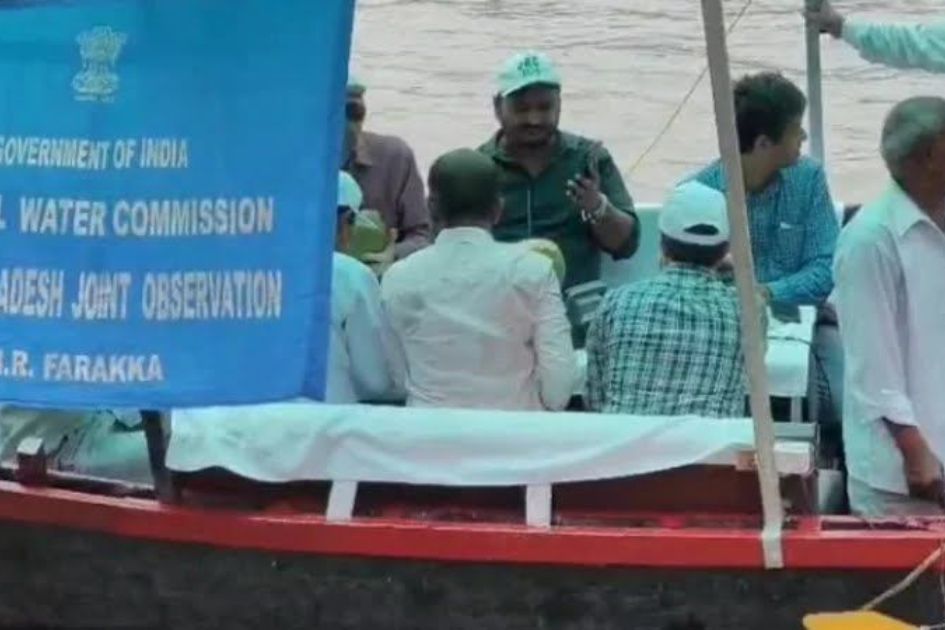
The 90th meeting of the JRC opened this week at the Farakka Barrage, where delegations from both sides carried out field inspections along the Ganges river system. Officials examined water levels, discharge patterns, sediment movement, and canal operations as part of technical preparations ahead of formal negotiations. While Indian officials described the exercise as routine, it is widely viewed as preparatory groundwork for treaty renewal discussions.
The Bangladeshi delegation is led by Joint Rivers Commission member Mohammad Anwar Kadir, along with officials from the Ministry of Foreign Affairs and Bangladesh’s diplomatic missions in India. The Indian delegation includes representatives from the Ministry of Jal Shakti and the West Bengal Irrigation Department. The three-day meeting is scheduled to conclude in Kolkata.
The treaty governs dry-season water distribution from January to May, when river flow drops sharply and demand rises across agriculture, drinking water supply, fisheries, and ecosystems. Under the current framework, when flow at Farakka is 70,000 cusecs or less, the water is shared equally. When flow is between 70,000 and 75,000 cusecs, Bangladesh receives 35,000 cusecs while India receives the remainder. When flow exceeds 75,000 cusecs, India receives 40,000 cusecs and Bangladesh receives the remaining volume. Allocations are reviewed every 10 days during the dry season.
A key issue in the negotiations is how river flow should be measured and interpreted. Bangladesh is proposing that upstream withdrawals from Indian states, including Uttar Pradesh, Bihar, Jharkhand, and Uttarakhand, be included in overall flow calculations. Indian officials argue that measurement should remain centered on real-time flow at Farakka for operational consistency and data reliability.
Experts and policymakers offered differing perspectives on the issue. Bangladeshi water expert Dr Ainun Nishat said, “The Ganges Barrage treaty renewal should not be limited to a few years but designed as a permanent framework.” Former caretaker government adviser and Dhaka University law professor Asif Nazrul stated, “We have the right to know how much water is being diverted upstream, and Bangladesh must be guaranteed a minimum flow under all circumstances.” Former Bangladeshi ambassador Humayun Kabir noted, “We started this process in July 1996. In 2011, there was a framework agreement between the two countries. These issues need to be reconsidered.” Former Indian High Commissioner to Bangladesh Pankaj Saran emphasized, “To divide water shares today, we need updated and reliable data on river flow. If we accept that the data has changed, we can align water sharing with the current reality.”
Political and administrative signals have also shaped expectations around the negotiations. It is increasingly understood that post-treaty arrangements will be influenced by the broader political relationship between Dhaka and Delhi. At the same time, the Joint Rivers Commission continues its technical work with the renewal process in focus.
Bangladesh’s Information and Broadcasting Minister Zahir Uddin Swapon said efforts are being made to renew the treaty before its expiry in December, prioritizing national interest. He stated, “The current government will continue strong diplomatic efforts through collective cooperation to ensure Bangladesh’s rightful share of water by strengthening international agreements and protocols that address river issues between upstream and downstream countries.”
On 13 May, Bangladesh’s Water Resources Minister Shahiduddin Chowdhury Anee said technical work is ongoing and that the treaty is expected to be reviewed within the year. He stated, “Our technical team is working. We hope to review this treaty this year. India is also working on it. The Joint Rivers Commission is discussing the matter. A decision will be made soon. We hope the 30-year-old treaty will continue.”
Despite these positions, both sides acknowledge that technical cooperation remains essential. Experts have highlighted concerns about the absence of a guaranteed minimum flow provision during periods of extreme scarcity, along with limitations in hydrological data and rising upstream withdrawals that continue to affect treaty effectiveness.
Climate change has added further pressure on the Ganges basin. Irregular rainfall patterns, Himalayan glacier melt, sedimentation, and rising water demand are reshaping river systems across South Asia. Future agreements, experts argue, will need to integrate climate resilience, ecological sustainability, and transparent data-sharing mechanisms.
The Farakka Barrage remains a long-standing point of contention since its commissioning in 1975. Bangladesh argues that upstream diversion has reduced dry-season water availability, affecting agriculture, navigation, and ecosystems downstream. The issue also carries historical significance, including the 1976 Farakka Long March led by Maulana Abdul Hamid Khan Bhashani, which became a landmark protest for equitable water sharing.
The 1996 treaty, signed by Indian Prime Minister H. D. Deve Gowda and Bangladeshi Prime Minister Sheikh Hasina, is widely regarded as a key milestone in bilateral water diplomacy. Despite implementation challenges, it has provided a structured framework for cooperation for nearly three decades.
Bangladesh is also expected to raise concerns over at least 14 shared rivers, including the Teesta, Dharla, Dudhkumar, Gomti, Khowai, Manu, and Muhuri rivers. Analysts suggest that future negotiations may eventually move toward basin-wide water governance models similar to frameworks such as the Mekong River system.
Officials from both sides say technical-level discussions are continuing ahead of the treaty deadline. Bangladesh has finalized its negotiation team while consultations continue on forming a joint technical committee. Some analysts suggest that if a revised agreement is not reached in time, the current treaty may be temporarily extended.
Water security experts warn that the outcome of these negotiations will shape agriculture, ecosystems, and livelihoods across the densely populated Ganges basin. At the center of the talks remain three core uncertainties: how river flow is measured, whether minimum guaranteed flow provisions will be introduced, and whether future governance will remain river-specific or shift toward basin-wide management.
As negotiations continue, both countries remain engaged in technical and diplomatic dialogue, with outcomes expected to define regional water security and India-Bangladesh relations for decades ahead.




