

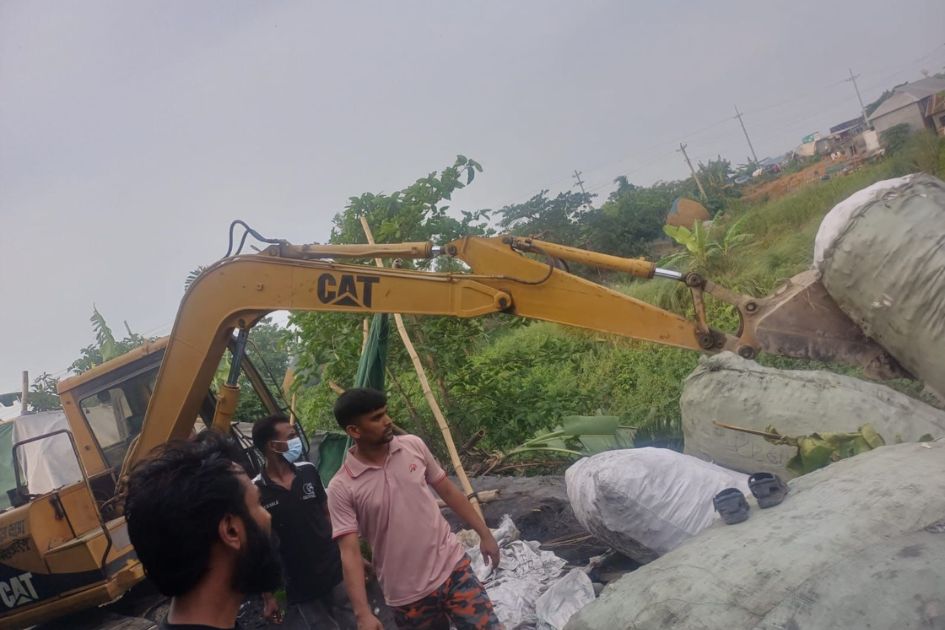



Authorities demolished an illegal lead recycling factory in Dhaka’s Nawabganj, citing severe pollution risks, seizing lead products and fining the owner during a coordinated anti-pollution enforcement operation.
Authorities in Bangladesh have shut down and demolished an illegal lead bar manufacturing factory in Nawabganj upazila of Dhaka district in a drive against hazardous industrial pollution and environmental violations.
The enforcement operation was carried out on May 23 by the Department of Environment’s Dhaka District Office in coordination with the Nawabganj upazila administration in the Gokulnagar area of Agla union.
Officials said the unnamed facility was producing lead bars by recycling used batteries, a highly polluting process that can release toxic substances into the air, soil and water when operated without proper environmental safeguards.
During the drive, the factory was completely demolished using an excavator to halt its operations. The owner was fined Tk 200,000, around USD 1,650, for violating environmental laws.
Authorities also seized 12 lead production dies and 22 finished lead bars from the site.
The mobile court was led by Md Afis Rahman, Assistant Commissioner (Land) of Nawabganj and Executive Magistrate. Md Habibur Rahman, Inspector of the Department of Environment’s Dhaka District Office, acted as prosecutor during the operation.
The enforcement drive was supported by Bangladesh Police, Fire Service and Civil Defence and the Rural Electrification Board, which provided logistical and operational assistance.
Environmental officials warned that illegal lead recycling facilities pose serious public health risks, particularly due to toxic lead exposure, which can have long-term impacts on children and nearby communities.
Reacting to the operation, Sohanur Rahman, Executive Coordinator of YouthNet Global, said stronger and sustained action is essential to prevent the recurrence of such illegal activities.
“This kind of enforcement is necessary and welcome, but it must be part of a continuous system of monitoring and accountability. Without long-term oversight and community-led monitoring, these hazardous operations will continue to re-emerge in different locations,” he said.
Authorities added that similar anti-pollution drives targeting illegal industrial activities will continue across the country to protect public health and the environment.




