

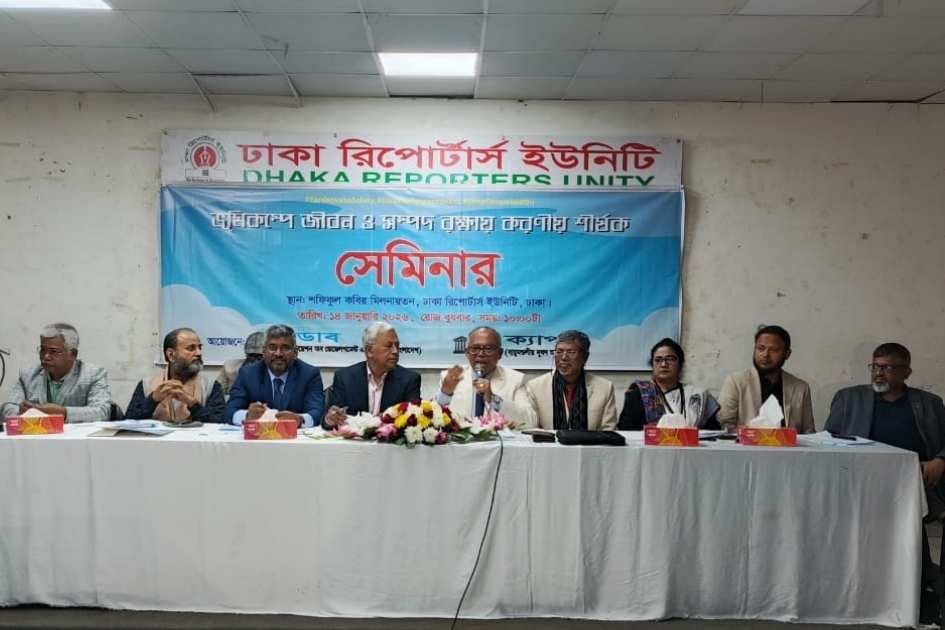



Experts at a Dhaka seminar warn Bangladesh faces catastrophic earthquake risk, citing unsafe buildings, weak enforcement, dense population and poor preparedness, urging urgent action to save lives nationwide now immediately.
Bangladesh remains dangerously unprepared for a major earthquake, experts warned on Wednesday (January 14), cautioning that a powerful tremor in the capital could cause catastrophic loss of life and property due largely to human failures rather than natural causes.
The warning came at a seminar titled “Measures to Protect Life and Property from Earthquakes,” jointly organised by the Association of Development Agencies in Bangladesh (ADAB) and the Centre for Atmospheric Pollution Studies (CAPS). The event was held at 10:00 am at the Shafiqul Kabir Auditorium of the Dhaka Reporters Unity.
Presided over by ADAB Chairperson Anwar Hossain and moderated by ADAB Director AKM Jasim Uddin, the seminar featured a concept paper presented by CAPS President Professor Dr Ahmad Kamruzzaman Majumder. A multimedia presentation on the technical aspects of earthquakes was delivered by Major (retd) Shakil Newaz, former Director of Operations of Fire Service and Civil Defence, Bangladesh.
Speakers said Bangladesh is located in a geologically earthquake-prone zone and earthquakes occur regularly, though their timing cannot be predicted. While some countries face higher seismic risk than Bangladesh, participants stressed that the country is almost entirely unprepared to deal with a major earthquake.
They identified multiple man-made factors that could sharply increase damage, including violations of building construction codes, unchecked construction of high-rise and glass buildings, excessive population density, depletion of groundwater layers, lack of alternative emergency exits in buildings, construction on soft alluvial soil, corruption, widespread public unawareness about earthquakes and prevailing superstitions.
Experts warned that urban areas would suffer far greater devastation than rural regions. They said a 7.5 magnitude earthquake in Dhaka could cause the collapse of more than one million buildings and potentially kill two-thirds of the city’s population. Emergency response capacity would be grossly inadequate to remove bodies, rescue the injured or transport them to hospitals.
They cautioned that hospitals themselves could collapse with doctors and patients inside. Gas and water pipelines would rupture, electricity and communication lines would fail, roads would crack or collapse and fires could break out. Debris from collapsed buildings could block roads, making them impassable for fire service and rescue workers. Firefighting would be hampered by the lack of a water supply.
Describing the situation starkly, speakers said people are “living inside their own dug graves.” They emphasised that survival depends largely on increasing public awareness and preparedness before, during and after earthquakes.
The seminar called for coordinated personal, family, community, office and national emergency planning involving communities, local governments, national authorities and the administration. Key recommendations included identifying and retrofitting risky buildings, strengthening civil defence, developing community-based disaster management systems and volunteer networks and empowering local governments.
Other proposals included assigning clear responsibilities to ward commissioners and municipal corporations, establishing community-based information hubs, strictly enforcing building codes and conducting awareness campaigns at local levels, including door-to-door outreach and programmes in schools and colleges by environmentalists, media and NGOs.
Speakers also stressed the need for psychosocial support programmes linked to hospitals to address trauma, maintaining clean roads and water sources, conserving rainwater and empowering the Geological Survey Department with adequate authority and resources to conduct surveys. They called for placing qualified professionals in appropriate positions and countering earthquake-related superstitions through public awareness.
Although earthquakes are natural phenomena, speakers said the scale of damage and deaths is largely a result of human actions and can only be reduced through a strong political commitment. Emphasising that people are the ultimate source of state power, they urged citizens to unite and pressure the state to fulfil its responsibilities.
The seminar concluded with a collective pledge to work together to ensure equal protection for all lives, regardless of their wealth, recognising that every life holds the same value.
Other speakers included Professor Dr Shahidul Islam, former chairman of the Department of Geography and Environment at the University of Dhaka; Professor Dr Adil Muhammad Khan, former president of the Bangladesh Institute of Planners; Wahida Banu, executive director of Aparajeyo Bangladesh and a human rights and social activist; Gowhar Naeem Wara, disaster management expert and founding convener of Disaster Forum; and Dr Md Khalequzzaman, professor of geology and environmental science at Commonwealth University of Pennsylvania in the United States.




