

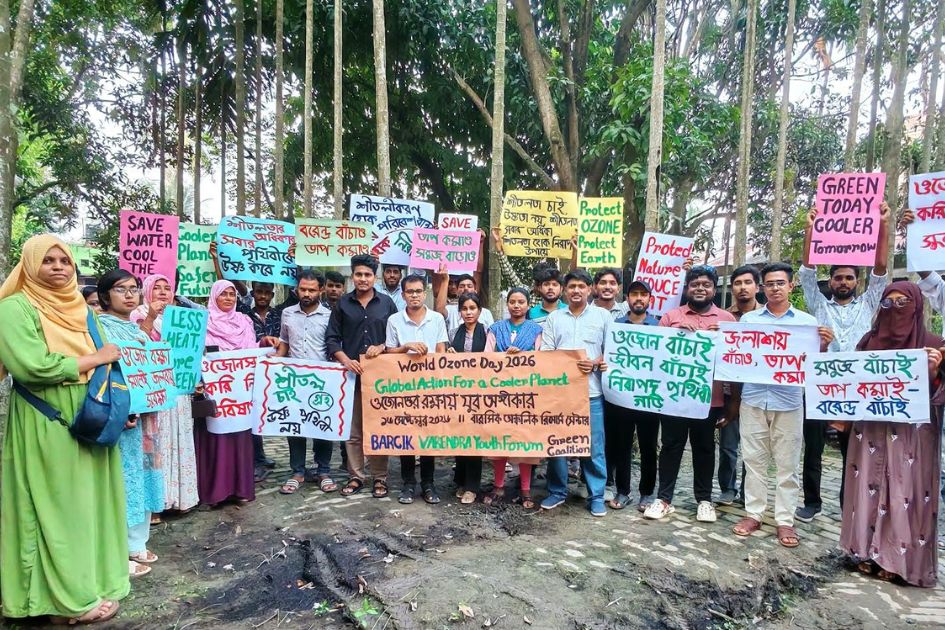



Speakers in Rajshahi called for integrated cooling policies linking ozone protection, energy efficiency and climate adaptation, with special measures for the drought-prone Barind region.
Bangladesh needs an integrated, long-term sustainable cooling system that protects the ozone layer while reducing energy use and climate impacts, speakers said at a discussion marking World Ozone Day 2026 in Rajshahi.
The event, titled “Global action for a cooler planet: Sustainable cooling and the future of Barind” and “Youth commitment to protecting the ozone layer”, was jointly organised by the Barind Youth Forum, research and development organisation Bangladesh Resource Centre for Indigenous Knowledge (BARCIK) and Green Coalition.
The discussion was held on Wednesday at BARCIK’s Regional Resource Centre in Rajshahi, focusing on the background and importance of World Ozone Day, as well as Bangladesh’s position and responsibilities in protecting the ozone layer. The main paper was presented by Barind Youth Forum President Md Atikur Rahman.
Speakers said cooling was no longer a luxury amid rising heatwaves, drought and climate risks, but had become important infrastructure for public health, food security, agriculture and climate adaptation.
They said expanding the use of air conditioners alone was not enough to address rising temperatures and that safe cooling for all should instead be ensured with lower energy and water use and less damage to the climate.
The theme of World Ozone Day 2026 is “Global action for a cooler planet”. This year also marks the 10th anniversary of the Kigali Amendment.
The 1987 Montreal Protocol established an important example of global cooperation to protect the ozone layer. The Kigali Amendment subsequently linked ozone protection more closely with climate protection by gradually reducing the use of hydrofluorocarbons, or HFCs, which have high global warming potential.
Bangladesh has already taken several measures to implement the Montreal Protocol and ratified the Kigali Amendment in 2020. The country has a regulatory framework that includes the Ozone Depleting Substances (Control) Rules, 2004, amended in 2014, as well as a related notification issued in 2021.
The country also has a legal framework to control ozone-depleting substances, regulate HFCs and reduce hydrochlorofluorocarbons.
Speakers said the focus now needed to extend beyond gas controls to include energy efficiency, recovery of refrigerants from old equipment, skilled technical personnel and environmentally friendly technologies under an integrated sustainable cooling policy.
Atikur Rahman said Bangladesh was at a point where the world had made significant progress in protecting the ozone layer while climate change was rapidly increasing the risks of heatwaves and excessive heat.
“As a result, the need for cooling is also increasing. In this situation, we need a cooling system that will meet people’s needs but will not create additional pressure on the environment and climate,” he said.
He said the issue was more urgent for the Barind region, where high temperatures, heatwaves, drought, pressure on groundwater and risks to agriculture-dependent livelihoods were interconnected.
“Therefore, the cooling policy for Barind cannot be limited to reducing the temperature inside homes. Ponds, water bodies, trees, shade, green areas, natural ventilation and heat-resistant buildings must be considered as natural cooling infrastructure,” he said.
Sabitri Hembrom, general secretary of the Indigenous Youth Council, said increasing the use of air conditioners alone was not a sustainable solution amid rising heatwaves and growing demand for cooling.
“Bangladesh needs to develop an integrated and long-term sustainable cooling system to protect the ozone layer, address climate change, save energy and ensure safe cooling for all,” she said.
Others who took part in the discussion included Tahmid Zaki, general secretary of Amar Bangla Tarun Sangha; Barind Youth Forum General Secretary Poly Rani; its Publicity Secretary Hasibul Hasnat Rizvi; and Md Mostakim Sardar, executive member of Naba Jagaran Foundation, among others.
The meeting put forward 10 demands and recommendations for World Ozone Day 2026.
They called for Bangladesh to implement an effective national policy and action plan integrating ozone protection and the transformation of cooling systems with climate adaptation.
They also called for a rapid shift from cooling gases with high global warming potential to low-global-warming-potential and environmentally friendly alternatives.
For new air-conditioning and refrigeration equipment, environmental impact and energy efficiency should be made mandatory criteria, they said.
A national system should also be established for recovering, reusing and safely disposing of refrigerants from old air-conditioning and refrigeration equipment.
The participants called for stronger training and certification for technicians in the air-conditioning and refrigeration sector on environmentally friendly alternative technologies, refrigerant management, preventing gas emissions and safe maintenance.
They also recommended introducing a green procurement policy for the use of environmentally friendly and energy-efficient cooling technologies in government offices, educational institutions, hospitals and other public facilities.
For the Barind region, they called for a pilot programme titled “Climate-smart Barind cooling”, combining natural cooling, greening, rooftop management and energy-efficient technologies in schools, health centres, agricultural storage facilities and community buildings.
The participants also called for the conservation of Barind’s ponds, water bodies, canals, trees and green areas, saying these were not only sources of biodiversity or water but also important natural infrastructure for regulating local temperatures and supporting climate adaptation.
They recommended local safe and affordable cooling systems and heat-related disaster preparedness plans for children, older people, workers, farmers and other vulnerable groups during heatwaves.
Finally, they called for research, innovation and youth leadership on sustainable cooling technologies and climate adaptation, with locally appropriate cooling models for Barind developed through a combination of local knowledge and modern technology.




