

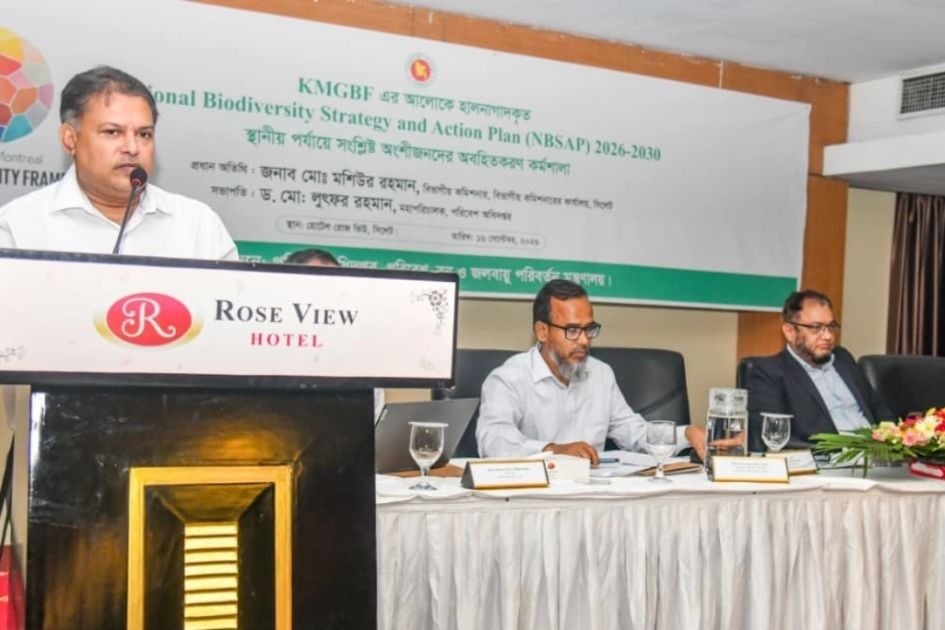



Sylhet stakeholders were urged to integrate biodiversity protection into development planning, with stronger coordination, protected-area management, pollution control and youth engagement.
Protecting biodiversity requires coordinated action across agriculture, fisheries, infrastructure, industry, urbanisation and tourism rather than relying solely on the environment authorities, the Divisional Commissioner of Sylhet said Wednesday.
“Let us make an integrated plan. Biodiversity conservation is not the responsibility of the environment department alone. Everyone has to implement it together,” Sylhet Divisional Commissioner Md Mashiur Rahman said.
He was speaking as the chief guest at a workshop in Sylhet to brief local stakeholders on the updated National Biodiversity Strategy and Action Plan (NBSAP) 2026-2030, prepared in line with the Kunming-Montreal Global Biodiversity Framework (KMGBF).
The workshop was organised by Bangladesh’s Department of Environment under the Ministry of Environment, Forest and Climate Change. The initiative to update the NBSAP in line with the KMGBF has also been reflected in government documents.
Rahman said Sylhet is an area of considerable biodiversity, with haors, hills, hillocks, tea gardens, rivers and other natural resources. Environmental protection and biodiversity therefore need to be incorporated into development planning in the region, he said.
“We assume that environmental issues will be handled only by the environment ministry or the Department of Environment. In fact, that is not the case. The environment is connected with everything, including agriculture, fisheries, roads, infrastructure, industry, urbanisation, tourism and disaster management,” he said.
He also stressed the need to balance tourism with environmental protection, saying tourism should be developed while preserving Sylhet’s natural beauty and biodiversity.
“Tourism cannot be stopped, but the natural environment cannot be harmed in the name of tourism either,” he said.
Citing Tanguar Haor, a wetland area, Rahman said the natural environment that once attracted tourists there had changed because of excessive commercial activities.
He also called for changes in individual behaviour, saying environmental protection could not be achieved through meetings and seminars alone.
“If I leave this seminar and do not change myself, there is no point in making big statements,” he said.
Rahman said awareness and coordinated action by all relevant institutions were essential to protect the environment and biodiversity. He also said progress could be made if the NBSAP framework presented at the workshop was properly implemented.
Speaking as chair of the workshop, Department of Environment Director General Dr Md Lutfur Rahman said views gathered from local stakeholders would play an important role in the next stage of preparing the NBSAP.
“The main objective of this workshop is to take your opinions. Later, the relevant stakeholder ministries will discuss these issues at the inter-ministerial level. Then they will be presented at the policymaking level,” he said.
Lutfur Rahman stressed effective management of protected areas, baseline assessments of species and ecosystems, area-based tree planting, pollution and plastic control, industrial waste treatment, reducing the use of harmful pesticides and minimising environmental damage from development activities.
He also placed particular emphasis on involving young people in raising environmental awareness. Young people can play an important role in taking the message of environmental protection to the grassroots level, he said.
Additional Director General of the Department of Environment Muhammad Solaiman Haider, Sylhet Divisional Director Md Abul Kalam Azad, Directors Mohammad Hasan Hasibur Rahman and A.K.M. Rafiqul Islam, Department of Environment Deputy Director Papia Sultana and prominent journalist and columnist Aftab Chowdhury also spoke as special guests.
Officials from various government and private-sector offices, leaders of social and professional organisations, teachers and students from different universities and media workers attended the workshop.




