

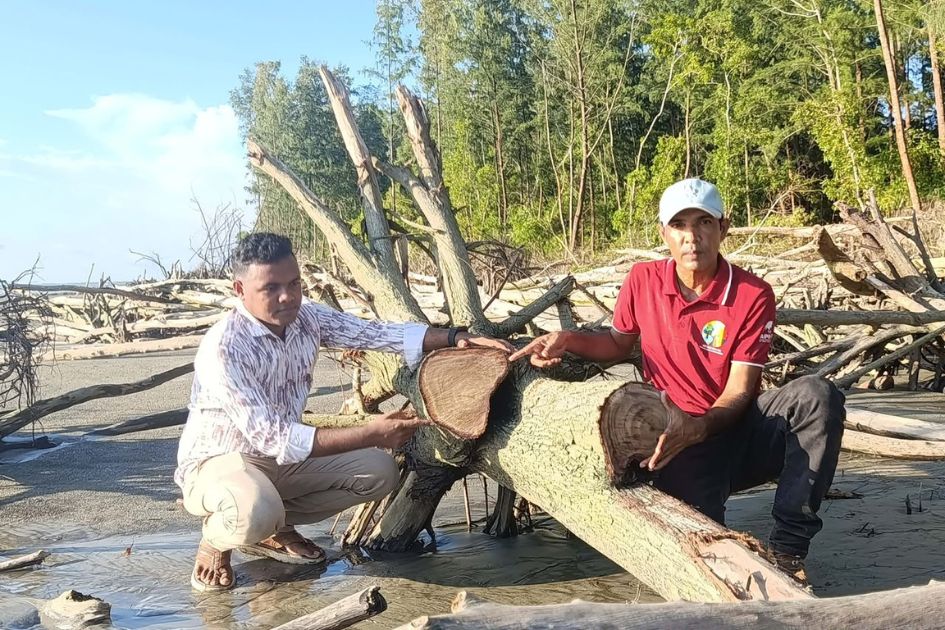



Once part of the Sundarbans, Tengragiri is a key coastal habitat and natural barrier, but residents report rapid timber removal and fear speaking against illegal logging.
The Tengragiri Reserved Forest in coastal Bangladesh is being openly cleared of trees, with local residents alleging that groups involved in illegal logging are operating in collusion with unscrupulous forest officials and that people who protest face threats of being implicated in tree-cutting cases.
The forest department has remained silent as valuable trees are reportedly being cut and transported from the forest, while officials have allegedly tried to persuade journalists not to publish reports on the logging, according to local residents and others familiar with the situation.
Forest department sources said the Tengragiri forest covers 13,644 acres. The naturally formed forest was once part of the Sundarbans and was declared a reserved forest on July 12, 1960, following a survey under the Forest Act of 1927. It was named Tengragiri Forest in 1967.
The forest contains various tree species including gewa, jam, dhundal, keora, sundari, bain, karomcha, kewra, palm, kakra, wild jackfruit, rain tree, hetal, tambulkata and goran. It is also home to wildlife including squirrels, monkeys, 40 species of snakes, porcupines, wild pigs, turtles, foxes and jungle fowl.
A recent visit to the forest in Talatali upazila, known as the “second Sundarbans”, found evidence of extensive illegal tree cutting in the area, which is an important habitat for coastal biodiversity and wildlife.
Trees were being cut in broad daylight directly in front of the office of the Chhakinа Beat Officer, while felled timber was being tied to trawlers and transported by river without apparent hindrance, according to observations during the visit.
A similar situation was found near the Nalbunia Beat Office. Valuable trees were also being cut one after another around the Shubha Sandhya sea beach tourism area.
The groups involved were transporting timber under cover of darkness and leaving some felled trees inside the forest to be removed later at a convenient time. They were also uprooting tree stumps and roots to remove evidence of the logging, according to the report.
In a stretch of about one kilometre of forest around Shubha Sandhya sea beach, nearly 200 trees had been cut and removed by several timber-smuggling groups over the previous three to four days, the visit found.
Local residents Md Rifat and Babul Howlader said they were unable to speak out despite watching the forest being cleared in front of them.
“Even though we see the forest being cleared before our eyes, we cannot say anything. Whenever anyone speaks out against tree cutting, forest department officials threaten to implicate them in tree-cutting cases. As a result, people are afraid and have lost the courage to protest,” they said.
Arifur Rahman, coordinator of the Talatali branch of environmental organisation Dharitri Rokkay Amra (Dhara), said the Tengragiri forest acts as a natural shield protecting coastal communities from cyclones, tidal surges and strong winds.
“If the forest continues to be cleared in this way, the balance of the natural environment will be disrupted and coastal communities will face extreme disaster risks,” he said.
When approached for comment on the tree cutting, Md Shawon, officer of the Nalbunia Beat, declined to comment and instead tried to persuade journalists not to report on the issue.
Md Ziaul Islam, range officer of the Talatali Range under the Forest Department, confirmed that illegal tree cutting had taken place.
“We went to the site and found evidence of illegal tree cutting. Legal action has been taken in the matter and a case has been filed,” he said.
Atish Sarkar, the Upazila Nirbahi Officer, or chief administrative official, of Talatali, said the Forest Department had been warned several times about the deforestation and instructed to take necessary measures.




