




Ancient Cycas plants, survivors from the dinosaur age, still grow in Bangladesh but face extinction. Scientists warn about their toxic seeds while urging conservation to protect this rare living fossil.
When dinosaurs roamed the Earth during the Mesozoic Era, Cycas was one of the dominant plant species on land. According to botanists, Cycas was so widespread during the Jurassic Period that this era is often referred to as the “Age of Cycads” alongside the “Age of Dinosaurs.” For millions of years these plants served as a primary food source for massive herbivorous dinosaurs. Although dinosaurs eventually went extinct with the passage of time, Cycas has survived to this day, retaining its primitive form almost entirely unchanged for more than 250 million years. This is why it is scientifically known as a “living fossil.”
In appearance, Cycas may resemble a palm tree or a fern, but its structure is quite distinct. The trunk is upright, cylindrical and typically unbranched. While a mature tree can reach heights of 8 to 15 feet, its growth is exceptionally slow. The trunk’s surface is not smooth. Instead it is covered in persistent leaf bases that act as a rugged protective armor. At the crown the bright green leaves are arranged like a majestic crown. These leaves are pinnately compound, meaning small leaflets are arranged in rows on either side of a central stalk. Interestingly the young leaves are coiled or circinate, a primitive trait also seen in ferns.
Reproductively, Cycas is a dioecious plant, meaning male and female organs grow on entirely separate trees. On the male Cycas numerous microsporophylls are tightly packed to form a solid cone-like structure called a male cone or strobilus. From the tiny sacs within this cone vast amounts of pollen are released and carried by the wind. In contrast the female plant does not form a tight cone. Instead its megasporophylls are arranged loosely in a spiral at the top. The upper part of these megasporophylls looks remarkably like a hooded cobra, leading to the local name “Sarpamoni” or Snake Gem. Large reddish or orange ovules sit at the base which eventually develop into naked seeds. It typically takes about 10 to 12 years for a Cycas plant to develop these reproductive structures.
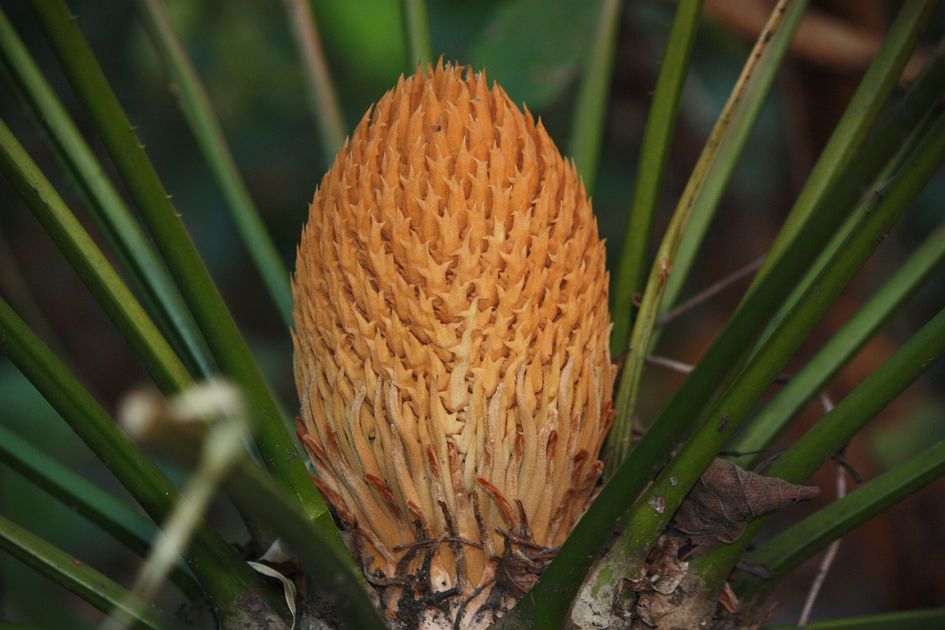
In various cultures Cycas or its “Sarpamoni” is often claimed to be a miracle cure for many ailments, a belief that modern science identifies as extremely dangerous. Research has proven that Cycas seeds and reproductive parts contain a potent toxin called Cycasin. This substance can cause severe liver damage and neurological disorders in humans. While the stomachs of dinosaurs might have been able to tolerate or process these toxins, they are life-threatening to humans. Therefore using Cycas for medicinal purposes without scientific validation is a grave risk.
In Bangladesh Cycas arrived as part of the natural distribution across Southeast Asia and the Indian subcontinent. In the past it was commonly found in the wild, particularly on the hill slopes and deep forests of the Chittagong Hill Tracts. Today due to urbanization and deforestation its numbers in the wild have declined alarmingly, placing it on the list of endangered plants in many areas. To save this valuable species modern methods like tissue culture are being used. In laboratory-controlled environments thousands of saplings can be produced from tiny plant tissues, a process that would take many years in nature. Beyond this Cycas is also propagated through bulbils or seeds. Protecting this plant in the Hill Tracts and other conserved regions of Bangladesh means safeguarding a living piece of history from the era of the dinosaurs.




