


Bangladesh’s FY2026-27 budget expands air quality monitoring and cleaner transport initiatives, but experts say stronger measures targeting vehicles, brick kilns, industrial emissions and fuel quality are needed.
Bangladesh’s proposed national budget for the 2026-27 fiscal year has announced a major expansion of air quality monitoring systems alongside limited cleaner transport initiatives. However, environmental and public health experts say the measures fall short of addressing the root causes of the country’s worsening air pollution crisis.
The budget proposes operating 15 Continuous Air Monitoring Stations (CAMS) and 16 Comprehensive Continuous Air Monitoring Stations (C-CAMS) across the country, aimed at strengthening air quality monitoring, environmental data collection and evidence-based policymaking.
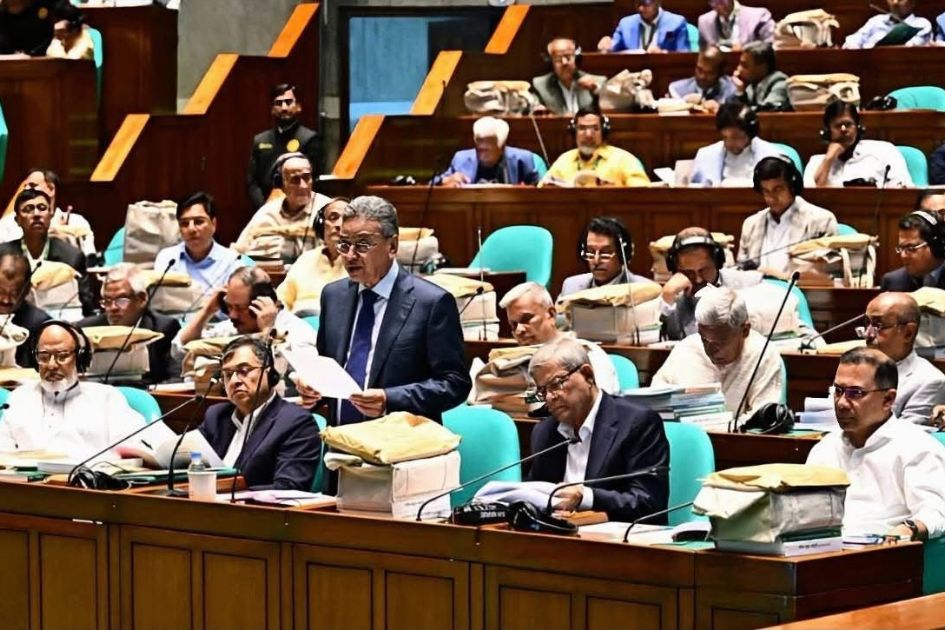
Finance Minister Amir Khosru Mahmud Chowdhury placed his maiden national budget for FY2026-27 in the Jatiya Sangsad on Thursday, outlining an economic roadmap focused on higher growth targets, regulatory reforms and an investment-driven vision of a trillion-dollar economy.
The total budget outlay is expected to reach Tk9.38 lakh crore, the largest in the country’s history. It is also the first budget of the BNP government following its landslide electoral victory on 12 February this year. A BNP-led administration last presented the national budget in 2006-07 under Finance Minister M Saifur Rahman.
Among environmental measures, the finance minister announced plans to establish 10 modern vehicle inspection centres to reduce emissions from motor vehicles and introduce electric bus services to promote cleaner public transport and reduce dependence on fossil fuels.
While these initiatives have been welcomed as positive steps, environmental analysts and public health experts say monitoring expansion and limited transport reforms alone will not deliver meaningful improvements in air quality without strong action on pollution sources.
Air pollution remains one of Bangladesh’s most pressing environmental and public health challenges. Dhaka regularly ranks among the world’s most polluted cities, while other urban and industrial areas also suffer from deteriorating air quality. Exposure to polluted air is linked to respiratory diseases, cardiovascular illnesses, stroke, lung cancer, adverse pregnancy outcomes and premature deaths while also driving up healthcare costs and reducing productivity.
Experts say the burden falls disproportionately on children, older people, outdoor workers, low-income communities and residents living near industrial zones and major road corridors, making clean air a public health and social justice issue.
Ahmed Kamruzzaman Majumder, chairman of the Centre for Atmospheric Pollution Studies (CAPS), said the budget includes positive steps but lacks a comprehensive pollution control strategy.
“There are positive aspects in the budget regarding environmental protection and expanding air quality monitoring is certainly a good initiative. However, there are no clear and specific proposals for reducing air pollution on a broader scale. We do not see a concrete plan to address the major sources of pollution,” he said.
Experts identify major contributors to air pollution in Bangladesh as old and high-emission vehicles, illegal brick kilns, industrial emissions, construction dust and open waste burning. They warn that without tackling these sources directly, monitoring alone cannot ensure cleaner air.
Environmental specialists say air quality monitoring is important for transparency, hotspot identification and policy direction but must be matched with enforcement, regulatory reform, investment in cleaner technologies and stronger institutional accountability.
They argue that effective pollution control requires phasing out high-emission vehicles, modernising or shutting down illegal brick kilns, enforcing industrial emission standards, ending open waste burning, improving dust management at construction sites and strengthening fuel quality standards.
A key concern highlighted by experts is the high sulphur content in fuel used across Bangladesh, which remains largely unaddressed in the budget despite its major role in worsening air quality.
Sulphur in fuel not only directly pollutes the air but also contributes to the formation of fine particulate matter (PM2.5), one of the most harmful pollutants to human health, increasing the risks of respiratory and cardiovascular diseases, stroke, lung cancer and premature death.
Professor Abdus Salam, an air quality researcher at the Department of Chemistry, University of Dhaka, warned that sulphur pollution poses a serious public health threat. He said sulphur not only causes direct pollution but also accelerates the formation of secondary pollutants, further worsening air quality.
Fuel quality tests conducted by the Bangladesh Standards and Testing Institution (BSTI) and the Bangladesh Council of Scientific and Industrial Research (BCSIR) found sulphur levels in some samples below the government limit of 350 parts per million (ppm). However, other samples recorded levels between 1,348 ppm and 2,800 ppm.
Experts say even the official limit of 350 ppm is far higher than international standards. Countries in Europe and neighbouring India have adopted ultra-low-sulphur fuel standards of around 10 ppm, making Bangladesh’s limit up to 35 times higher than global benchmarks.
Critics note that the 350 ppm standard was raised in 2023 to allow cheaper fuel imports. However, experts warn that the long-term health, environmental and economic costs far outweigh any short-term savings. They say fuel reform must be a central pillar of any meaningful clean air strategy.
Experts also point to a growing but often overlooked public health issue: lead exposure. Lead contamination from fuel, industrial emissions, paint, dust and waste sites can cause irreversible neurological damage, particularly in children, even at low levels. It is linked to reduced cognitive development, learning disabilities, kidney damage and long-term cardiovascular risks.
Environmentalists say lead pollution, like air pollution, is a silent health crisis that requires urgent monitoring and enforcement alongside broader emission control measures.
Beyond air pollution, experts also highlight the absence of strong measures on noise pollution, another growing urban health concern. Traffic congestion, excessive horn use, construction activity and industrial operations expose millions to harmful noise levels, leading to stress, sleep disorders, hearing impairment and cardiovascular risks.
Majumder noted that the budget does not include significant initiatives to address noise pollution despite its growing impact on urban liveability and public health.
Sohanur Rahman, executive coordinator of YouthNet Global, said expanding monitoring is important but insufficient without action at the source.
“Expanding air quality monitoring infrastructure is an important step but monitoring alone will not clean Bangladesh’s air. The real challenge is reducing pollution at its source. The budget should include stronger measures to phase out highly polluting vehicles, regulate brick kilns, enforce industrial emission standards, control open waste burning and reduce construction dust,” he said.
He added that air pollution is not only an environmental issue but also a major public health, economic and social justice challenge, affecting millions every year, particularly vulnerable groups.
“Investments in monitoring must be matched with enforcement, cleaner technologies, sustainable urban planning, public transport, renewable energy and climate-resilient infrastructure. Clean air should be treated as a fundamental right and a core pillar of climate resilience and sustainable development,” he said.
Rahman also called for stronger coordination among the environment, transport, energy, local government, housing and industry ministries, saying air pollution cannot be solved through fragmented action.
Environmental advocates say the success of the government’s initiatives will depend on whether monitoring data is translated into enforcement and whether environmental regulations are effectively implemented.
For experts, the real measure of success will not be the number of monitoring stations installed but whether Bangladesh achieves sustained reductions in pollution levels and health impacts across its cities.
Until major pollution sources are addressed, experts warn that monitoring alone will not be enough to deliver meaningful improvements in air quality, public health, climate resilience and quality of life.




