

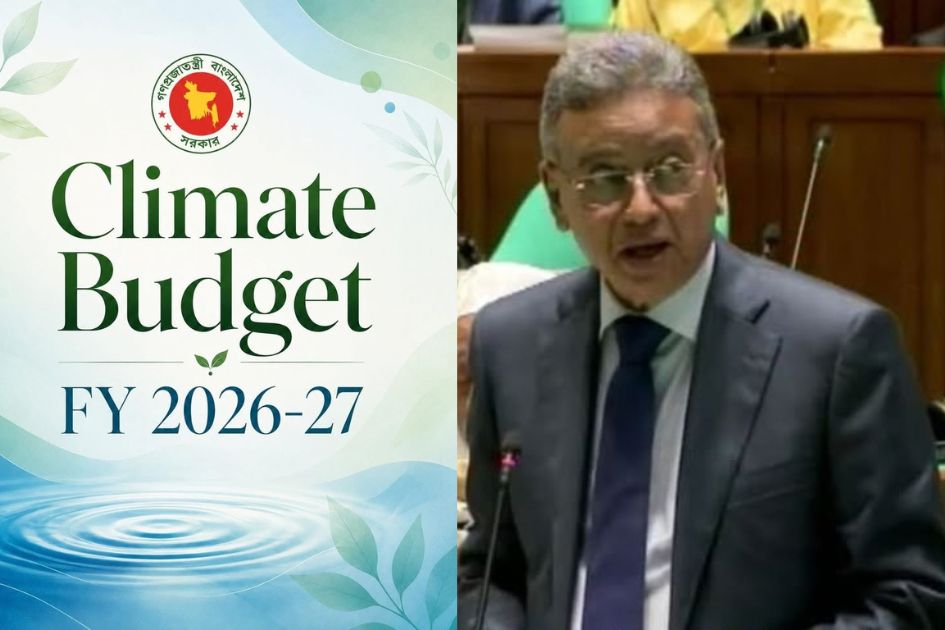

Bangladesh’s FY2026-27 budget allocates Tk 2,240 crore for climate and environment initiatives, prioritising afforestation, clean transport, waste management and digital forest governance amid concerns over adaptation financing gaps.
Bangladesh, one of the world’s most climate-vulnerable countries, has proposed an allocation of Tk 2,240 crore for environmental protection and climate change response in the FY2026-27 national budget, reflecting a modest increase of Tk 96 crore compared to the revised allocation of Tk 2,144 crore in the current fiscal year.
Finance Minister Amir Khasru Mahmud Chowdhury presented the budget proposal in Parliament on Thursday, saying the government is prioritising environmental conservation, afforestation and long-term climate resilience as Bangladesh continues to face escalating climate risks.
The country remains highly exposed to cyclones, floods, river erosion, salinity intrusion, droughts and sea-level rise, with impacts increasingly concentrated in coastal belts, haor basins, char islands and densely populated urban areas.
Digital forestry governance and large-scale afforestation
A key feature of the budget is a strengthened push for afforestation combined with digital monitoring systems. The government plans to introduce GPS and GIS-based forest monitoring tools alongside a Tree Monitoring App to improve transparency, accountability and real-time tracking of plantation activities.
The budget also reiterates a five-year target of planting 2.5 billion trees, expected to generate approximately 350,000 direct and indirect green jobs, according to official projections.
For FY2026-27, plantation targets include 428.97 million saplings across 25,960 hectares of block plantations, 37.27 million saplings along 3,727 km of strip plantations, 177.76 million mangrove saplings across 4,000 hectares and 5.6 million saplings under homestead forestry programmes.
In addition, the government will implement the One Child, One Tree initiative, involving schoolchildren in planting 100 million trees nationwide.
Carbon markets and circular economy transition
Officials said 50 percent of coastal mangrove forests will be gradually brought under carbon trading mechanisms, signalling a shift towards nature-based climate finance and ecosystem valuation.
The budget also introduces a circular future model for waste management alongside updated e-waste regulations. Under a broader reduce-reuse-recycle (3R) framework, Bangladesh aims to reduce plastic waste by 30 percent over five years.
Air quality monitoring and clean transport measures
To address worsening air pollution, the government plans to expand monitoring capacity through 15 Continuous Air Monitoring Stations (CAMS) and 16 compact monitoring units across the country.
Key transport-related measures include the establishment of 10 modern vehicle inspection centres under the Bangladesh Road Transport Authority (BRTA), the introduction of electric bus services and incentives for domestic electric bicycle manufacturing.
The budget also includes major fiscal adjustments for electric mobility. Import duties on EV chargers and charging infrastructure will be reduced from 39.75 percent to zero, aiming to accelerate nationwide charging infrastructure development.
For electric vehicles, revised import tax structures set rates at 34 percent for vehicles priced up to USD 25,000 and 80 percent for vehicles priced up to USD 50,000, reflecting differentiated policy support across market segments.
Plug-in hybrid electric vehicles (PHEVs) will also see reduced tariffs, with lower duties based on engine capacity and the withdrawal of regulatory duties for selected categories.
Environmental advocates have meanwhile called for stronger investment in cycling infrastructure and affordable bicycle networks, arguing that low-carbon mobility must go beyond motorised transport.
Climate finance gap raises concerns
Despite the broad policy push, the allocation of only Tk 100 crore for the Bangladesh Climate Change Trust Fund has drawn scrutiny from climate policy observers and civil society groups.
They argue that the funding remains limited compared to the scale of annual climate-related losses and rising adaptation needs, particularly in vulnerable coastal and riverine regions where displacement and livelihood disruption are increasing.
Experts have long urged greater investment in embankment strengthening, water management systems, urban drainage, ecosystem restoration and planned relocation strategies for climate-displaced communities.
“Sustainable transition will only be meaningful if climate finance governance is transparent, predictable and justice-centred. A just transition must ensure that frontline communities, youth and vulnerable workers are not left behind in the process of green transformation,” said Sohanur Rahman, Executive Coordinator of YouthNet Global.
Balancing ambition and fiscal constraints
Overall, the FY2026-27 budget presents a structured green transition agenda combining afforestation, digital forest governance, pollution control, waste management reform and clean mobility incentives.
While the policy direction signals continued commitment to environmental transformation, questions remain over whether current fiscal allocations are sufficient to match the scale and urgency of Bangladesh’s climate challenges.
As one of the countries most exposed to climate impacts globally, the effectiveness of these initiatives will depend not only on policy ambition but also on sustained, predictable and scaled-up climate financing.




