




Bangladesh’s garment sector faces export risks as EU carbon rules tighten, exposing gaps in renewable energy transition, policy barriers and growing tensions between climate ambition, trade fairness and industrial competitiveness.
Bangladesh’s export-driven garment industry is facing a major challenge as the country risks losing up to 30 percent of its apparel exports to the European Union if it fails to meet mandated decarbonisation targets by 2030.
The EU’s Carbon Border Adjustment Mechanism (CBAM) officially entered its definitive phase on January 1, 2026. Currently focused on carbon-intensive sectors such as steel, cement and aluminium, CBAM is set to expand to apparel in the coming years. Importers of covered products must purchase and surrender CBAM certificates to account for the embedded emissions of their goods, with the first annual declaration for 2026 imports due by September 30, 2027. The mechanism effectively places a carbon price on imports to align them with EU climate standards.
The urgency of the issue was underscored at the COP30 climate summit held in Belém, Brazil, in November 2025, where CBAM emerged as a major source of global tension. While the EU defended the policy as essential to prevent carbon leakage, developing nations led by China and India criticised it as a protectionist trade measure that penalises economies without providing adequate green finance or technology support.
The South Asian Network on Economic Modeling estimates that Bangladesh may suffer a 30 percent decline in exports to the EU, a development that could severely affect the ready-made garment sector, which accounts for more than 80 percent of national export earnings.
The Bangladesh Nationalist Party, in its 2026 election manifesto, has pledged a transition to a more sustainable and diversified energy system, placing renewed emphasis on renewable energy expansion alongside broader sector reforms. The party aims to build an “affordable, reliable and environmentally sustainable” power sector by increasing generation capacity to 35,000 megawatts by 2030. It also plans to promote solar home systems, microgrids and biogas projects, particularly in underserved areas. Modernising inefficient plants, introducing smart grids and reducing system losses are also priorities. The manifesto signals a shift toward green development through renewable energy expansion, environmental protection, climate resilience measures and promises to create green jobs while improving energy access equity across regions.
Major global apparel brands sourcing from Bangladesh have already aligned with stricter climate commitments. American Eagle now requires at least 10 percent renewable electricity use among its suppliers, while Levi Strauss and GAP have pledged to cut emissions by 42 percent by 2030. These requirements are already influencing sourcing decisions in Bangladesh.
At COP30, the debate widened into a direct conflict between climate ambition and trade equity, with developing countries warning that CBAM risks becoming a “green trade wall,” while China reportedly pushed back against stronger climate ambition language unless the EU agreed to modify the mechanism. The final Belém Package included a commitment to launch annual global dialogues on trade and climate starting in June 2026, aiming to ease tensions and address concerns over fairness and equity. Despite the diplomatic pushback, the EU has maintained that CBAM will proceed as planned.
However, analysts say the gap between ambition and implementation remains wide. Bangladesh currently has only 5.38 percent renewable energy capacity in electricity generation, far behind competitors such as India, Cambodia and Pakistan, which have moved faster to green their industrial energy systems.
Industry leaders warn that Bangladesh’s heavy dependence on imported fossil fuels, particularly liquefied natural gas and crude oil, is undermining both export competitiveness and national energy security. According to LightCastle Partners, Bangladesh imported 109 LNG cargoes worth $3.88 billion in 2025, up from 86 cargoes costing $3.02 billion in 2024.
Despite policy efforts to encourage private investment in renewable energy, stakeholders say the proposed tariff structure is creating serious obstacles. A proposed Tk 2 to Tk 3 per kilowatt markup aimed at recovering legacy public subsidies has been strongly criticised by industry groups, who argue that it makes renewable power commercially unviable compared with conventional grid electricity.
The Bangladesh Garment Manufacturers and Exporters Association (BGMEA) has warned that such costs could deter investment, weaken competitiveness and push buyers toward countries already aligned with low-carbon production systems.
“Our manufacturers are operating on very tight margins, and any increase in utility costs directly affects their competitiveness and long-term investment decisions,” said BGMEA Vice President Vidiya Amrit Khan.
Corporate leaders have echoed similar concerns.
“To scale up sustainable power generation, a favourable pricing policy is essential. If industries need to spend much more to use renewable energy, it will directly affect their bottom line,” said Shahed Alam, chief corporate and regulatory officer of Robi Axiata.
Amid these concerns, climate advocates are calling for a fair and inclusive transition.
Sohanur Rahman, who served at COP30 as a young negotiator on just transition, said, “This is not only an energy transition, it is an industrial justice issue. Bangladesh needs a just transition framework where workers’ rights, green jobs, affordable renewable power and export resilience move together.”
He suggested Bangladesh engage early on just transition issues under the Belém Action Mechanism and deploy trade negotiators and climate diplomacy with the EU to safeguard both industry and communities. He added, “Bangladesh’s decarbonisation pathway must ensure garment workers, factory communities and small suppliers are not left behind as global markets shift rapidly toward low-carbon production.”
Policy experts have also highlighted steep import taxes on renewable equipment as a major barrier, with duties on solar panels and batteries reaching as high as 58.6 percent and 89.32 percent respectively.
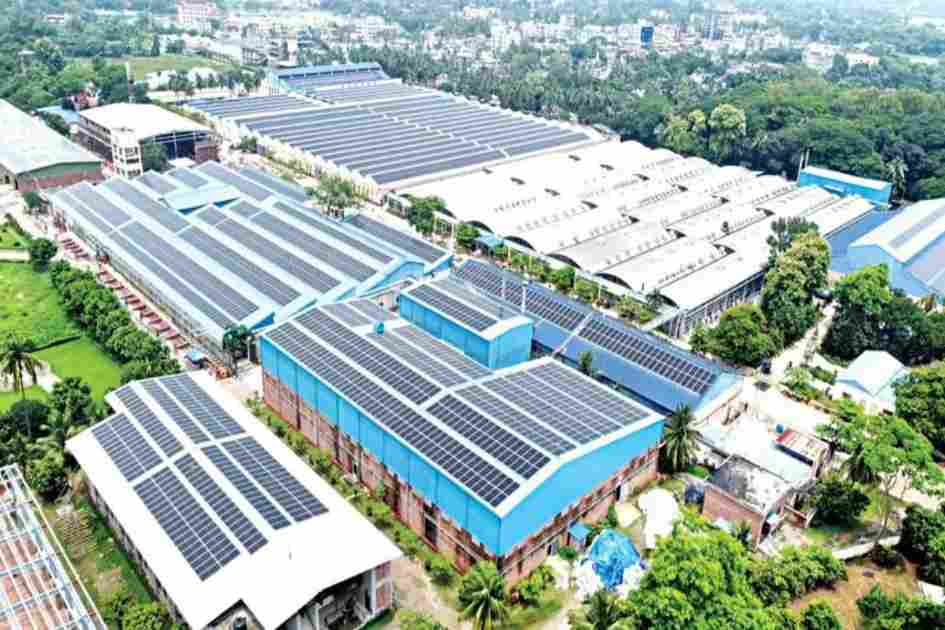
Despite these challenges, some exporters are already moving ahead. Ha-Meem Group has installed 12 megawatts of rooftop solar capacity to secure future export orders and reduce reliance on diesel during power outages.
“By setting up rooftop solar, we are getting a good advantage. During load-shedding, it works as a backup. Without renewable energy, we would have needed to rely on diesel generators, which would be extremely costly,” said Managing Director A K Azad.
With only four years remaining before CBAM begins affecting the apparel sector, analysts say Bangladesh faces a decisive moment. Whether the country removes policy barriers and accelerates a just and inclusive renewable transition will determine if it retains its position as a leading apparel exporter or sees orders migrate to regional competitors already moving toward low-carbon production.




