

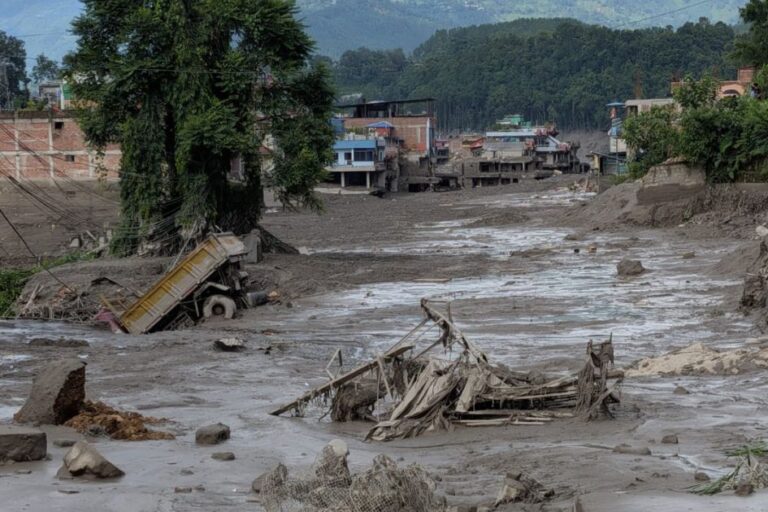



Scientists say warming has destabilised Himalayan glaciers and frozen ground, while the disaster exposed the limits of Nepal’s existing adaptation and early warning measures.
Climate change contributed to the thinning of glaciers and thawing of frozen ground in the Himalayas, which likely played a role in the deadly rock and ice collapse in Nepal last month, according to a new scientific analysis.
The study was carried out by an international team of glaciologists and climate scientists.
More than 1,300 people were killed and over 5,000 remain missing after a large section of rock and glacier collapsed from Langtang Lirung mountain on August 26. The collapse triggered a huge flow of water, ice and debris that swept through communities downstream.
Scientists said the disaster was not caused by a single extreme weather event. Instead, it was the result of several geological and climate-related factors coming together.
“Climate warming, caused by humans burning fossil fuels, is melting ice and snow in the Himalayas, reducing glacier coverage and thawing permafrost,” said Professor Bethan Davies, Professor of Glaciology at Newcastle University.
“This is making mountain slopes less stable and increasing the risk of disasters like this one. Urgent action is needed to reduce emissions and prevent faster melting and greater risks in the future,” she said.
According to the study, decades of warming have pushed the freezing line-the level above which temperatures remain below zero degrees Celsius-upward by about 100 metres every decade.
As a result, glaciers are retreating and frozen ground and ice inside cracks in mountain rocks are exposed to warmer temperatures for longer periods. This can weaken the slopes and make them more likely to collapse.
The researchers identified several factors that may have contributed to the collapse. Glacier thinning reduced the ice that helps stabilise mountain slopes, while increased melting may have added more water to the area.
A magnitude 7.8 earthquake in 2015 may also have weakened the slope before the latest collapse. However, scientists said they cannot yet confirm how much the earthquake contributed to the 2026 disaster.
Manjeet Dhakal, Director of Climate Analytics South Asia, said the disaster was a serious warning about the growing risks faced by people living in a rapidly warming Himalaya.
“Rising temperatures are changing glaciers, snow, permafrost and the wider mountain environment, creating increasingly complex hazards,” Dhakal said.
He said the size of the disaster has tested Nepal’s ability to respond and has shown the limits of existing adaptation measures. He called for faster cuts in global greenhouse gas emissions, stronger monitoring and early warning systems, better understanding of mountain risks and greater international climate finance for countries such as Nepal.
Temperatures were also unusually high just before the disaster. July and August 2026 were the warmest on record in the local area, according to the analysis. Heavy snowfall in October and November 2025 also provided additional water that later contributed to melting before the collapse.
The study found that climate change has increased July and August temperatures in the area by about 1.5 degrees Celsius compared with pre-industrial times. Climate change has increased annual temperatures in the region by about 2 degrees Celsius.
However, scientists stressed that the study does not prove that the collapse would not have happened without climate change. Instead, it shows that rising temperatures are changing the Himalayan environment and affecting several factors that can make mountain slopes unstable.
The disaster has also highlighted the limits of adaptation. Nepal has early warning systems and disaster preparedness plans, but the scale and complexity of this event were beyond the capacity of existing measures, the study said.
Professor Friederike Otto of Imperial College London said the study was different from a traditional World Weather Attribution study because it did not examine a single extreme weather event. Instead, scientists looked at a multi-stage mountain disaster involving many factors.
She said the disaster also raised an issue of climate justice, as communities in Nepal are facing the effects of a global crisis largely driven by fossil-fuel emissions.
“When warming destabilises the roof of the world, no amount of local adaptation can fully shield vulnerable people downstream from this scale of destruction,” Otto said. She warned that without faster action to reduce fossil-fuel use, disasters of this scale could become more common in the future.
The researchers are calling for faster reductions in fossil-fuel emissions, stronger monitoring of glaciers and high-altitude permafrost, improved early warning systems and greater investment in understanding mountain hazards.
They also called for increased international climate finance to help vulnerable countries such as Nepal prepare for and recover from the growing risks linked to a warming Himalaya.




