

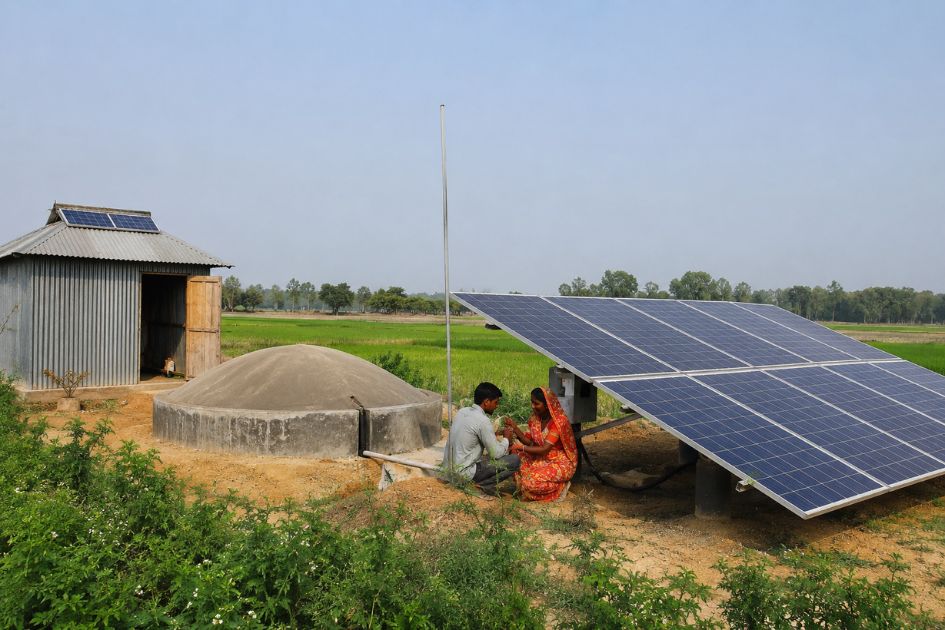



Bangladesh has already proven zero-upfront-cost solar works. Carbon credits could help fund the next wave.
Bangladesh’s experience with concessional renewable energy financing and its emerging carbon market framework could be combined to create a revolving investment model that strengthens long-term clean energy deployment while reducing reliance on continuous donor funding.
Bangladesh has already solved one of the hardest challenges in rural renewable energy: helping millions of families adopt solar power without asking them to pay the full cost upfront. The next challenge is financing the country’s next generation of clean energy at scale. Carbon credit revenue, if integrated carefully into existing financing models, could become part of that solution.
A model Bangladesh has already proven
Between 2003 and 2019, Bangladesh’s state-backed Infrastructure Development Company Limited (IDCOL) supported the installation of more than four million Solar Home Systems, bringing electricity to millions of rural households that previously lacked reliable access. Rather than requiring families to purchase solar systems outright, IDCOL used concessional financing from international development partners and channelled it through local partner organisations, which offered affordable household loans repayable over two to three years.
The model proved remarkably successful. Partner organisations reported loan collection rates of up to 96%, demonstrating that rural households are willing and able to invest in clean energy when repayment schedules align with their income and the upfront financial barrier is removed. Beyond solar, IDCOL has also financed more than 71,000 biogas plants and over four million improved cookstoves, collectively avoiding an estimated 35 million tonnes of carbon dioxide emissions.
Bangladesh has therefore already demonstrated two important realities: renewable energy can reach rural communities at national scale and well-designed financing mechanisms can make clean energy affordable even for low-income households.
Where carbon credits could fit in
Bangladesh is now entering a new phase of climate policy. Under its updated Nationally Determined Contribution (NDC 3.0), the country has committed to developing a national Article 6 carbon market registry while advancing its broader carbon market framework. As international carbon markets expand, verified emissions reductions could become an increasingly important source of climate finance.
The opportunity is not to replace Bangladesh’s existing renewable energy financing model but to strengthen it.
A revolving renewable energy fund could be capitalised initially through grants, concessional loans or blended finance, much like the original IDCOL programme. The fund would finance solar home systems, solar irrigation pumps or clean cooking technologies without requiring households to make large upfront investments. Families would continue repaying affordable monthly instalments, allowing capital to circulate and finance additional projects.
The difference is that these projects could also generate verified carbon credits. Revenue from selling those credits could flow back into the revolving fund alongside loan repayments, replenishing its capital and gradually reducing dependence on continuous donor funding. Rather than financing the first installation, carbon revenue would help finance the second, third and fourth rounds of investment, creating a more sustainable financing cycle.
Where this idea requires realism
Carbon credit revenue should not be viewed as a shortcut to financing renewable energy. Several practical challenges need to be acknowledged.
First, carbon revenue takes time. Projects must be registered, monitored and independently verified before credits can be issued, a process that often takes one to three years. Carbon finance therefore cannot replace the initial capital required to install renewable energy systems. Seed funding from governments, development finance institutions or blended finance remains essential.
Second, carbon markets remain volatile. Credit prices fluctuate, and Bangladesh’s own experience with carbon finance is still relatively limited. Any financing mechanism relying partly on carbon revenue must be designed to withstand market uncertainty rather than assuming consistently high prices.
Third, successful repayment cannot be taken for granted. IDCOL’s strong repayment performance resulted from careful partner selection, local financial relationships and disciplined loan management. Any future carbon-linked revolving fund would require the same institutional safeguards, including appropriate risk management, reserve mechanisms and prudent financial oversight.
Finally, success will depend on transparent digital monitoring, reporting and verification (dMRV) systems that can accurately measure emissions reductions and build confidence among international carbon credit buyers.
Not a new invention, but a new connection
None of the individual components of this idea are entirely new. Revolving renewable energy funds, pay-as-you-go solar financing and results-based carbon finance have all been implemented in different countries.
Bangladesh’s opportunity lies in connecting two strengths it already possesses: a nationally proven renewable energy financing model and an emerging carbon market framework. While these systems have largely developed independently, integrating them could create a financing model that is both nationally relevant and increasingly self-sustaining.
A pathway toward self-sustaining climate finance
If implemented carefully, this approach could deliver benefits beyond expanding renewable energy access. Reliable electricity and clean irrigation improve agricultural productivity, strengthen rural livelihoods and reduce dependence on fossil fuels. A revolving financing mechanism also ensures that climate finance continues generating new investments rather than being spent once and exhausted.
Most importantly, it offers Bangladesh an opportunity to recycle climate finance domestically. Instead of relying indefinitely on external concessional funding, the country could gradually use verified carbon revenue to reinforce its own renewable energy investment cycle.
Bangladesh has already shown that innovative financing can transform rural energy access. The next challenge is determining whether that proven model can evolve into a more self-sustaining system, supported not only by public and development finance but also by credible carbon markets. If successful, Bangladesh would not simply expand renewable energy. It could demonstrate how climate finance can strengthen national development while accelerating the transition to a low-carbon future.
Author Bio
The author works on climate finance and renewable energy financing models in Bangladesh and is a final-semester BBA student at East Delta University, a private university in Chattogram, Bangladesh, and Founder & CEO of Polyjute Ltd & CarbonZero Bangladesh.




