

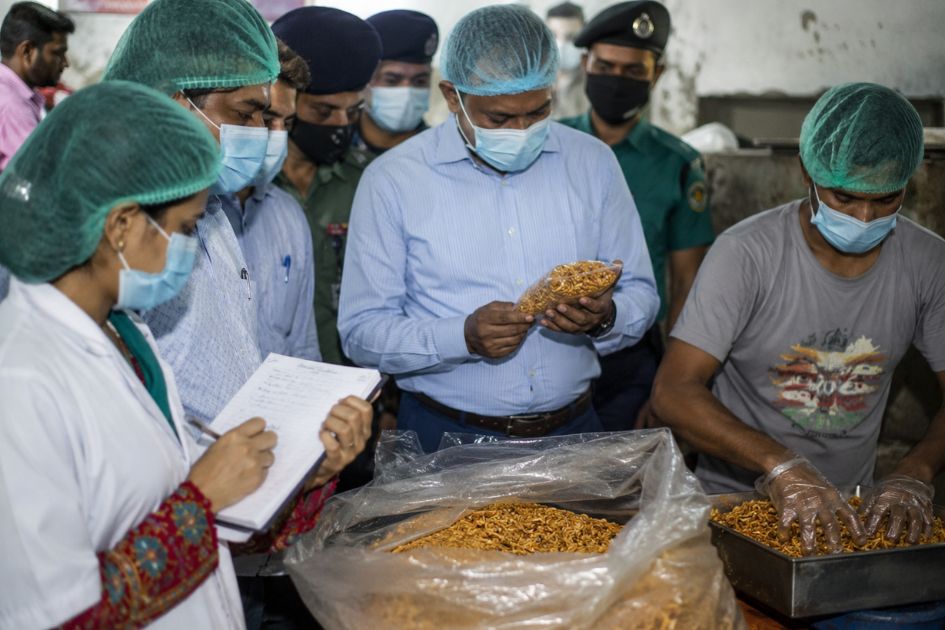

Consumer rights leaders called for expanded mobile food court operations after inspections in Chattogram uncovered widespread food safety violations, unhygienic processing practices and the production of substandard food products.
Consumer rights leaders have called for a major expansion of field-level food safety enforcement in Chattogram, Bangladesh’s second-largest city and the commercial hub of the country’s southeast, after a mobile court uncovered widespread violations at several food processing facilities.
During a mobile court operation conducted on June 20 in different areas of Chattogram, the Pure Food Court detected multiple food safety violations at Abul Khair Food and Beverage, Madhuban Sweets Industries Ltd. and Mymensingh Agro, according to a statement issued by the Consumers Association of Bangladesh (CAB).
Inspectors found evidence of toxic materials, including plastic substances, in food processing activities, the use of burnt cooking oil in the production of food items such as chanachur, flattened rice and roasted gram and the storage of waste materials inside processing facilities. Authorities also found that approved packaging procedures were not being followed and that misleading information had been included on product labels.
The inspection team further identified unhygienic storage, transportation and processing practices involving mango fruit pulp. Food workers were also found to be failing to comply with basic hygiene requirements.
According to the findings, food products were being manufactured in extremely unsanitary conditions where insects moved freely through production areas. Authorities also found the production of substandard food products, the storage and use of waste materials during processing, the use of open paper and newspapers as food-contact materials, the storage of expired food products intended for sale and multiple violations of packaging regulations.
The operation was led by Mohammad Mostafa, Metropolitan Magistrate of the Chief Metropolitan Magistrate Court and Judge of the Pure Food Court. Officials from the Bangladesh Food Safety Authority participated in the drive alongside members of the Metropolitan Magistracy, Police, Rapid Action Battalion (RAB) and Ansar.
Following the operation, leaders of CAB’s Chattogram Divisional and Metropolitan units welcomed the initiative and urged authorities to further strengthen field-level monitoring through additional mobile court operations.
They thanked the judge of the Pure Food Court for conducting inspections beyond the courtroom and said such actions were essential to protecting consumers from unsafe food practices.
In a press release sent to the media on June 21, the statement was signed by CAB Central Committee Vice President S M Nazer Hossain, CAB Chattogram Divisional General Secretary Kazi Iqbal Bahar Chaberi, CAB Chattogram Metropolitan President Jesmin Sultana Paru, General Secretary Ajay Mitra Shanku, Joint Secretary Md Selim Jahangir, Organising Secretary Jannatul Ferdous and CAB Youth Group Chattogram Metropolitan President Abu Hanif Noman, among others.
The CAB leaders said consumers continue to suffer from widespread fraud and deception in the marketplace while government agencies responsible for quality control and monitoring often fail to take effective action.
As a result, they said, food-borne illnesses have become increasingly common across the country, affecting public health on a large scale.
The leaders pointed to overcrowded hospitals, clinics and diagnostic centres in Chattogram as evidence of the growing health burden. They argued that it would be difficult to find a family in which at least one member does not regularly require medication, describing the situation as a sign of a nation increasingly affected by illness.
The consumer rights leaders expressed hope that the Pure Food Court’s continued field-based operations in Chattogram would serve as a model for the rest of Bangladesh.
They said the court’s proactive approach reflects public expectations and demonstrates a commitment to addressing food safety concerns directly at their source. They also argued that judicial intervention in cases involving consumer rights and other public grievances could help strengthen good governance and the rule of law while restoring public confidence in state institutions.




