

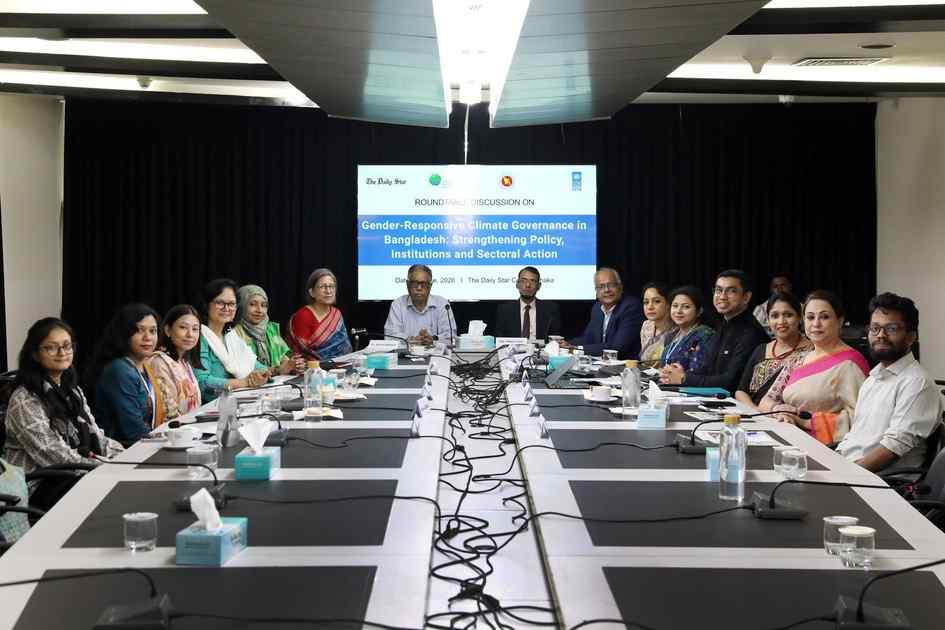



Experts urged Bangladesh to turn gender-responsive climate policies into measurable results, warning weak finance, data and coordination still keep vulnerable women excluded from climate decisions, budgets and community-level benefits nationwide.
The call came at a roundtable titled “Gender-Responsive Climate Governance in Bangladesh: Strengthening Policy, Institutions and Sectoral Action,” jointly organised by The Daily Star and UNDP Bangladesh in Dhaka.
Speaking at the event on Sunday, participants said Bangladesh has developed a strong policy framework, including its updated Nationally Determined Contributions (NDC 3.0), the Climate Change and Gender Action Plan (CCGAP) and the National Adaptation Plan (NAP). However, they stressed that the core challenge now lies in implementation and accountability.
They noted that while gender is increasingly recognised as a cross-cutting issue in climate policy, financing systems, data collection and inter-ministerial coordination remain too weak to ensure benefits reach frontline communities. The discussion was moderated by Tanjim Ferdous of The Daily Star.
Implementation gap remains the central challenge
Climate expert Dr Ainun Nishat, adviser at the Centre for Climate Change and Environment Research, said Bangladesh’s climate and gender frameworks are strong on paper but weak in execution.
He said gender mainstreaming is too often reduced to representation in committees rather than being translated into measurable action on the ground.
He called for stronger accountability mechanisms and results-based monitoring to ensure policies deliver real outcomes.
Finance and data gaps limit impact
Keynote speaker Sumaiya Siddiqui, a gender analyst at UNDP Bangladesh, said that although 12 of 13 major climate projects are tagged as gender-responsive at the approval stage, only one project led by the Ministry of Women and Children Affairs is fully gender-responsive by design.
She said this creates a significant gap between allocation and actual impact, making large portions of climate finance difficult to track in terms of benefits for women.
She also pointed to the FY2026-27 budget, noting that despite substantial allocations for water resources and green job creation targets, gender outcomes remain insufficiently defined in planning and monitoring systems.
Experts call for reform and stronger accountability
Dr Tania Haque, professor of Women and Gender Studies at the University of Dhaka, said Bangladesh faces not a policy gap but an implementation deficit driven by reactive governance.
She proposed institutional reforms, including the creation of a National Climate Ombudsman and a Time Poverty Index to measure unpaid care work and strengthen accountability.
Prof Sharmind Neelormi of Jahangirnagar University said climate vulnerability is shaped not only by environmental stress but also by structural issues such as land use and water governance.
She called for integrating measurable indicators into national budgeting and linking social protection systems with climate vulnerability mapping.
Climate advocate Sohanur Rahman, executive coordinator of YouthNet Global, said initiatives such as community-based adaptation projects demonstrate how climate finance can reach vulnerable communities but should be integrated into broader social protection systems.
He called for a just transition approach that addresses unpaid care work and ensures meaningful engagement of men and boys in climate action.
He also pointed to ongoing global climate negotiations, including discussions on implementing the Belém Gender Action Plan and improving gender-disaggregated data systems.
Structural barriers in agriculture and governance
Tasnuva Zaman, gender focal point at the Food and Agriculture Organization of the United Nations (FAO) Bangladesh, said women make up 58 percent of Bangladesh’s agricultural workforce but continue to face systemic exclusion due to limited land ownership.
With only 12-13 percent land ownership, women are often not formally recognised as farmers, restricting their access to credit, insurance and climate-smart technologies, she said.
Weak coordination and institutional bottlenecks
Md Shamsoddoha, chief executive of the Centre for Participatory Research and Development, said discussions on the gendered impacts of climate change are often limited to regions such as Satkhira and Khulna and focused primarily on water scarcity.
He warned that women’s daily exposure to saline conditions during household work poses serious reproductive health risks.
He also said the updated Climate Change and Gender Action Plan lacks a designated “guardian authority” to institutionalise implementation across ministries. He further noted a decline in the effective representation of women in Bangladesh’s international climate negotiations.
Climate finance and governance concerns
Farah Kabir, country director of ActionAid Bangladesh, said that while Bangladesh appears strong in climate and gender-responsive policy frameworks, implementation remains weak.
She stressed the need to move from budget tagging to outcome-based tracking, decentralised budgeting and stronger engagement of local women in adaptation and mitigation efforts.
She questioned the effectiveness of gender focal points and gender budgeting, asking whether funds are being spent on bureaucratic salaries and infrastructure rather than programme delivery.
Success should be measured not by the size of plans but by tangible improvements in the lives of climate-affected people, she added.
Sharmin Islam, gender team leader at UNDP Bangladesh, Foyzun Nahar of World Food Programme Bangladesh, Farhana Hafiz of UN Women Bangladesh, Shakila Sattar of The Earth and Samira Yasmin of The Asia Foundation highlighted coordination gaps and the need for decentralised planning, stronger monitoring and outcome-based budgeting.
They stressed that gender-transformative climate action must go beyond budget tagging to ensure real benefits reach women at the community level.
Coastal adaptation project shows potential
The Gender-responsive Coastal Adaptation (GCA) project, led by the Ministry of Women and Children Affairs with technical support from UNDP Bangladesh and co-funded by the Government of Bangladesh and the Green Climate Fund, was highlighted as an example of how climate finance can support grassroots women’s empowerment.
Md Abdul Hye Al Mahmud, national project director and additional secretary of the Gender-responsive Coastal Adaptation project, said empowering women drives broader national development and called for sustained policy support and stronger implementation.
Sarder M Asaduzzaman, assistant resident representative of UNDP Bangladesh, said the project’s success depends on scaling up and stronger government ownership.
Shared call for measurable action
Throughout the discussion, speakers agreed that Bangladesh’s leadership in climate action will increasingly depend on its ability to move from policy design to measurable implementation.
They called for stronger institutional accountability, better inter-ministerial coordination and a shift from input-based reporting to outcome-based climate governance that delivers tangible results for women and marginalised communities.




