

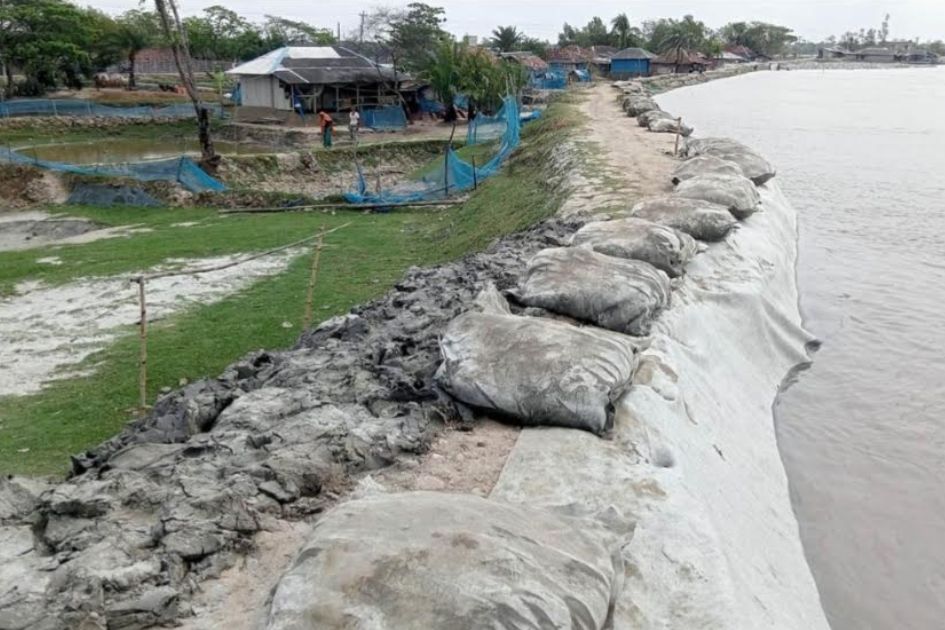

Erosion, cracks and weak embankments at 40 locations in Satkhira’s coastal areas have heightened fears of flooding, prompting residents to demand urgent, sustainable repairs before peak monsoon conditions worsen.
At least 40 vulnerable points have been identified along embankments in the coastal upazilas of Shyamnagar and Asashuni in Satkhira, a district in southwestern Bangladesh’s Khulna Division, raising fears of flooding and widespread damage as the monsoon season intensifies, according to local residents and officials of the Bangladesh Water Development Board (BWDB).
Residents of the two upazilas say erosion, cracks and weakened embankments have become a recurring threat every rainy season, leaving thousands of people living in constant fear of river erosion, tidal surges and possible embankment failures.
Locals alleged that embankments under the Water Development Board in several unions of Shyamnagar and Asashuni have remained in a fragile condition for a long time. Recent erosion and visible cracks at multiple locations have further heightened concerns among coastal communities.
In Asashuni Upazila, riverbank erosion has threatened a bridge built over the Morichchap River. Residents fear the situation could worsen significantly if river water levels rise during the monsoon. Erosion has been reported at several sections of embankments in Kurikaunia, Harishkhali and Chakla areas of Pratapnagar Union. Severe erosion has also been observed near Kakbasia ferry terminal in Anulia Union and at different locations in Bichhat village.
Similar conditions have been reported across several unions in Shyamnagar Upazila, including Padmapukur, Gabura, Burigoalini, Atulia, Nawabeki, Harinagar and Munshiganj. Although repair work has been carried out at some of the affected locations, residents say the measures are insufficient to ensure long-term protection.
“We spend every monsoon season in anxiety,” said residents of Burigoalini and Padmapukur areas, including Rabiul Kayal, Alak Gazi and Solaiman Sardar. “Riverbanks are collapsing in many places and the foundations of embankments are being damaged. If the embankments break, vast areas of the upazila could be inundated by saline water.”
For many residents of Asashuni, memories of previous embankment breaches remain vivid. Villages in Anulia Union, Bichhat and surrounding areas were flooded after earlier embankment failures, causing extensive suffering. Locals said the absence of permanent and sustainable repairs has forced them to face the same risks year after year.
Coastal residents also accused authorities of carrying out repairs in an unplanned manner. According to them, erosion often reappears at the same locations within days of repair work. They urged authorities to strengthen and repair vulnerable embankments before the peak monsoon season begins.
Santosh Kumar, a resident of Goaldanga area in Asashuni, said the Morichchap River flows past Goaldanga Bazar and has recently brought the market area close to destruction through erosion.
“A temporary embankment will not solve the problem anymore. A sustainable embankment must be built,” he said.
Residents Saidul Islam and Rahima Khatun of Kurikaunia village said they had already lost their home years ago due to erosion caused by the Kapotaksha River.
“Now the embankment near the place where we have taken shelter is collapsing and moving closer to our house. If the erosion continues, we will have to leave this place as well,” they said.
According to the Satkhira Water Development Board, approximately 40 locations along a 20-kilometre stretch of embankments within various polders under its two divisions have been identified as highly vulnerable.
Civil society leaders in Satkhira said the government should prioritize sustainable embankment construction despite the higher costs involved.
“Otherwise, hundreds of crores of taka spent every year on embankment renovation will continue to go to waste,” they said.
Md. Ashraful Alam, executive engineer of Water Development Division-1 in Satkhira, said his department oversees 383 kilometres of embankments.
“Of these, around five kilometres at 10 to 15 locations are considered risky. Renovation work is currently underway at the most vulnerable points,” he said.
Abdur Rahman Tazkia, executive engineer of Water Development Division-2 in Satkhira, said a 15-kilometre stretch of embankments in Pratapnagar and Anulia unions of Asashuni and Padmapukur Union of Shyamnagar remains particularly vulnerable.
“Renovation work is underway on five kilometres of the embankment. If funding is allocated for the remaining 10.88 kilometres, repair and renovation work will also be carried out there,” he said.




