

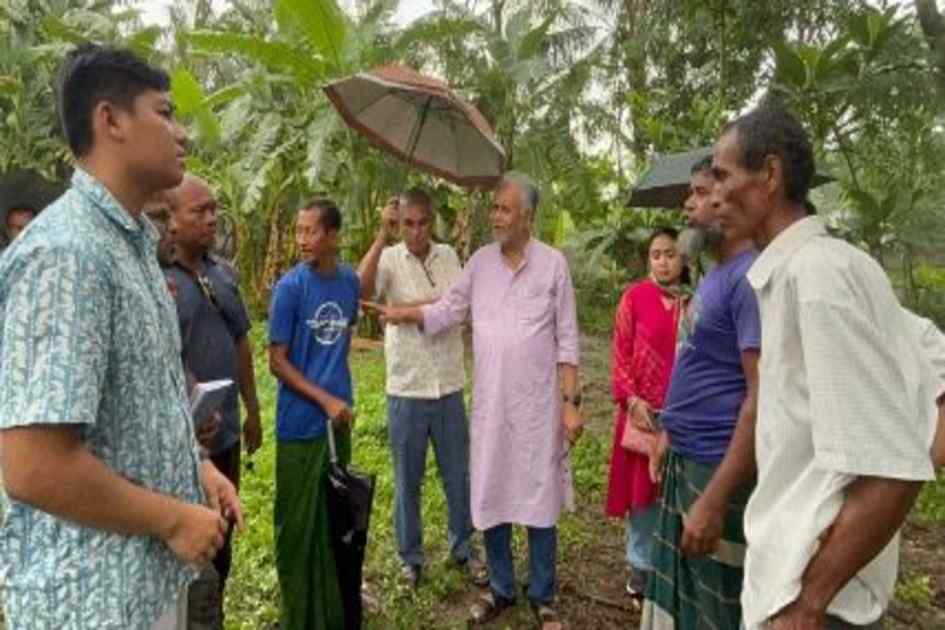



Kuakata’s centuries-old Rakhine Indigenous community is facing mounting pressure from land disputes, delayed rehabilitation, tourism-driven development and coastal erosion, raising concerns over the future of its cultural heritage, livelihoods and ancestral lands.
The centuries-old Rakhine Indigenous community in Kuakata, a coastal tourism hub known for offering both sunrise and sunset views from the same beach, is facing growing pressure from land disputes, alleged encroachment, infrastructure development and coastal erosion, according to a recent civil society field visit.
A delegation from Citizens for Human Rights visited Kuakata and surrounding areas in Kalapara upazila of Patuakhali district between June 12 and 14, documenting what it described as escalating tensions over land ownership and increasing vulnerability within the Rakhine community.
Experts warn that ecosystem degradation is also narrowing livelihood opportunities. Rakhine households, once engaged in a wider range of economic activities, are increasingly dependent on weaving, small-scale trade and livestock rearing as traditional livelihood options decline.
Land disputes and allegations of encroachment
Community members and rights advocates allege that recurring disputes over land titles, contested documentation and prolonged legal proceedings have contributed to growing displacement pressures on the Rakhine population, which has lived in the coastal region for nearly two centuries.
They claim that increasing pressure on land acquisition has gradually confined what was once a more widespread Indigenous presence into smaller pockets across Kuakata.
The delegation raised concerns over religious and cultural heritage sites, including the Shree Mongol Buddhist Temple, established in 1943 during the British colonial period. Community representatives alleged that parts of the temple’s original land have come under encroachment threats, with accusations directed at private actors as well as government-linked entities. These claims could not be independently verified.
Rights advocates and community members say the lack of urgent, effective and fair institutional responses has failed to deter land grabbing and has deepened insecurity over ancestral homes and cultural spaces.
Displacement linked to development projects
Six Rakhine families displaced in 2021 due to the Payra Port development project reportedly remain without permanent rehabilitation despite earlier assurances of housing support and compensation.
According to affected families, monthly assistance was initially provided but later discontinued, leaving them in prolonged uncertainty. Authorities have previously acknowledged rehabilitation challenges in development-induced displacement cases, though implementation gaps remain a recurring concern raised by civil society groups.
Delayed rehabilitation of Payra Port evacuees
In 2021, six Rakhine families from Shani Para village were evicted to make way for the construction of Payra Port and have yet to be properly rehabilitated. They are now living in scattered locations.
Ching Damo Rakhine, a representative of one of the affected families, said the six households collectively received BDT 9.6 million in compensation at the time of eviction.
He said the Divisional Commissioner and the Deputy Commissioner had assured each household of BDT 5,000 in monthly rent support until permanent rehabilitation was completed. However, the support reportedly stopped after six months.
According to an October 8, 2025 letter signed by Payra Port Authority Project Director Captain Muhammad Nazmul Haque, 40 decimals of land in Sonapara mouza of Kalapara would be acquired for the families’ rehabilitation. However, land filling and housing construction remain incomplete.
The rehabilitation project is scheduled to end in June this year, raising uncertainty over whether the displaced families will ultimately be relocated there.
Following discussions with the delegation, Kalapara Upazila Assistant Commissioner (Land) Yasin Sadik assured that necessary steps would be taken to address the issues.
“The administration is committed to protecting Rakhine land. However, there are attempts to grab their land through forged documents. Influential individuals and groups are often involved in such activities,” he said.
Cultural exclusion amid tourism growth
Despite Kuakata’s rapid expansion as a major tourism destination, members of the Rakhine community say they have not been able to meaningfully benefit from the growing tourism economy.
Stakeholders argue that community-led tourism initiatives could strengthen local self-reliance while allowing visitors to engage more closely with Rakhine traditions, weaving practices and cultural heritage developed over centuries.
Without greater inclusion, they warn, tourism-led development risks further marginalising Indigenous communities from economic opportunities in their own ancestral region.
Coastal erosion, environmental loss and shrinking livelihoods
Environmental vulnerability is emerging as another major concern. Kuakata, located in a climate-sensitive coastal zone, is increasingly exposed to coastal erosion, biodiversity loss and other slow-onset climate impacts.
Local accounts suggest that large sections of Kuakata National Park have been lost to the sea over the past two decades because of coastal erosion and shifting shoreline dynamics, though estimates vary among sources.
Md Jahidul Islam, a local resident and member of YouthNet Global, said: “I had my school picnic in the National Park in 2012 and that spot has already disappeared into the sea.”
“If we are able to fully protect the park, it would mean safeguarding the natural world that supports our communities and shields us from cyclones,” he added.
Calls for protection and inclusive development
Civil society representatives have called for stronger protection of Indigenous land rights, faster and more transparent rehabilitation for displaced families and stricter enforcement against illegal land occupation.
They also stressed that Kuakata’s tourism-driven growth must be more inclusive, ensuring Indigenous communities are active participants in the local economy rather than passive observers of development in their ancestral homeland.
Sohanur Rahman, executive coordinator of YouthNet Global, said: “Protecting Kuakata is not only about saving land or tourism assets. It is about safeguarding the coexistence of culture, ecology and Indigenous rights. Any development pathway that excludes local communities will ultimately undermine resilience itself.”
Local officials, while acknowledging ongoing land administration challenges and disputes, said relevant cases are under review and steps are being taken to address illegal occupation and support affected communities. Civil society groups, however, continue to call for more visible and timely action.
As Bangladesh continues to promote Kuakata as a flagship coastal tourism destination, the situation highlights a broader governance challenge: balancing tourism expansion, infrastructure development, cultural preservation and climate resilience in one of the country’s most environmentally fragile coastal regions.




