

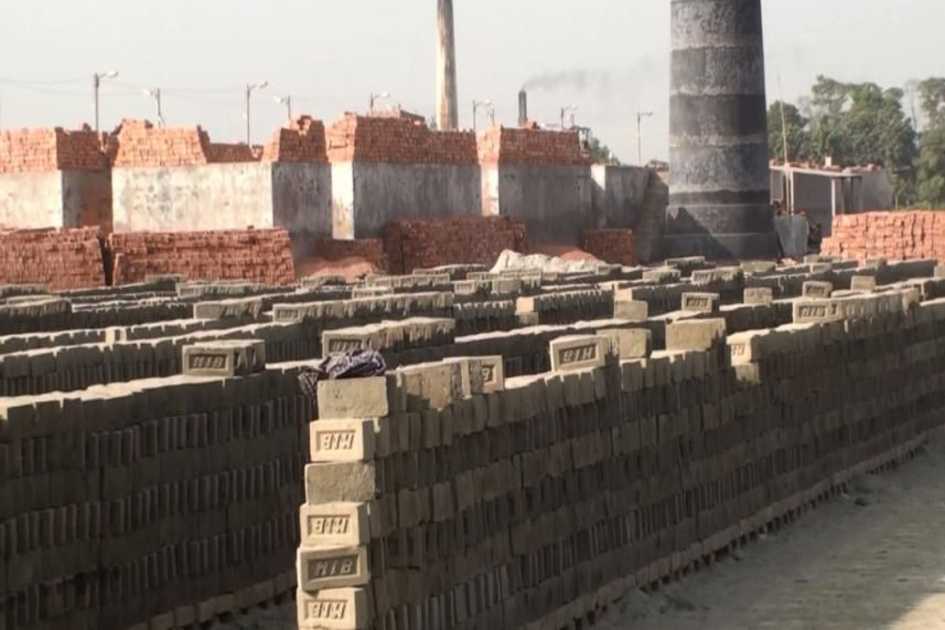



Expanding brick kilns in Manikganj are choking farmland with smoke and dust, reducing crop yields, damaging ecosystems and raising health risks for residents as demand from Dhaka’s construction boom grows.
Rows of brick kilns belching thick black smoke across fertile farmland have become a familiar and troubling sight in Singair upazila of Manikganj district, raising serious concerns about environmental degradation, declining crop yields and growing health risks for local residents.
In Jamirta union, four brick kilns stand side by side next to stretches of agricultural land and even near the union parishad office. Labourers move quickly between piles of clay and rows of raw bricks drying under the sun while tall chimneys release constant streams of smoke into the sky.
Just beyond the kilns lie fields of winter crops, but the atmosphere is heavy with dust and fumes. Farmers say the pollution is steadily destroying their livelihoods.
Mohammad Hanif, a local farmer, recently visited his land where mustard was cultivated on three pakis of land, a traditional unit similar to a bigha. The crop, however, is now covered in dust.
“Since these kilns started operating we farmers are being ruined,” he said.
Across the district the same picture is visible. Manikganj, located across the Dhaleshwari River from Savar and close to Dhaka, has become a major supplier of bricks for the capital’s booming construction sector.
Before entering Singair, long lines of trucks loaded with bricks can be seen travelling along the roads. After crossing the river into Manikganj the number of trucks multiplies while the air grows dense with smoke, dust and noise.
Roadside trees appear dull and lifeless, coated in a reddish film of dust. Even village roads are frequently shaken by speeding trucks carrying bricks to Dhaka.
In many areas agricultural land is scarred by deep pits where topsoil has been excavated for brick production. Locals say the once fertile landscape has lost much of its vitality.
According to the Department of Environment (DoE), there are 124 brick kilns in Manikganj district. However residents believe the real number may be higher.
Official data indicates that 101 kilns operate legally while at least 23 are illegal. In Baldhara union alone there are 36 kilns.
The brick making season usually runs from November to June. During these dry months smoke and dust combine to create extremely poor air quality across the district.
Each kiln produces around seven to eight million bricks every year. Because of the district’s close proximity to Dhaka transportation costs remain relatively low.
A thousand bricks from Manikganj are sold for around Tk10,000 to Tk11,000, making them cheaper than in many other regions. As a result kiln owners are expanding production to meet the high demand from the capital’s construction market.
Many kiln operators promote their products on social media and often sell large quantities in advance to traders, increasing pressure to maintain high output throughout the season.
However farmers say this booming business is coming at a heavy cost.
Nazimuddin, a farmer who owns about 7.5 bighas of land, said crop yields have dropped significantly.
Hanif also described a sharp decline in rice production. “Earlier I used to get about 20 maunds of rice from one paki of land. Now I get only 12 to 14 maunds,” he said.
Residents say pollution from the kilns is also affecting fruit trees and homes. Many households try to block dust by covering doors and windows with paper but the effort offers little relief.
Mohammad Alam, another local resident, said fruit trees in his yard no longer produce. “I have 12 coconut trees but none of them bear fruit anymore,” he said.
Environmental damage extends beyond crops. Large excavations around kiln sites leave water filled pits that permanently alter the landscape.
Shahjahan Siraj, deputy director of the Manikganj District Agricultural Extension Department, said the removal of topsoil is one of the most damaging consequences.
“When topsoil is removed for brick making the land loses its essential nutrients and organic matter. The hot air from kilns also disrupts pollination which reduces crop yields,” he explained.
Siraj added that crops such as rice and seasonal fruits are particularly vulnerable. Mango blossoms can drop or become deformed while reduced pollination results in sterile grains in rice fields.
He also warned that many kilns burn wood as fuel contributing to deforestation.
Health concerns are also rising. Several kilns operate close to residential areas and schools. In one case in Deboltoli locals said three to four kilns once operated near a kindergarten.
Doctors at Singair Upazila Health Complex report a growing number of respiratory illnesses, allergies and cold related diseases especially among children and elderly people.
Dr Saima Talukdar said on some days nearly 80 percent of patients suffer from respiratory problems or cold related symptoms. “The most worrying part is that many of these patients are children,” she said.
Bangladesh’s Brick Making and Brick Kiln Establishment (Control) Act 2013 prohibits using soil from agricultural land for brick production and bans kilns from being set up near residential areas or farmland.
However many kilns in Manikganj appear to operate in violation of these regulations.
Kiln owners deny the allegations. Moinul Haq, manager of THB Bricks in Jamirta, said their operations follow legal requirements.
“We have valid licences from the deputy commissioner and the Department of Environment. Our certificates are valid until 2027,” he said.
He also claimed the soil used for brick production is purchased from contractors rather than taken forcibly from farmland.
Officials from the Department of Environment say enforcement drives are carried out periodically.
Muhammad Abdullah Al Mamun, deputy director of the DoE, said authorities inspected five kilns during a drive in Manikganj Sadar in December.
“Two chimneys were demolished and the remaining three kilns were fined a total of Tk1.8 million,” he said.
However he admitted enforcement remains challenging. Kiln owners often resume operations once authorities leave.
Environmental experts say Bangladesh must gradually shift toward eco friendly building materials such as concrete blocks.
The government issued a gazette notification in 2019 directing that all government construction projects should use 100 percent eco friendly blocks by 2025. Implementation of the policy however remains incomplete.
For residents of Manikganj the situation has become increasingly urgent. Without stricter enforcement and a transition to greener alternatives they fear more farmland will disappear and environmental damage will continue to threaten both livelihoods and public health.




