

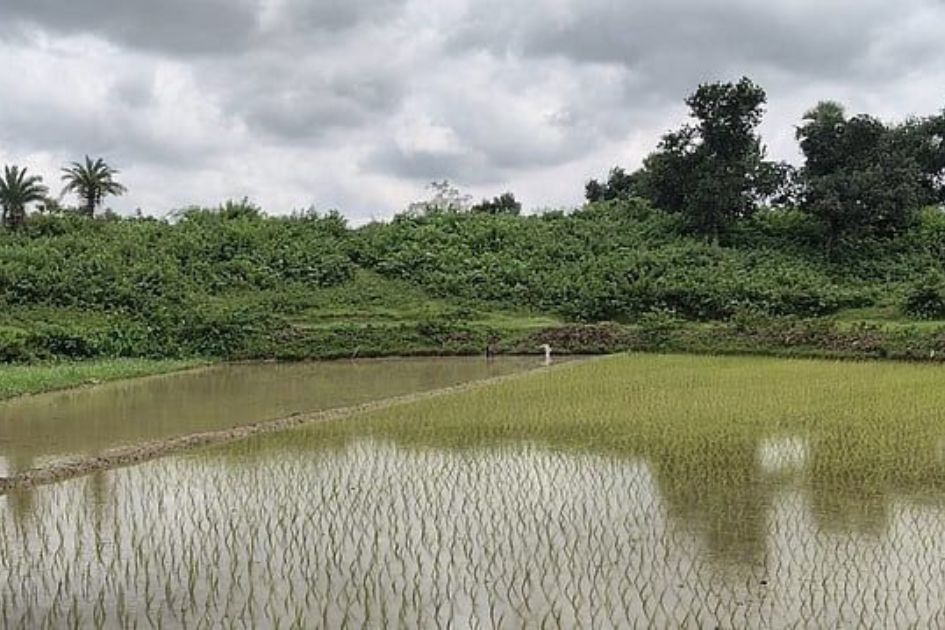



Farmers and agriculture officials in Bhaluka question land classifications for a 45MW solar project as Bangladesh balances renewable power targets with shrinking cultivable land and rural livelihoods.
Conflicting land assessments and allegations of official pressure cloud plans for 45MW plant in Mymensingh. Agriculture officials initially objected to the project, but later issued a no-objection certificate amid allegations of pressure.
A proposed 45-megawatt solar power plant in Bangladesh’s Mymensingh district has triggered a dispute over agricultural land, with government officials providing sharply different assessments of the proposed site and a local agriculture officer alleging she was pressured to issue a no-objection certificate.
The project is planned on about 173 acres in Nandipara and Jhalpaja areas of Habirbari Union in Bhaluka upazila.
The controversy comes as Bangladesh seeks to expand renewable energy while agricultural land continues to shrink, raising a broader question over how the country can accelerate its clean-energy transition without putting additional pressure on farmland and rural livelihoods.
The project has also drawn political scrutiny because Bhawal Engineers and Construction Ltd, the company identified as the project proponent, is chaired by Taslima Akter, wife of Mymensingh-11 lawmaker Fakhr Uddin Ahmed. Local residents commonly describe the company as belonging to the lawmaker, although the available project information identifies Akter as its chairperson.
Companies seeking to participate in the solar-power tender are required to obtain a no-objection certificate, or NOC, from agriculture authorities concerning the proposed land.
Conflicting assessments
At the centre of the dispute is a significant discrepancy over the amount of agricultural land within the proposed project site.
On July 16, the Bhaluka administration formed a committee headed by the upazila agriculture officer to determine the nature of the land and identify whether agricultural plots were single-crop or double-crop farmland.
The committee’s report, submitted on July 23, found that 63 acres of the 167.84 acres examined were single-crop agricultural land. The report said farmers cultivate Boro rice on the land and warned that construction could reduce rice production.
But on August 19, the agriculture authorities issued an NOC stating that 141.97 acres of the proposed 173.13-acre site were non-agricultural land, while 31.16 acres were single-crop land.
The NOC concluded that the solar plant would not have any significant adverse impact on agriculture.
The difference between the two assessments has raised questions over how the classification of the land changed.
Mymensingh Deputy Director of the Department of Agricultural Extension Md Enamul Haque said the proposed site contains substantial agricultural land.
“The proposed site contains both single-crop and double-crop land. Around 140 acres are cultivable agricultural land,” Haque said.
Bhaluka Sub-Assistant Plant Protection Officer Md Moazzem Hossain separately estimated that about 131 acres of the proposed site are used for Boro rice cultivation.
Agriculture officer alleges pressure
Bhaluka Upazila Agriculture Officer Nusrat Jaman alleged that she was pressured to certify the proposed land as non-agricultural.
She said she informed senior authorities in writing about the pressure and was told to issue the clearance because the project was considered development work and Bangladesh faced electricity shortages.
“I had to issue the no-objection certificate because of pressure from people representing the lawmaker, the administration and officials in my own department,” Jaman said.
Jaman said she faced resistance from residents when she visited the area to assess the land. She said people told her they would not give up their property and that the proposed site contained both homes and farmland.
She also said that after some land-plot numbers were changed in a revised proposal, she was not given another opportunity to conduct a fresh field inspection and ultimately issued the NOC based on documents.
The agriculture department’s Mymensingh deputy director said agricultural land normally cannot be certified for industrial development but acknowledged that officials sometimes face pressure from local or institutional quarters.
Farmers say they will not sell
For farmers in Nandipara and Jhalpaja, the dispute is about more than the technical classification of land.
Residents submitted a written application to the Mymensingh deputy commissioner on August 9, demanding that the proposed solar project be stopped. They alleged that farmers were being forced to bear the cost of the development.
“We grow crops on this land. We produce Aman and Boro rice as well as vegetables,” said elderly Jhalpaja resident Sirajul Islam.
“Our request is simple — do not build the solar plant here,” he said.
Another resident, Riton Mondal, said farmers could not simply surrender their land.
“We are farmers. If we sell our land, where will we go?” he said.
In Nandipara, resident Billal Khan said the proposed project area includes both agricultural and residential land.
“If the land were lying unused, that would be different. But there is no spare land here,” he said. “I will not give up my land.”
Another farmer, Abu Bakkar Siddiq, said his family had cultivated their land for generations and harvested rice twice a year.
Asked whether he would give up his land for the solar project, he replied: “No.”
Administration says farmland can be excluded
Bhaluka Upazila Nirbahi Officer Md Firoz Hossain said the administration was examining the proposal carefully because of the project’s scale and the possibility of future disputes over land.
He said the administration instructed the applicant to exclude plots identified during field inspections as single-crop agricultural or fish-farming land.
According to Hossain, the applicant later submitted a revised schedule excluding around 20 acres of single-crop and fish-farming land.
The administration denies that officials were pressured to issue the NOC.
Hossain said parts of the proposed site are elevated or uneven and unsuitable for rice cultivation, while other areas contain trees and vegetation.
If the company is selected through the tender process, he said it would have to reach a lawful arrangement with landowners through purchase, partnership or another legally permitted mechanism.
Political sensitivity
The project has also become politically sensitive during the reporting process.
According to the journalist’s account, several young men identified locally as supporters of the lawmaker approached him after learning that he was interviewing residents about the proposed solar plant.
They asked why he was visiting the area and later took him to the office of local political figures associated with the lawmaker. They also sought information about which residents the journalist had interviewed and attempted to direct him to other people for comments.
The incident highlights the sensitivity surrounding the project, although it does not independently establish that the journalist was formally threatened or obstructed.
Agricultural land under growing pressure
The controversy comes as Mymensingh continues to lose agricultural land.
According to Department of Agricultural Extension data, the district lost 4,572 hectares of cultivable land over the past decade.
Agricultural land fell from 331,823 hectares in fiscal 2016-17 to 327,251 hectares in fiscal 2025-26.
Bhaluka has been particularly affected by industrialisation and land conversion.
The upazila currently has about 28,335 hectares of agricultural land, with 1,043 hectares lost over six years.
The amount of land converted from agricultural to non-agricultural use increased from 278.69 hectares in 2020 to 577 hectares in 2021, 610 hectares in 2022, 703 hectares in 2023, 761 hectares in 2024, 913 hectares in 2025 and 1,043 hectares in 2026.
Bhaluka now has 198 industrial establishments, according to Mymensingh district industrial police.
Clean energy versus food security
The Bhaluka dispute illustrates a broader challenge for Bangladesh’s renewable-energy transition.
The country needs to expand clean electricity generation to strengthen energy security and reduce dependence on fossil fuels. But Bangladesh also has limited land and faces increasing competition between agriculture, industry, housing and infrastructure.
The Bangladesh Power Development Board invited tenders in April for 10 solar power plants across the country, including the proposed 45MW Bhaluka facility.
The projects are being developed under the independent power producer model, under which private companies generate electricity and sell it to the government under contractual arrangements.
The government aims to bring the projects into operation by January 2029, with contracts expected to be awarded to the lowest qualified bidders in December.
The Bhaluka case therefore raises an issue that extends well beyond one solar plant.
Bangladesh’s transition to renewable energy will require not only more solar capacity, but also transparent land assessments, protection of productive farmland and meaningful consultation with communities whose land is being considered.
The question is not whether Bangladesh should expand solar power.
It is where that expansion should take place – and who should bear the cost when clean-energy development competes with food production and rural livelihoods.
Lawmaker denies allegations
Fakhr Uddin Ahmed has rejected the allegations of pressure.
“I have never spoken by phone or in person with any agriculture official or other official about this matter,” he said to media.
Ahmed also denied using his personal assistant or anyone else to influence officials.
He challenged the agriculture department’s assessment of the site, saying a six-member committee had conducted field inspections and used digital and Google maps to measure the area.
According to Ahmed, no more than 18 percent of the 173 acres was single-crop agricultural land.
He said any allegation of pressure should be supported by evidence from the officials concerned.
Taslima Akter, chairperson of Bhawal Engineers and Construction Ltd, declined to comment directly on the issue and referred questions to her husband.




