

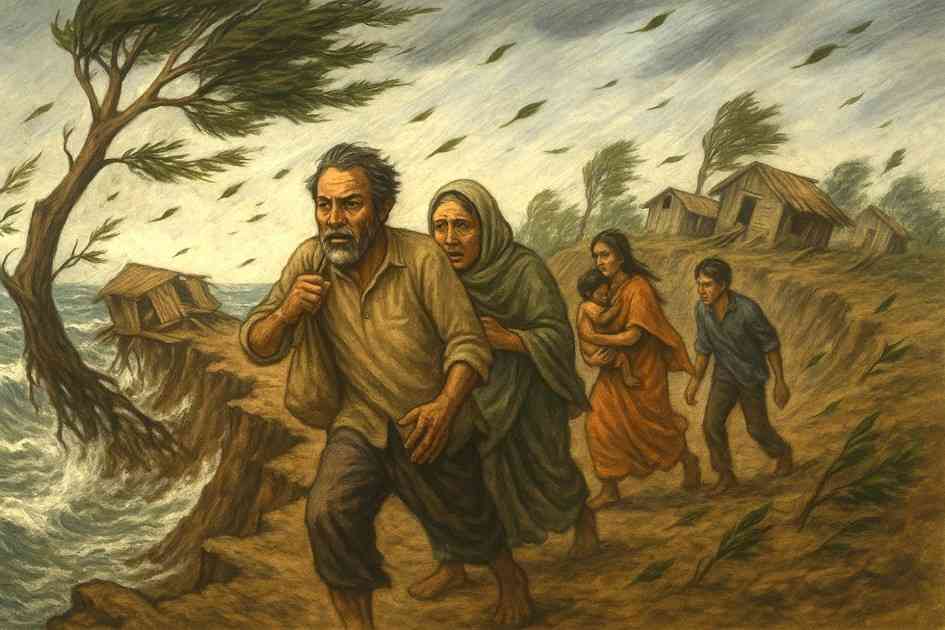



Over the past century, Sandwip Island has faced severe coastal erosion, displacing tens of thousands. Entire villages vanished, along with heritage and homes. Climate migrants face stigma, identity loss, and injustice—yet their struggle for recognition and climate justice remains largely unheard.
“I lost my home to the sea five times. Every time, it left me penniless. But I never gave up hope,” says Rafiqul Islam, a former Union Parishad chairman of Horishpur in Sandwip. “I worked hard each time to start over — and I was elected chairman three times.”
Rafiqul’s story is not an isolated one. It reflects the harsh reality faced by tens of thousands from Sandwip Island, a frontline community in Bangladesh’s battle against climate change. Once a thriving union, Batajora — Rafiqul’s birthplace — was entirely swallowed by the sea by the 1970s. His family, once wealthy with 80 acres of farmland, became homeless overnight. Over the years, they were displaced multiple times, each time forced to rebuild their lives from scratch.
Rafiqul, now 72, shared his experience at a public event titled “Face to Climate Refugee” held on February 25, 2023 in Rahamat Char, Sandwip. The programme, organized by volunteer network Human24, aimed to amplify the voices of climate victims seeking justice. “Like me, several hundred thousand people have been displaced from Sandwip over the decades,” Rafiqul said.
A life on the run
Mokarom Hossain Manik, a local farmer, also bears scars of repeated displacement. From 1974 to 2019, he was forced to move multiple times due to erosion. One particular memory haunts him to this day.
“In the evening of 2000, my eldest daughter went into labour,” he said. “The doctor advised us to take her to Chattogram city. But Sandwip becomes isolated after sundown due to rough seas.” They set off on a wooden boat. In the middle of the Bay of Bengal, amidst towering waves, she gave birth. The baby did not survive.
Nurul Akhter, a local political leader, has also faced displacement due to sea-level rise. His experience is part of a larger, unspoken tragedy. Over the last century, nearly half the population of Sandwip is believed to have been uprooted by rising seas, frequent cyclones, and increasing salinity in agricultural lands.
Villages like Namaste, Izzatpur, Batajora, Hudrakhali, and Rohini have vanished into the sea. Along with land and livelihoods, Sandwip has lost history, heritage, and identity. The cultural erosion is as stark as the physical.
Historical giants lost to the tides
Sandwip has given birth to many eminent figures. But their ancestral homes are now underwater: Such as Poet Abdul Hakim (1620–1690), the 17th-century literary icon who championed the Bangla language against the Persian-Arabic dominance of his time, was born here. His home has been claimed by the sea. Muzaffar Ahmad, co-founder of the Communist Party of India, hailed from Musapur village. AKM Rafiq Ullah Choudhury, a Language Movement hero and former MP, as well as Mustafa Kamal Pasha and Fakhrul Islam, the first mayor of Sandwip — all lost their ancestral homes.
A childhood erased by the Sea
Former Lt. General Chowdhury Hasan Sarwardy was born in Katghar Union, which disappeared beneath the waves by 1974. At the time, he was just 14 years old.
“About 10,000 people lived in Katghar. The erosion started in 1972, and within two years the entire area was gone,” he said. “We relocated to Raikhali jungle in Rangunia with around 2,000 families.”
Sarwardy also highlighted a little-discussed dimension of the climate crisis: stigma. “Being a climate migrant carries a social burden. In Bangladesh, such migrants are rarely appointed to top public service roles. It creates an identity crisis,” he lamented. “On all my official documents, my address is still Katghar — but it’s nothing but sea now.”
The science of displacement
A study by Dhaka University titled “Coastline Change and Erosion-Accretion Evolution of the Sandwip Island, Bangladesh”, using Remote Sensing (RS) and GIS technologies, revealed startling changes. In 1880, Sandwip covered 502 square kilometers. By 1979, due to severe river and sea erosion, it had shrunk to 290 km². Between 1984 and 2007, 40% of the island’s eastern part was lost.
The Center for Environmental and Geographic Information Services (CEGIS) reports that the island continues to shrink at a rate of 1.51 km² per year — displacing approximately 1,500 people annually. Between 1973 and 2020, Sandwip lost nearly 71 km² of land, affecting over 71,000 residents.
Sandwip’s current area is now approximately 258 km², according to former Upazila Nirbahi Officer Samrat Khisa.
The Intergovernmental Panel on Climate Change (IPCC) has recognized sea level rise and salinity intrusion as major threats to Bangladesh’s coast. Sandwip stands as a stark example. With increasing salinity and growing water scarcity, farmers struggle to grow crops and survive.
Climate justice, not charity
Saleh Noman, journalist and coordinator of Human24, underscored the larger narrative. “More than half of Sandwip’s residents have lost their homes at least once. But the world treats their suffering as inevitable — a ‘natural destiny.’”
“They are not responsible for this crisis,” he said. “Our initiative seeks to amplify their voices, push for accountability, and demand climate justice.”
Sandwip’s story is not just about lost homes — it’s about lost legacies, lost roots, and a vanishing identity. As climate change accelerates, Sandwip stands as both a warning and a call to action.




