




South Asians seeking jobs abroad are being trafficked into cyber scam operations, where they can be confined and forced to commit online fraud, prompting the United Nations to call for stronger victim protection, investigations and cross-border cooperation across the region.
South Asia is emerging as an important source of victims trafficked into cyber scam operations, while criminal networks are also establishing smaller and more dispersed scam centres within the region, according to a new United Nations report.
Victims are often lured by fraudulent job advertisements, social media offers or informal brokers before being confined and forced to carry out online fraud, the United Nations Office on Drugs and Crime, or UNODC, said in the report launched in Dhaka on Wednesday.
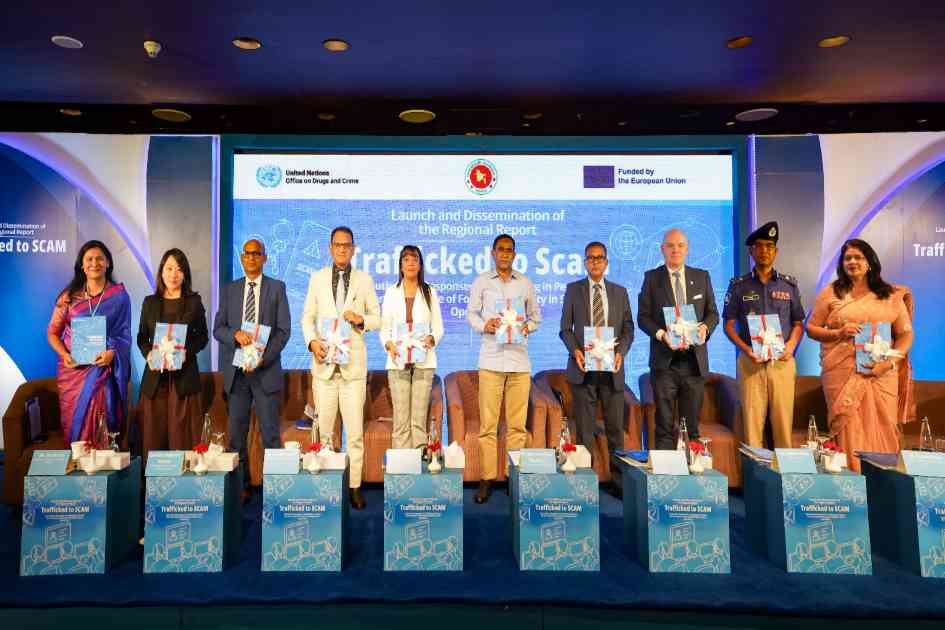
The report, “Trafficked to Scam: South Asian Responses to Trafficking in Persons for the Purpose of Forced Criminality in Scam Operations,” examines the growing intersection between human trafficking, cyber-enabled fraud and organized crime across Bangladesh, Bhutan, Maldives, Nepal and Sri Lanka.
It warns that people trafficked into scam operations can face a particularly complex form of exploitation because authorities may initially see them as offenders rather than victims.
People found operating fraudulent online accounts, contacting potential scam victims or handling other elements of cyber fraud may have been deceived, threatened or compelled to perform those activities, according to the assessment.
The report therefore calls for stronger individual screening and referral procedures to determine whether people found in scam operations have been trafficked.
It also stresses the principle that trafficking victims should not be punished for unlawful acts they were forced to commit as a direct consequence of their exploitation.
The findings come as organized criminal groups involved in cyber scams adapt both their recruitment methods and the locations from which they operate.
While large industrial-style scam compounds have become widely associated with cyber fraud operations in parts of South-East Asia, recent cases detected in South Asia have involved smaller premises, including villas, hotels, rented apartments and offices, the report said.
Such dispersed operations can make detection more difficult for police and other authorities and create additional challenges in identifying trafficking victims and collecting evidence.
Fake jobs used to recruit victims
The report identifies fraudulent employment offers as a major pathway into trafficking for forced criminality.
Potential victims can be approached through online job advertisements, social media or informal recruitment networks with promises of legitimate employment.
After recruitment and travel, however, some are deprived of their freedom and forced to participate in online scams and fraud.
The UN assessment highlights the need for governments to strengthen preventive measures before victims leave their home countries, including improved scrutiny of fraudulent recruitment and more targeted public awareness.
The increasingly digital nature of recruitment also means trafficking investigations need to extend beyond conventional methods and examine online communications, digital records and financial transactions.
The report assesses national and regional responses under three interconnected areas: prosecution, protection and prevention.
It identifies weaknesses in investigating organized criminal networks, obtaining digital and financial evidence, recognizing trafficking victims, preventing fraudulent recruitment and sharing information across borders.
The transnational structure of scam operations means investigators may have to trace recruiters, brokers, financial transactions, online infrastructure and victims across several countries.
That requires closer coordination between anti-trafficking units, cybercrime investigators, immigration authorities, prosecutors and financial crime specialists, according to the report.
Victim or offender?
One of the most difficult issues identified in the assessment is the overlap between victimization and criminal activity.
A person forced to participate in a scam operation can appear to have committed an offence, even though the activity was carried out under coercion.
The report says effective screening is therefore critical when law enforcement agencies encounter people inside suspected cyber scam operations.
Authorities should assess how individuals were recruited, whether they were deceived about the nature of the work, whether their movement was restricted and whether threats, coercion or other forms of control were used.
Appropriate referral and protection should follow where indicators of trafficking are identified.
The report emphasizes the non-punishment principle for trafficking victims, under which people should not be penalized for unlawful conduct they were compelled to undertake because of their trafficking situation.
This approach is particularly important in scam cases because the activities victims are forced to carry out can themselves constitute serious criminal offences.
South Asia both source and location
The report finds that South Asia has become an important region of origin for people trafficked into scam operations.
But it also points to the emergence of scam operations within South Asian countries as criminal networks diversify their activities and move into new locations.
The use of smaller facilities presents a different enforcement challenge from the large compounds that have drawn international attention elsewhere in Asia.
Operations located inside apartments, hotels or ordinary office buildings may attract less attention and can potentially be relocated more easily.
The report says authorities will need to adapt their investigation and victim-identification methods to these changing patterns.
The assessment covers Bangladesh, Bhutan, Maldives, Nepal and Sri Lanka and was prepared through open-source research and consultations with 103 stakeholders.
Those consulted included representatives of ministries, government departments, law enforcement agencies, international organizations, non-governmental groups and civil society.
Representatives from the five countries also reviewed the draft findings during a regional validation workshop in Colombo, Sri Lanka, from June 2 to 4, 2026.
Bangladesh urged to strengthen response
The report was formally launched by Bangladesh’s Ministry of Home Affairs in collaboration with UNODC.
Manzur Morshed Chowdhury, senior secretary at the Ministry of Home Affairs, said the findings offered practical guidance for Bangladesh.
“This is a timely intervention for Bangladesh, providing practical recommendations that can help strengthen our national policies, institutional arrangements and operational priorities in addressing trafficking for forced criminality in cyber scam operations,” he said.
Officials, law enforcement representatives, diplomats, international organizations, civil society groups, academics, private-sector representatives and journalists attended the Dhaka launch.
Kristian Hölge, UNODC regional representative for South Asia, called for the report’s findings and recommendations to be translated into practical action at both national and regional levels.
Rebeka Khan, joint secretary at the Ministry of Home Affairs, highlighted the importance of national coordination and ensuring regional project activities produce practical results in Bangladesh.
Senior police officials also highlighted the challenges facing investigators dealing with trafficking linked to cyber scams.
Rezaul Karim, additional inspector general of police and chief of the Special Response Unit, and Barrister Mosharraf Hossain, additional inspector general of police and chief of the Criminal Investigation Department, addressed priorities including coordinated investigations, victim screening and digital and financial evidence.
They also highlighted the need for stronger cooperation across borders.
Human rights and victim protection
Carol Flore-Smereczniak, United Nations Resident Coordinator in Bangladesh, stressed the importance of human rights-based and victim-centred responses.
Dr Ziauddin Ahmed, additional secretary at the Ministry of Home Affairs, who chaired the event, underscored the need for stronger institutional coordination and effective implementation.
Jee Aei Lee, deputy project coordinator and legal and policy officer with UNODC’s Human Trafficking and Migrant Smuggling Section, presented the methodology, findings and recommendations.
Participants at the launch identified improved victim screening and referral systems as immediate priorities.
They also called for stronger digital and financial investigation capacity, more reliable data, targeted public awareness and practical mechanisms for cross-border cooperation.
The report suggests the changing nature of cyber scam operations will increasingly require law enforcement agencies working on human trafficking to collaborate with specialists dealing with cybercrime and illicit financial flows.
Better data will also be necessary to understand the scale of the problem and distinguish trafficking cases from other forms of cybercrime and irregular migration.
Regional cooperation needed
Because recruitment, transportation, exploitation and financial transactions can occur in different jurisdictions, the report says national action alone will be insufficient.
Information sharing and international cooperation are particularly important when criminal networks recruit victims in one country, move them through another and operate scams from a third.
Financial investigations can also be critical for identifying the people and networks benefiting from the operations rather than focusing only on workers found at scam sites.
The assessment calls for responses that combine criminal investigation with protection measures for victims and prevention efforts targeting recruitment networks.
It was prepared under the regional project “Preventing and Addressing Trafficking in Human Beings and Smuggling of Migrants in South Asia (2024-2027),” funded by the European Union.
The project supports South Asian countries in developing evidence-based and human rights-based approaches to trafficking in persons and migrant smuggling.
The report warns that criminal groups are continuing to adapt, meaning governments will need to update their responses as recruitment methods, technologies and operational locations change.
For South Asian countries, the challenge is increasingly not only to stop people from being trafficked abroad but also to detect scam operations operating closer to home, identify victims correctly and pursue the organized networks controlling and profiting from them.




