




Climate pressures and institutional barriers are deepening livelihood insecurity for river-dependent Manta families, prompting calls for sustained links with government services beyond individual development projects.
The floating Manta fisherfolk community of Barishal has called for improved access to public services, social protection and recognition of their rights as local authorities and development partners joined a dialogue in Barishal to address long-standing challenges faced by river-dependent families.
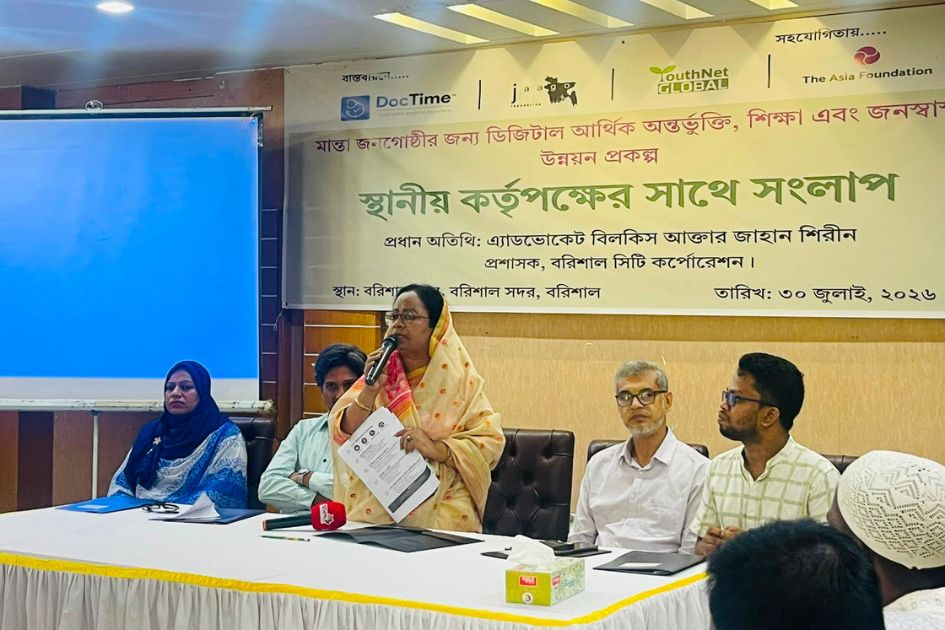
The call was made at a dialogue titled “Dialogue with Local Authorities” held on Thursday (30 July) at Barishal Club. The event was organised under the MantaConnect project, implemented by YouthNet Global with support from The Asia Foundation, aiming to strengthen links between the Manta people and public service institutions.
The Manta people are a traditional river-dependent fisherfolk community in Bangladesh whose livelihoods and daily lives are closely connected with rivers. For generations, many families have faced barriers in accessing education, healthcare, financial services, social protection schemes and government support due to geographical isolation, social exclusion and limited institutional access.
Many Manta families depend on fishing and river-based livelihoods. However, climate change, changing river ecosystems and declining fish stocks have created additional pressure on their traditional way of life, increasing livelihood insecurity and making access to essential services even more critical. The dialogue created a platform for community members and local authorities to discuss practical solutions for greater social inclusion, access to rights and sustainable development.
Barishal City Corporation Administrator Advocate Bilkis Akter Jahan Shirin attended the event as the chief guest.
Speaking at the dialogue, she said, “We are all human beings, and we have to live together. Everyone is equal to me. We cannot move forward by creating divisions among people based on identity or background.”
She added, “It is our responsibility to work for communities that have been left behind. Land rights and basic services are important issues for socially excluded people. At a personal level, I will work for the Manta community. They can come to the City Corporation with their needs, and I will always stand beside them.”
Officials from the Department of Fisheries, Department of Women Affairs and Sher-e-Bangla Medical College Hospital, representatives from Tungibaria and Charbaria Union Parishads, Team Leader of The Asia Foundation Mir Junaid Jamal, government and non-government representatives, development partners, members of the Manta management committee and journalists participated in the discussion.
During the dialogue, Manta representatives shared their experiences and highlighted barriers related to education, healthcare access, financial inclusion, government services, land rights and social discrimination. They also discussed how initiatives under the MantaConnect project have supported digital education, healthcare assistance and financial inclusion opportunities.
Jashim Sardar, a Manta community representative, said access to education, healthcare and social protection remains a major challenge for families living in river areas, stressing the need for stronger connections with public institutions and long-term support.
Government officials informed participants about available services from their respective departments and assured continued cooperation to improve access for the Manta people.
YouthNet Global Executive Coordinator Sohanur Rahman said the Manta people should be recognised first as citizens with equal rights and dignity.
“Before being identified as Manta, they are human beings. Yet they remain among the most marginalised communities in Bangladesh. Ensuring their access to education, healthcare, financial inclusion and social dignity is not merely a project issue; it is a matter of fundamental rights,” he said.
He said the MantaConnect project is supporting digital education, healthcare access and financial inclusion opportunities for the community.
“However, these efforts should not remain limited to a project timeline. Our goal is to create a sustainable connection between the Manta people and regular government services so that inclusion continues beyond individual projects,” Sohanur added.
YouthNet Global General Secretary Arifur Rahman Shuvo said the Manta people are an integral part of Bangladesh’s society and have the right to participate fully in social and economic development.
“Long-standing social and institutional barriers have prevented many Manta families from accessing essential services. Ensuring sustainable development and inclusion requires coordinated efforts from local administration, government institutions, development partners and the community itself,” he said.
Participants at the dialogue emphasised the need for stronger institutional coordination, improved access to public services, social protection programmes and long-term support mechanisms to improve the quality of life of the Manta people.
Stakeholders said the experience of the Manta community reflects a wider challenge of ensuring that vulnerable populations are not left behind in Bangladesh’s development journey. They stressed that meaningful inclusion requires more than short-term interventions; it requires accountable institutions, accessible public services, recognition of rights and active participation of communities in decision-making.
The dialogue marked an important step towards building stronger links between river-dependent communities and service providers, contributing to a more inclusive Barishal where all citizens can access opportunities, protection and services equally.




