


Türkiye’s push for global electrification faces questions over its continued oil expansion, while campaigners demand clean power guarantees and Brazil advances a roadmap for a fossil fuel transition.
As Antalya talks turn to energy, campaigners seek stronger clean power commitments while Brazil advances a roadmap for moving away from fossil fuels.
Türkiye announced new oil discoveries on the opening day of COP31 while seeking international backing for a global electrification pledge, highlighting tensions between its fossil fuel expansion and climate ambitions.
Speaking after a cabinet meeting in Ankara on Monday, President Recep Tayyip Erdoğan said the Gabar region was producing 84,000 barrels of oil a day from 184 wells. He announced two new fields, Gaziler and Çardaklı, with an estimated combined oil-in-place potential of 135 million barrels.
The figure describes oil contained in the fields, rather than a confirmed volume that can be commercially recovered. Erdoğan said production at the new sites began in October.
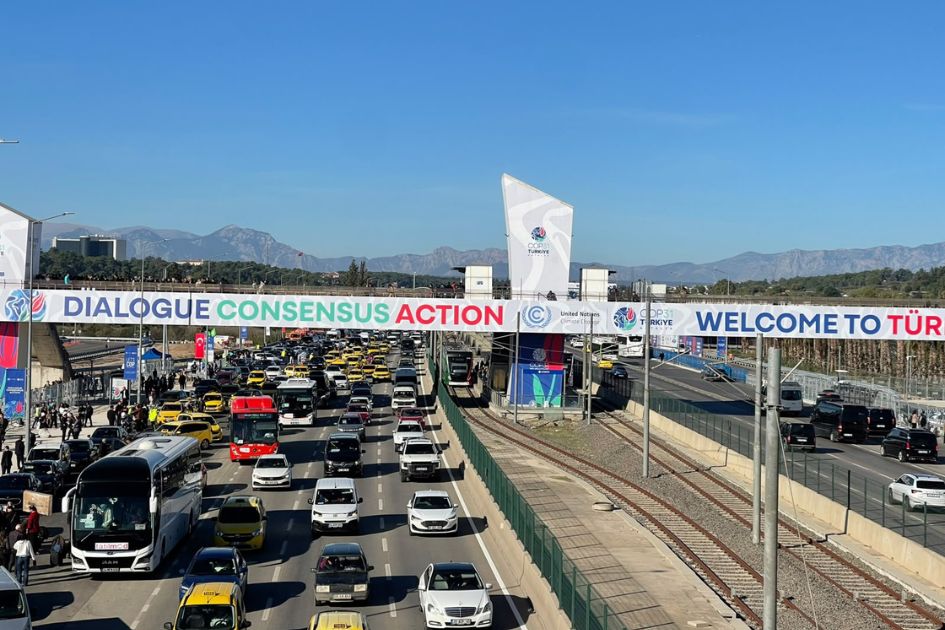
The announcement came ahead of Tuesday’s energy and transport discussions at the UN climate summit in Antalya, where Türkiye is promoting electrification as a central part of its climate and energy security agenda.
Hundreds of sessions scheduled as delegates discuss energy security, electrification, grid infrastructure and sustainable mobility.
Clean power commitments under scrutiny
Türkiye’s non-binding “35 by 35” Global Electrification Pledge aims to raise electricity’s share of global final energy consumption to at least 35% by 2035, from roughly one-fifth today.
The target covers energy used across the economy, including transport, buildings and industry. It is distinct from a target for the share of electricity generated from renewable sources.
COP31 President and Turkish Environment Minister Murat Kurum has presented electrification as a response to energy insecurity and volatile fuel markets.
In remarks reported by AFP on 5 November, Kurum argued that reliance on imported energy reduced countries’ control over their supplies. He said electrification could protect communities against market volatility while cutting emissions.
Campaigners are seeking stronger assurances about how the additional electricity will be generated.
The pledge unveiled in September links electrification with renewable energy expansion and efficiency improvements. However, it does not explicitly require the additional power to come from clean sources, and says the use of clean electricity will vary according to national circumstances.
Claire Smith of the civil society coalition Beyond Fossil Fuels warned that electrification could conceal additional fossil fuel consumption unless supported by renewables, stronger grids and storage. Janet Milongo, energy transition lead at Climate Action Network International, said success also depended on access, infrastructure ownership and whether communities were moving away from fossil fuels.
Electrification can reduce emissions through greater efficiency, with deeper cuts as power supplies become cleaner and electricity replaces fossil fuels. Its contribution to energy security likewise depends on the generation mix, reliable infrastructure and exposure to imported fuels.
Finance, grid investment and national implementation policies will therefore be central to delivering the pledge.
Its status within the negotiations is another question. A voluntary declaration supported by some governments does not, by itself, constitute an agreement adopted by all parties to the UN climate process. Recognition in a negotiated COP outcome would require a separate agreement.
Oil expansion and Brazil’s transition roadmap
Türkiye’s domestic energy policies bring added scrutiny to its international initiative.
Climate Action Tracker rates the country’s overall climate action as “critically insufficient”. The independent monitoring group acknowledges progress in wind and solar but warns that continued investment in coal, oil and gas undermines its climate goals and risks prolonged fossil fuel dependence.
Emel Türker Alpay, an energy campaigner with Greenpeace Türkiye, told AFP that the country should commit to no new coal and set a timetable for beginning a just transition away from fossil fuels.
Brazil’s COP30 presidency is meanwhile scheduled to present its roadmap for transitioning away from fossil fuels on Tuesday at the Akdeniz plenary in Antalya.
The initiative seeks a just, orderly and equitable transition in energy systems, accelerating action this decade towards net zero by 2050. Brazilian officials have described the roadmap as a call to action, rather than a document to be negotiated at COP31.
Together, the initiatives put two connected challenges before governments: expanding electricity use and ensuring that expansion helps reduce dependence on coal, oil and gas.
According to the conference program, around 370 sessions are scheduled throughout the day, including 140 under the energy and transport theme.
In the Blue Zone, which hosts official negotiations and high-level meetings, key events include a ministerial meeting on the Azerbaijan–Kazakhstan–Uzbekistan green energy partnership, as well as panel discussion on green energy security and Ukraine’s energy transition.
Other Blue Zone sessions will address energy security amid geopolitical risks, financing the energy transition and expanding renewable energy infrastructure.
Meanwhile, the Green Zone, which opened to visitors Monday, will host discussions on sustainable mobility, clean energy investment and industrial decarbonization.
Among the scheduled sessions are Redefining Sustainable Mobility, organized by Turkish electric carmaker Togg.
Panels on sustainable aviation fuels, energy storage and the role of artificial intelligence in sustainable mobility are also on the agenda.
The conference opened Monday with a focus on food, agriculture and health, bringing together policymakers, international organizations, businesses and civil society representatives.
Small emissions decline, continuing climate pressure
The discussions come as the Global Carbon Budget projects that carbon dioxide emissions from fossil fuels and cement production will fall by just 0.4% in 2026, to about 38.2 billion tonnes.
Researchers link the projected decline to expanding solar and wind power and the energy shock associated with the Iran conflict. Oil-related emissions are expected to fall by 1.9%, partly reflecting a response to disrupted markets that could prove temporary. These figures do not represent a decline in all greenhouse gas emissions.
The report estimates the remaining carbon budget from the start of 2027 at around 150 billion tonnes of carbon dioxide for a 50% chance of limiting warming to 1.5°C. That is equivalent to less than four years of emissions at current rates.
The comparison describes how quickly the emissions allowance could be exhausted, rather than a precise date when warming will cross the temperature threshold.
Adaptation and finance remain central to the wider talks. In their opening positions, the Least Developed Countries Group prioritised adaptation, the Alliance of Small Island States stressed the 1.5°C limit, and the African Group of Negotiators pressed for delivery of agreed financial support.
For governments in Antalya, the test is whether new energy declarations become funded national measures, cleaner power systems and credible plans to move away from fossil fuels.