


The five-district initiative will train women in disaster preparedness, promote their representation in local decision-making and establish community peacebuilding networks.
A new initiative to strengthen women’s leadership in disaster management and community peacebuilding was launched in flood-prone Kurigram on Thursday.
Titled “Nari Agragoti” (Women’s Advancement), the project is funded by the UN Women’s Peace and Humanitarian Fund (WPHF), with technical support from UN Women Bangladesh. Youth for Change Bangladesh Foundation and YouthNet Global.
It will run in five districts: Kurigram, Satkhira, Feni, Sunamganj and Bandarban. Together they face riverbank erosion, floods, coastal salinity, cyclones and flash floods.
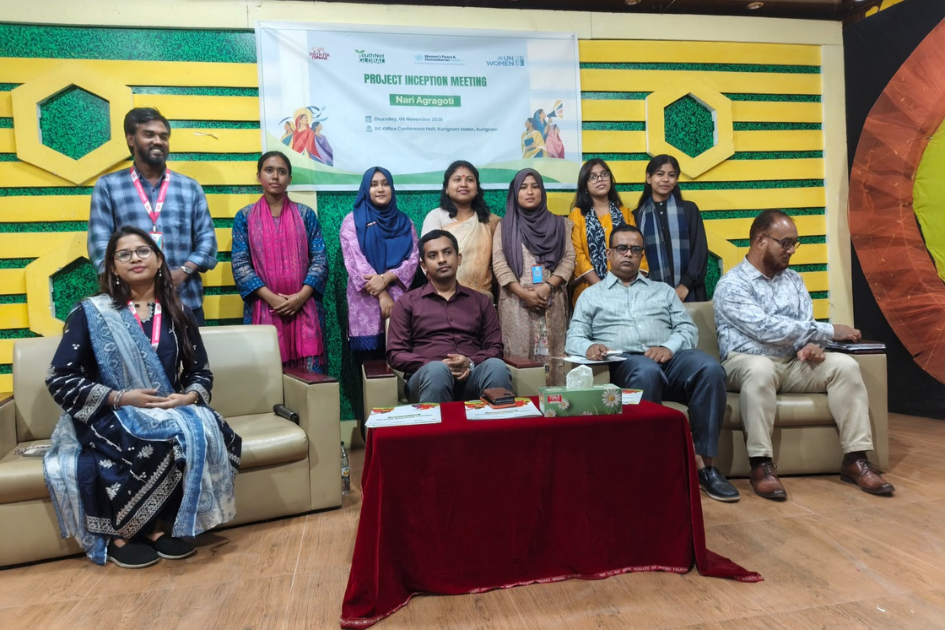
The inception meeting was held at the Deputy Commissioner’s Office conference room. Additional Deputy Commissioner B. M. Kudrat-e-Khuda was chief guest. Among others present were District Relief and Rehabilitation Officer A. T. M. Benazir Rahman, Kurigram Press Club General Secretary Mahfuzar Rahman Khandaker, YFC-BD Lead for Field Implementation and Local Engagement Zahid Kabir, and Project Coordinator Jannatunnahar Tonni. Government officials, civil society representatives, elected local representatives and women from marginalised communities also attended.
At an open discussion, women from flood- and erosion-hit areas spoke of insecurity in emergency shelters, displacement, loss of livelihoods and difficulty reaching healthcare during past disasters.
“Women in Kurigram are often the first to respond when floods threaten their families and communities, yet their voices are frequently missing from disaster management decisions,” said Marjia Medha, YouthNet Global’s District Coordinator in Kurigram. “Through Nari Agragoti, we want to create opportunities for these women to develop their leadership and participate meaningfully in decisions affecting their safety and livelihoods.”
The project will train women in disaster preparedness, emergency response and recovery, and seek greater women’s representation in Union Disaster Management Committees. It also plans mangrove restoration in coastal areas such as Assasuni in Satkhira, with community and women’s participation.
It will engage men and boys as allies through community dialogue and awareness activities, and set up community “Peace Circles” to ease local tensions and build social cohesion.
“Climate-related disasters do not affect everyone equally,” said Jahir Rayhan, Executive Director of YFC-BD. “We aim to strengthen women’s leadership, promote community-based peacebuilding and engage men and boys as partners in creating a more inclusive and resilient society.”
The project also contributes to the UN Women, Peace and Security Agenda, including UN Security Council Resolution 1325.
“Climate justice cannot be achieved without gender justice, and sustainable peace cannot be built while women remain excluded from decision-making,” said Sohanur Rahman, Executive Coordinator of YouthNet Global. “We want women and girls to be recognised not simply as victims of climate change, but as leaders of resilience, peacebuilding and environmental stewardship, with men and boys standing beside them as allies.”