

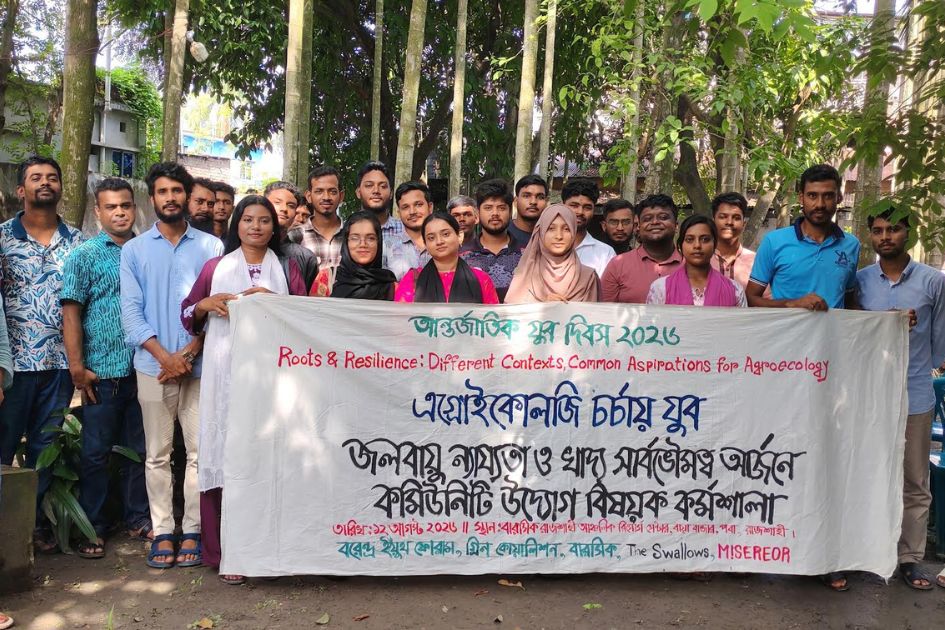



Young people in the Barind region are urging policymakers to link water security, biodiversity, farmers’ rights and food safety through an agroecology-based development approach.
Young leaders in Bangladesh’s drought-prone Barind region have called for sustainable agricultural solutions and policy support to address severe water shortages, food safety concerns and land degradation.
The call came on World Youth Day at a participatory workshop titled “Different realities, common aspirations: Towards a just and sustainable Barind through the voices of youth”, jointly organised by the Barind Youth Forum, Green Coalition and Bangladesh Resource Centre for Indigenous Knowledge (BARCIK) in Rajshahi.
The workshop focused on community initiatives aimed at achieving climate justice and food sovereignty. Young farmers, women farmers and representatives of various social, cultural and environmental organisations from urban and rural areas took part.
At the Barind Common Aspirations Lab, young people from different parts of the Barind region discussed water, agriculture, biodiversity and nature, climate, social and environmental justice, community initiatives and youth innovation.
The participants said young farmers in the Barind region, urban youth, women, fishermen, Indigenous people and students face different realities, but share aspirations for safe food, water, a healthy environment, dignified livelihoods, food sovereignty and a better future.
The organisers said the agricultural crisis in the Barind region should not be viewed solely as a crisis of agricultural production. They said agriculture is inseparably linked to water, soil, biodiversity, food systems, farmers’ dignity, local seeds, climate and people’s livelihoods.
They called for a policy for the Barind region that would not only increase production but also protect natural resources, safeguard farmers’ rights, ensure safe food and protect the environmental security of future generations.
Mohammad Riday, a young farmer practising agroecology in Paba upazila of Rajshahi, said he had grown guava on 55 percent of an acre of land using completely chemical-free methods.
“My guava yield was much better than that of farmers in my area who cultivated using pesticides and chemicals. The government should encourage farmers to adopt environmentally friendly agricultural practices and take measures to stop the use of highly harmful pesticides,” he said.
Sabitri Hembrom, general secretary of the Indigenous Youth Council, said agricultural and development policies could only be considered just when the distribution of their benefits and environmental costs was fair.
“During policy formulation and implementation, it must be considered whether any policy is creating disproportionate impacts on farmers, women, Indigenous people, marginalised communities and local people,” she said.
Mohammad Atikur Rahman, president of the Barind Youth Forum, said young people wanted a development framework that treated agricultural production, water security, biodiversity and nature and people’s rights in an integrated manner.
“The reality of the Barind region demands an environmentally friendly, agroecology-based agricultural policy now, one that ensures the protection of water, soil, agricultural biodiversity and health alongside farmers’ production,” he said.
Mohammad Shahidul Islam, an anthropologist, environmental law researcher and regional coordinator of BARCIK Rajshahi, said local agricultural knowledge, local seeds and farmers’ own adaptation strategies should be given due importance in development planning.
“Policies suited to climate change must be formulated by combining modern science with local knowledge, where the experiences of local communities are also considered important evidence,” he said.




