

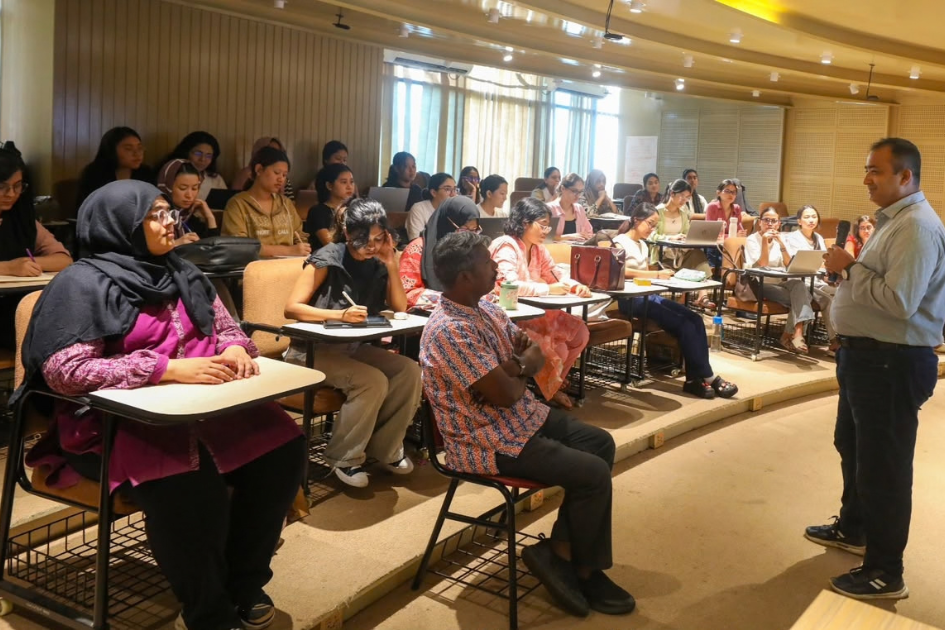



AUW students practised climate reporting, story development and editorial pitching through hands-on exercises designed to strengthen environmental communication and prepare them for a university-wide journalism contest.
Asian University for Women (AUW) successfully concluded a two-day Environmental Journalism Workshop led by Mr Shamsuddin Illius on 28 and 30 September 2026. The workshop was organised under the Environmental Law and Policy course, taught by Dr Nazifa Rafa. Dr Mosae Selvakumar Paulraj, Director of the Environmental Sciences and Biological Program, was in presence during the workshop. The workshop aimed to strengthen students’ ability to communicate environmental issues clearly, accurately, and in ways that can influence public understanding and policymaking.
Mr Shamsuddin Illius is an award-winning climate and environmental journalist, Founder of The Climate Watch, Chattogram Bureau Chief of The Business Standard. Drawing on his professional experience, Mr Illius introduced participants to practical approaches used by journalists when reporting on climate and environmental issues.
The first day of the workshop was dedicated to the basics of climate and environmental journalism. Students learned how to choose an appropriate angle for a story, write a compelling headline and lead, and structure the story with an introduction, the main part, and supporting details. The students also learned the significance of evidence and reliable sources in journalism.
After the learning session, participants joined a writing competition. They were asked to prepare a 300-word story about the Palmyra Fruit Festival at AUW using the techniques introduced during the workshop. The activity allowed students to transform an event into a structured journalistic story while practising concise writing and effective presentation of information. Three participants, Tasfiya Asad Toya, Yashna Ikter, and Parwana Jafari, were selected as winners of the first-day competition.
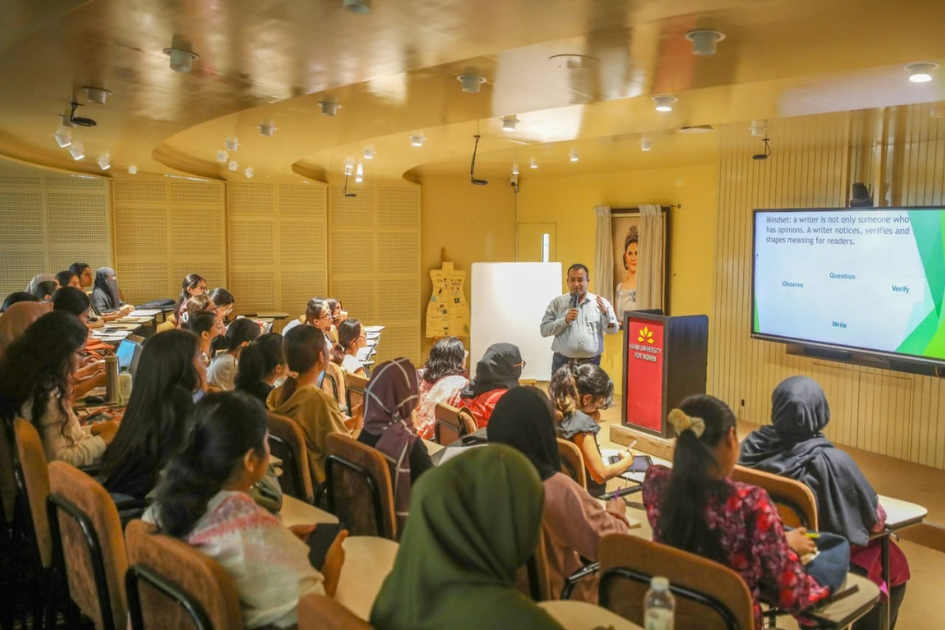
The second session built on these foundations by concentrating on how to tell a compelling climate story and how to pitch an environmental story to an editor or media platform. Students explored ways to explain why a story matters, identify the people affected, connect evidence with policy, and present a clear and original story proposal.
A second hands-on competition followed the session, giving participants an opportunity to apply their new pitching and storytelling skills. Their work was assessed based on the strength and relevance of the story angle, evidence and accuracy, clarity and structure, originality, and the connection to environmental policy. Three additional winners, Mushrura Binte Bashar, Sinzeria Teresa Maria Tavares, and Horya Mowlaie, were recognised, bringing the total number of competition winners across the two workshop days to six.
The workshop was designed in a way that ensures that theoretical principles were put into practice right away. It also served as preparation for a university-wide environmental journalism contest. Those who completed both workshops were awarded e-certificates of participation.
During the session, the participants were made aware of journalism’s importance in presenting complex environmental issues to common people. The workshop motivated students at AUW to make use of their skills in environmental reporting and storytelling.




