

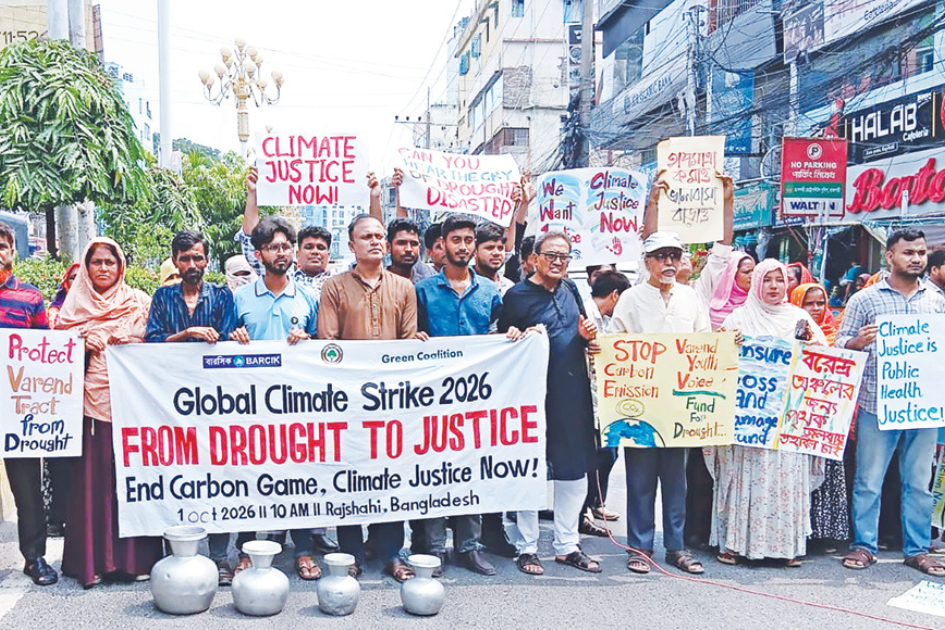



Farmers, students and researchers urged stronger climate finance, water security and adaptation measures as Barind communities face worsening drought, groundwater depletion and livelihood risks.
Environmental activists on Thursday(1 October) demanded that the climate crisis in the drought-prone Barind region be prioritised in national and global climate negotiations.
They made the demand at a climate strike at Shaheb Bazar Zero Point in Rajshahi city under the slogan, ‘From drought to climate justice – from Barind to the global climate conference’.
Held around 10:30am, the programme was jointly organised by the Varendra Youth Forum, Green Coalition and Bangladesh Resource Centre for Indigenous Knowledge.
Farmers, students, researchers and representatives of marginalised communities also joined the programme.
Participants said drought, heatwaves, groundwater depletion, threats to agriculture and food security and degradation of rivers, canals, ponds and wetlands were worsening in the region.
They said biodiversity loss and livelihood insecurity were interconnected and required a long-term, integrated adaptation framework.
Mahbub Siddiqui, president of Green Coalition, said the region’s ponds, canals and small rivers had been degraded or destroyed, while excessive groundwater extraction was worsening the water crisis.
‘A separate fund from global climate financing should be created for the Barind region to address these problems,’ he said.
BARCIK regional coordinator Md Shahidul Islam said the effects of climate change were already evident in the region through drought, water shortages and threats to farmers’ livelihoods.
‘Alongside climate justice, people’s rights to water, food and livelihoods must be ensured,’ he said.
Varendra Youth Forum president Atikur Rahman said the region’s problems were directly linked to global climate discussions.
‘Barind’s realities must be effectively incorporated into COP31 discussions on climate finance, adaptation and loss and damage,’ he said.
The participants presented five key messages, including recognising Barind as a climate frontline, making water security a central climate priority, developing climate-resilient food systems, ensuring equitable financing for loss and damage and adaptation and ensuring meaningful participation of vulnerable communities.
They also presented a 12-point charter demanding a long-term Barind climate resilience framework, control of excessive groundwater extraction, restoration of water bodies and waterways, climate-resilient agriculture, a separate drought fund and social protection for vulnerable communities.




