




The government plans tougher action on plastic waste while highlighting forest recovery, Sundarbans protection and greener development practices.
Bangladesh’s environment, forest and climate change state minister Sheikh Faridul Islam on Wednesday called for the construction of pillar-free or suspension bridges instead of conventional pillar-supported bridges to protect the country’s rivers and maintain natural water flows.
He also said reducing the use of polythene would be possible if everyone acted responsibly to protect the environment.
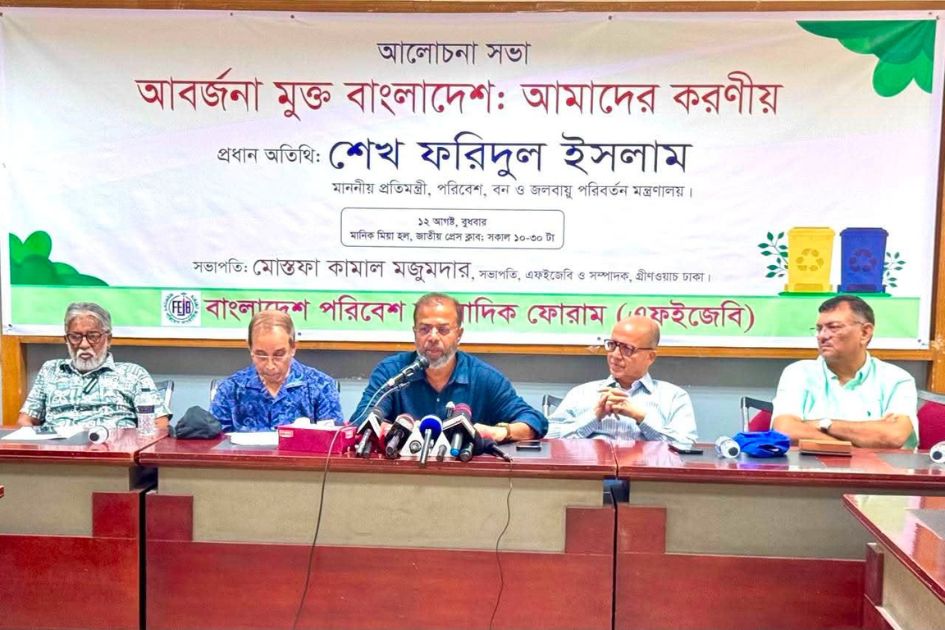
The minister made the remarks as the chief guest at a discussion titled “Garbage-Free Bangladesh: What We Should Do” at the Towfique Hossain Manik Mia Hall of the National Press Club in the capital Dhaka on Wednesday, August 12. The Bangladesh Environment Journalists Forum (FEJB) organised the event.
Speaking about river protection and suspension bridges, Faridul Islam said rivers were living entities. But the way bridges and culverts are built in Bangladesh with pillars causes silt to accumulate on riverbeds, leading them to fill up rapidly, he said.
Countries such as Hong Kong, the United Kingdom and Turkey build suspension bridges to protect rivers, the minister said. Bangladesh should also act in accordance with that reality and move away from the tradition of pillar-based bridges, he added.
On waste and plastic pollution, the minister stressed the “four-R” approach and said people needed to become more aware and responsible to reduce polythene and single-use plastic waste.
He urged people to develop the habit of using their own jute or cloth bags when shopping. He said monitoring and legal drives had been intensified to stop the use of harmful polythene in markets by the end of August.
Faridul Islam also outlined several achievements and plans of his ministry, saying that 1,807 acres of illegally occupied forest land had been recovered by July 30 against a target of 2,000 acres over the previous six months.
He said there had been no fire incidents in the Sundarbans this year because of strict monitoring.
Under Prime Minister Tarique Rahman’s programme to plant 250 million trees, more than 4 million trees had been planted in Cox’s Bazar, he said. An initiative had also been taken to plant 20 million keora trees in coastal areas to ensure carbon trading, he added.
The minister said burning wood in brick kilns had been completely banned. Divisional commissioners and field-level administrators had been instructed to take strict action against brick kilns that burn wood to protect the environment, he said.
He also said health impact assessments, in addition to environmental impact assessments, were essential when development projects were undertaken. Environmental pollution was causing damage to public health, which in turn was having a negative impact on the overall economy, he said.
FEJB President Mostafa Kamal Majumder chaired the event. National Press Club President and poet Hasan Hafiz, General Secretary Ayub Bhuiyan, journalist leader Elahi Newaz Khan Saju, journalists Nurul Huda Chowdhury, Shah Abdul Halim, Motaleb Masreki, Bulbul Ahmed, Delowara Yasmin and Tariq Hasan also spoke at the discussion.




