

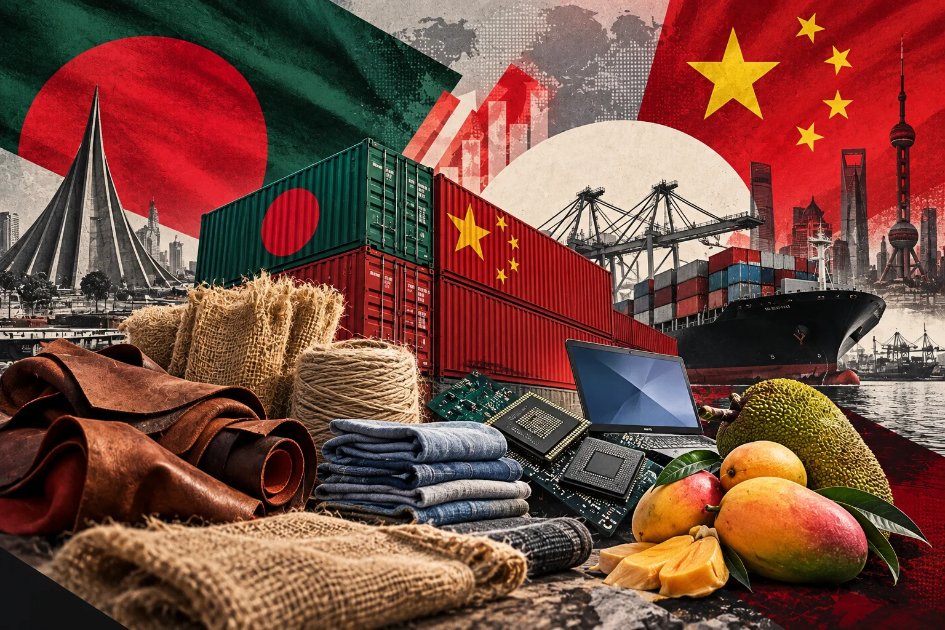



Permanent product outlets, joint research and participation in Chinese trade fairs are among efforts to expand market access, attract investment and diversify Bangladesh’s export basket.
Bangladesh seeks to reduce its trade deficit with China. Every year, the country imports goods worth $18-20 billion from China. In contrast, Bangladesh exports goods worth only $1 billion. During Prime Minister Tarek Rahman’s visit to China from June 23 to 25, he provided directions on reducing the trade deficit between the two countries. He prioritised six products, including leather, IT products, ITS, jute products and semiconductors. With this goal in mind, a joint venture committee was formed in September, headed by Md Firoz Uddin Ahmed, joint secretary of the Export Wing of the Ministry of Commerce, to systematically increase imports, exports and investment. The government expects the committee to help identify exportable products, explore markets and increase investment.
Meanwhile, the Export Promotion Bureau (EPB) of Bangladesh has reported encouraging figures. According to the EPB, Bangladesh earned $225.41 million from exports to China between July and September, an increase of 9.33% compared with the same period last year. Export earnings stood at $206.18 million during the corresponding period last year.
What does Bangladesh export to China?
Bangladesh mainly exports processed hair, jute yarn, readymade garments, leather and leather goods, and cotton yarn to China. In addition, agricultural products such as mangoes and jackfruit have recently entered the Chinese market. According to the Ministry of Commerce, on June 16, 2020, China granted Bangladesh duty-free and quota-free access for 97% of products, covering a total of 8,256 HS codes. The facility came into effect on July 1. As China provided the benefit unilaterally to least developed countries under the World Trade Organization (WTO), Bangladesh was not required to offer any concessions in return.
According to EPB sources, exports to China increased to about $821 million in the 2025-26 financial year, up 18.24% from the previous year. Exports stood at about $641.4 million in the 2024-25 financial year. In the 2022-23 financial year, exports amounted to only $680 million, while imports from China stood at $21.12 billion. In the 2021-22 financial year, exports were about $683 million. Bangladesh’s highest-ever exports to China were recorded in the 2016-17 financial year, at $949.01 million.
According to EPB data, Bangladesh imported goods worth $21.12 billion from China in the 2022-23 financial year. Import statistics covering 37 years from Bangladesh Bank show that goods worth $110 million were imported from China in the 1988-89 financial year. Imports from China amounted to $2.08 billion in 2005-06, $3.82 billion in 2009-10 and $15.582 billion in 2015-16.
In this regard, Commerce Secretary Md Ataur Rahman Khan said Bangladesh would reduce its trade deficit with China by increasing export capacity. The prime minister formed a committee after returning from his visit to China. It is a research-based committee that will investigate where the trade deficit can be reduced. China has also formed a committee, whose members visited Bangladesh. Their approach has been very encouraging. A researcher from an institution like the Bangladesh Institute of Development Studies (BIDS) has been assigned trade-related research responsibilities. A representative from China’s Ministry of Commerce also visited, and we held a meeting.
He said they had examined various organisations and capabilities in Bangladesh, visited departments and held discussions with agencies involved in trade and commerce. They also examined export-related RCC and IND. We will prepare a joint report. They will provide some input after returning and reporting on their work. This will help increase exports to some extent.
Asked why Bangladesh had not been able to identify which products to export or what barriers it faced despite China granting tariff concessions on 97% of Bangladeshi products in 2020, the commerce secretary said some products had been selected. In particular, they had been working on six or seven products for nearly five or six years. These included leather, IT products, ITS and jute products as alternatives to garments, while semiconductors had been added this year.
Asked about the agreement to export mangoes and jackfruit, which also involves the Ministry of Agriculture, and what other plans were being considered, Md Ataur Rahman Khan said the government was now focusing on diversifying both products and export destinations. It was examining whether more products could be exported to existing markets and whether other countries offered potential export opportunities. For this purpose, the government was considering 18 sectors and 18 countries.
The government was examining which Bangladeshi products could be exported to these 18 countries. A meeting with stakeholders was held last week, and the government received useful feedback from industries and associations. Officials from other ministries would assess their capabilities and identify areas where work could be done. Jackfruit and mangoes featured prominently in the discussions. Other available fruits, such as pineapples, were also mentioned. Bangladesh would need to process these products domestically before considering exports and assess whether there was demand in the target markets. The government was also considering exporting products such as dried fruits, which are already well established in international markets.
The prime minister himself had identified six products, and the government would have to report whether it could capture markets for them. Exporting products from Bangladesh also requires several certificates, such as halal and Bangladesh Standards and Testing Institution (BSTI) certification. The government could demonstrate its capabilities through a few minor changes to meet the minimum requirements.
Md Firoz Uddin Ahmed said Bangladesh enjoyed 100% tariff concessions in China. A joint research team had been formed, and work had begun. Asked what major problems had been identified, he said the report had not yet been finalised and the root causes were still being explored. China had formed a committee and Bangladesh had formed a separate one. The two committees would later combine their reports to produce a joint report. Once the Chinese report was shared, the reasons for the trade deficit and the extent of the gap would become clearer. The aim was to reduce the difference.
Firoz Uddin Ahmed said Bangladesh imported large quantities of industrial raw materials from China in addition to basic goods. About 60% of industrial machinery came from China. The government would examine whether some factories could also be established jointly.
20 outlets needed for Bangladeshi products to enter China’s market
Mohammad Khorshed Alam, president of the Bangladesh-China Chamber of Commerce and Industry (BCCCI) and a veteran businessman, said Bangladesh’s trade deficit with China stood at $18-19 billion. Against imports worth $19 billion, Bangladesh exported goods worth between $7.25 million and nearly $1 billion. This was very low. The country was planning to reduce the deficit by increasing exports.
He said Bangladesh was considering a different strategy to boost exports: establishing 20 outlets in major cities across various Chinese provinces. These outlets would display all kinds of Bangladeshi products, similar to department stores, allowing consumers to purchase goods directly. Customers could choose products according to their preferences, helping identify those in greatest demand. At present, Bangladesh did not know which products would be most popular with Chinese consumers.
China wanted to close some of its smaller factories. Bangladesh would try to display a wide range of products, from ballpoint pens and leather goods to bed sheets and other textiles. During the first six months, the products would be displayed for people to see. A survey would then be conducted to identify which products sold well. Bangladesh would also examine which products the Chinese government planned to stop producing and which could be sourced from Bangladesh. After taking responsibility in October 2025, the BCCCI raised the proposal with the Chinese ambassador in December.
The Chinese government had provided an outlet in Kunming free of rent. The chamber had requested an outlet measuring 2,500 square feet, but China had offered 2,000 square metres. A warehouse of the same size had also been provided to store products. There were no tariffs on exports to China, he said. Each outlet would also have a box where people interested in investing in Bangladesh could submit applications.
In addition, the outlets would have a small counter. Information and guidance would be provided to those interested in investing in Bangladesh. A Chinese representative would be assigned to each outlet because Chinese consumers prioritise their own language. Support from the EPB would be needed, as it would be better to discuss which products should be displayed. If the EPB consulted the chamber, work could begin quickly.
He said Bangladesh hoped to earn $1 billion annually from exports to China from the following year. On that basis, exports could increase by $3 billion over three years. He also expected imports from China to decline this year for two reasons. First, the electricity and gas shortages had prevented imports of capital machinery, reducing imports by $1.5 billion. Second, China had reduced exports of rice chemicals because production costs had increased. Bangladesh was now importing them from India.
Asked which products Bangladesh exported, he said the country exported only a small range of goods, including some agricultural products, seeds, textiles, handicrafts and medicines, none of them on a large scale. However, Bangladesh had expected a strong market for home textiles and readymade garments. Products sold in China were often routed through intermediaries and marketed under different names, generating substantial profits for those intermediaries. If Bangladesh could sell directly, the profits would remain in the country. Garment manufacturers would benefit and could sell at higher prices. However, proper planning was essential. Mistakes could result in losses and the market could be lost.
He said no other country in the world had provided 100% tariff-free access like China. Bangladesh had wasted the opportunity provided in June 2020 for five years without making use of it. Asked why the opportunity had been wasted, he said many people assumed there was no point in entering the Chinese market because China manufactured everything. He said this was the wrong approach.
He added that young people in Bangladesh were entering business but increasingly relying on employees instead of working directly themselves, whereas previous generations would go out and meet people. In contrast, young Chinese people travelled around the world. A few days earlier, 32 Chinese people had visited the BCCCI office.
He questioned the EPB’s commitment and sense of responsibility, alleging that it accepted money from some people to include their products without checking whether the goods were of good quality. This risked losing markets. At a trade fair in Kunming last year, 100 stalls had been allocated to Bangladesh free of charge. However, the EPB allocated 50 of them to Nakshi Kantha products, whereas separate allocations for a wider range of products were needed. Mangoes, jackfruit, guavas, pineapples and other locally produced goods could have been displayed.
He said the government had sent people to the fair who did not know how to run a stall. They sat using Facebook, some went sightseeing and others attended seminars with ministers. This had caused embarrassment for the country.
On October 1, a meeting was held in Dhaka with a visiting Chinese delegation to further expand bilateral trade, investment and economic cooperation between Bangladesh and China’s Yunnan province. The meeting was chaired by Mohammad Hasan Arif, vice-chairman and chief executive of the Export Promotion Bureau (EPB), who holds the rank of additional secretary. Discussions focused on strengthening existing trade relations between Bangladesh and Yunnan, creating new markets and business links, and expanding opportunities for bilateral trade.
Proposals from Yunnan’s provincial commerce department also highlighted the need to assess market demand in Bangladesh for construction materials, engineering products and agricultural machinery, visit local exhibitions and commercial markets, develop distribution and logistics networks, and expand exports of agricultural and light industrial products. The meeting also discussed strengthening commercial links between Bangladeshi textiles and specialised agricultural products and goods from Yunnan.
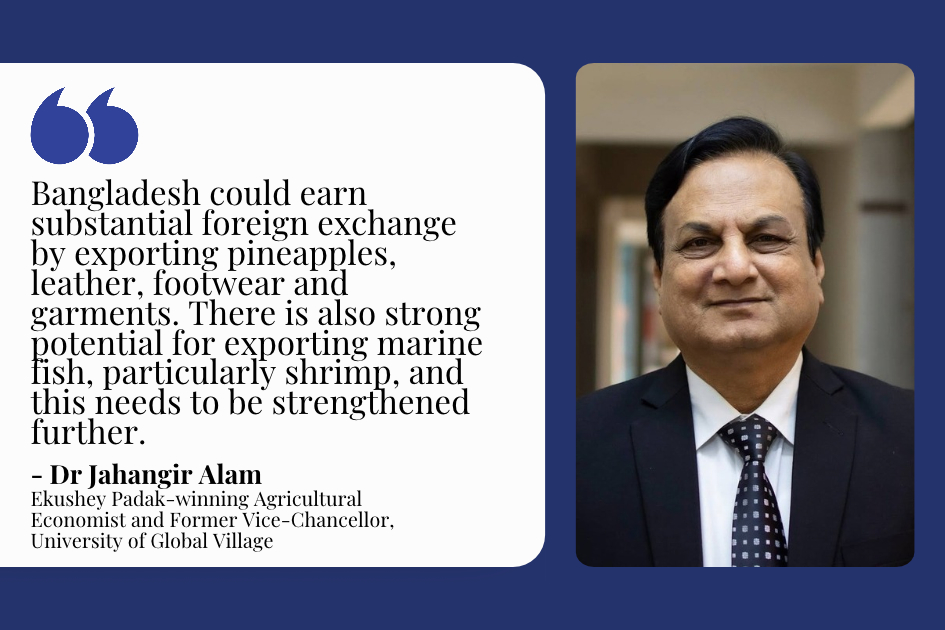
Dr Jahangir Alam, an Ekushey Padak-winning agricultural economist and former vice-chancellor of the University of Global Village, said most jute sticks and leather products were exported to China. Bangladesh imported more from China than it exported. If the country could diversify its exports, it could capture the Chinese market.
Asked which other products Bangladesh could export in the future, he said an understanding had been reached with China last year on exporting mangoes and jackfruit. Bangladesh could earn substantial foreign exchange by exporting pineapples, leather, footwear and garments. There was also strong potential for exporting marine fish, particularly shrimp, and this needed to be strengthened further. The footwear market was also large, offering opportunities to increase exports of leather and shoes.
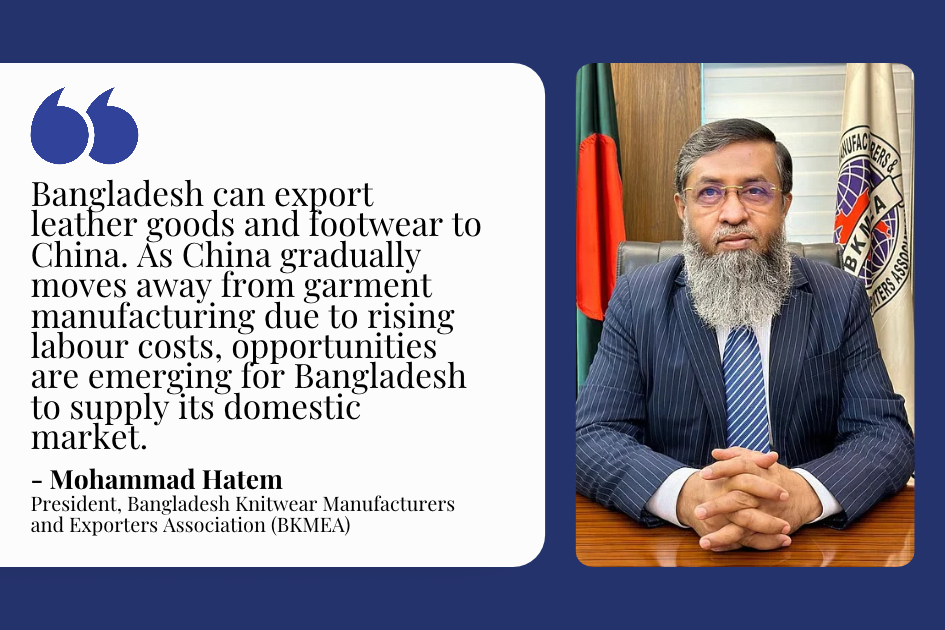
Mohammad Hatem, president of the Bangladesh Knitwear Manufacturers and Exporters Association (BKMEA), said Bangladesh could export leather goods and footwear to China. He also believed garment products had potential. Asked whether China was a competitor in the garment sector, he said China was gradually moving away from garment manufacturing because labour costs had risen. This created opportunities for Bangladesh to supply products needed in the Chinese domestic market. Chinese investors were also successfully operating garment factories in Bangladesh.
He said the government wanted to increase exports and his recommendation was to attract more Chinese investment. Bangladesh would also benefit if China brought its technology to the country.
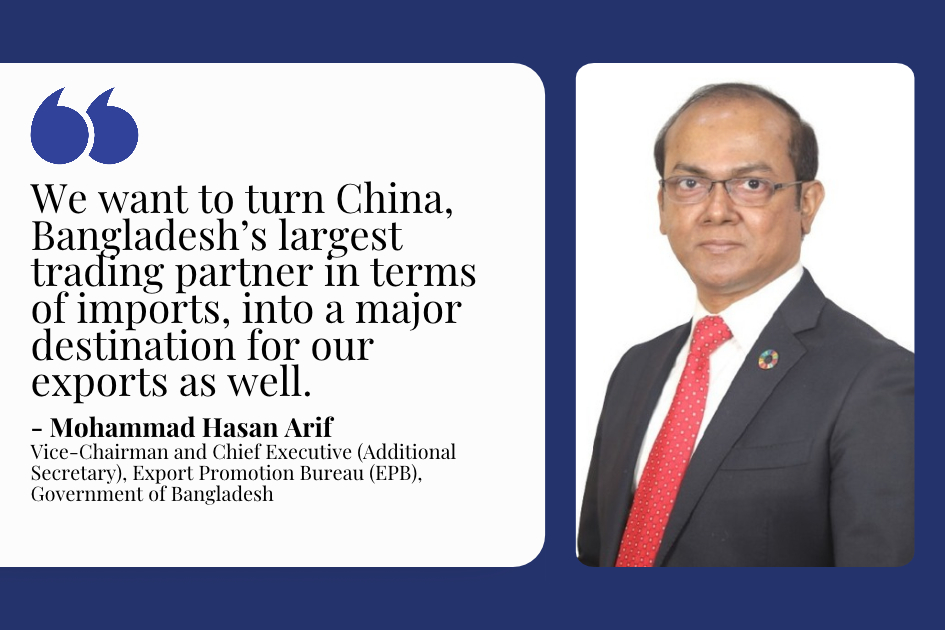
Mohammad Hasan Arif said Bangladesh’s exports to China had performed positively in the previous year, and exports during the first three months of the current financial year had exceeded those of the same period last year. When Bangladesh attended a major Chinese trade fair in June with nearly 100 exhibitors, Chinese businesses showed strong interest in expanding trade with Bangladesh. Bangladeshi businesses were also optimistic after visiting China and had identified new business opportunities. There were expectations of further opportunities in the future.
As a result, the EPB had intensified efforts to increase exports to China. This year, Bangladesh would participate in five or six trade fairs in China and Hong Kong. Participation in these fairs would bring positive momentum to business relations and exports. In addition, the EPB planned to organise the Global Sourcing Expo in Dhaka in November, where it expected a large business delegation from China. The delegation would be able to establish new business relationships with Bangladeshi exporters. The EPB would continue engaging with China and gradually work to increase exports.
He said China could become a major export destination among Bangladesh’s non-traditional and Asian markets. Referring to China as Bangladesh’s largest trading partner, the EPB vice-chairman said China was the country’s largest trading partner because of imports. Bangladesh wanted to turn China into a major destination for its exports as well.
He said representatives from Yunnan had visited Bangladesh on October 1. Some were already doing business with Bangladesh, while others were interested in entering different sectors. They were optimistic about Bangladesh. If the two governments continued to cooperate and business contacts between the countries increased, Chinese investment in Bangladesh and Bangladeshi exports to China could both grow.
Chinese businesses were already sourcing various products from Bangladesh, particularly non-traditional items. He recalled one businessperson who exported soft-shell crab from Bangladesh to China. Bangladesh was also exploring opportunities to export various other non-traditional products to China.
There was also potential for exporting Bangladeshi fruit to China. During the prime minister’s visit to China in June, a protocol was signed for jackfruit exports. The EPB had been working to enable future exports of various types of fruit. However, exporting fruit to China required several procedures, including registration under China’s GACC system. The EPB and the Ministry of Agriculture were providing training to exporters on these requirements. To increase fruit exports, they had previously trained hill-fruit producers in Lama, Bandarban. Another training programme was scheduled for Friday and Saturday in Khagrachhari. National-level training would continue.
Mohammad Hasan Arif said he had inspected the site being offered for Bangladesh’s outlet in Kunming. Other countries, including Thailand, already had displays there. Bangladesh’s display in Kunming would be permanent. This would allow buyers from across China, not just Kunming or Yunnan, to visit and place orders. The products could then be distributed more easily throughout China, helping increase Bangladesh’s exports.
A series on economic diplomacy | Part 2




