




Experts highlight Chinese technology, solar irrigation, agricultural inputs and waste recycling as key areas for deeper Bangladesh-China cooperation.
Bangladesh imports urea from China. Nano-fertiliser technology will play a major role in the coming days. We have advised the government that using nano-fertilisers will reduce subsidies on fertilisers. As they are environmentally friendly, they will not cause harm to nature. This is very appropriate for us.
Dr Md Shahidul Islam, former director general of the Bangladesh Agricultural Research Institute
China is far ahead in the agricultural sector. They are particularly advanced in seed production, technology adoption, innovation and development. If we have an understanding with them, we will also be able to make significant progress in the agricultural sector.
Dr Jahangir Alam, Ekushey Padak-winning agricultural economist and former vice-chancellor of the University of Global Village
Bangladesh’s agriculture, fisheries and livestock sectors use various technologies, equipment, food and medicines made in China. In particular, China’s affordable equipment for modern agricultural technology has taken agricultural productivity to a new level. After independence, Bangladesh’s formal relations with China began in June 1974 with a goodwill visit by a Red Cross team from the country, through which $1 billion in aid was provided for flood victims. This developed into trade relations in May 1975 with the signing of the first Bangladesh-China trade agreement. Over time, the relationship has become more dynamic in response to changing needs. Business and trade between the two countries have increased and investment has expanded. Chinese technology and investment have also facilitated Bangladesh’s environmental management, waste management, pharmaceutical industry and foreign exchange earnings.
Agricultural inputs dependent on China
Cultivation is increasing on dead and fallow land in Rajshahi, Naogaon and Natore in the Barind region. Following the installation of solar-powered irrigation pumps, many plots that previously depended only on Aman rice are now producing Aus, Aman and Boro rice in all three seasons. At the same time, farmers are cultivating various winter crops including tomatoes, potatoes, cauliflower, cabbage, eggplant and chilli.
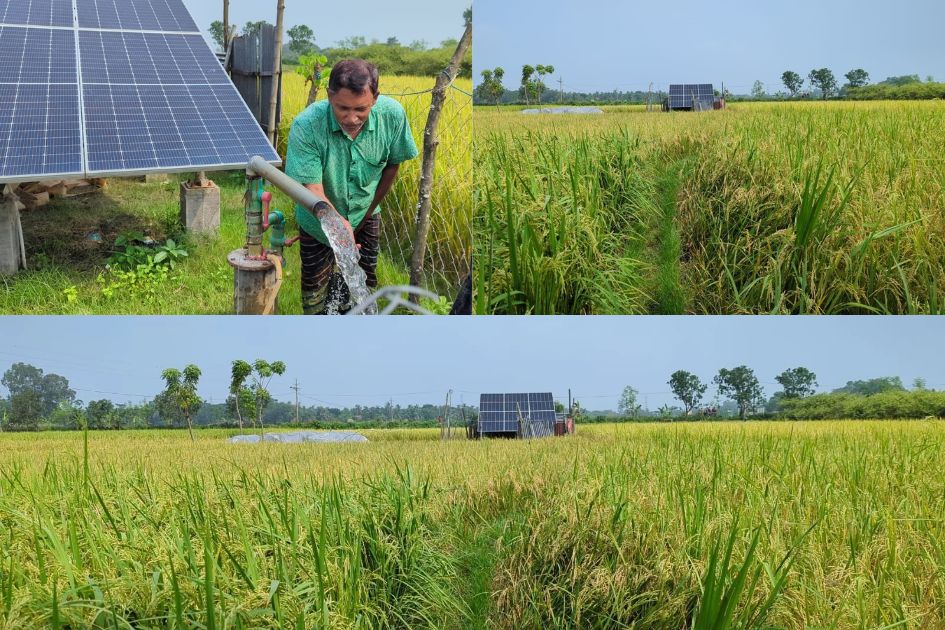
Solar panels are also gaining popularity in different divisions of the country.
According to farmers and project officials, the introduction of solar-powered irrigation systems has reduced dependence on diesel and electricity from the national grid. This has reduced irrigation costs on the one hand while increasing cropping intensity as uncultivated and fallow land is gradually being brought under cultivation on the other. Previously, only Aman rice was cultivated. Winter vegetables and pulses were also produced. Now, alongside Aman, farmers are cultivating Boro and Aus rice. Many farmers are growing cauliflower, cabbage and tomatoes as early-season crops.
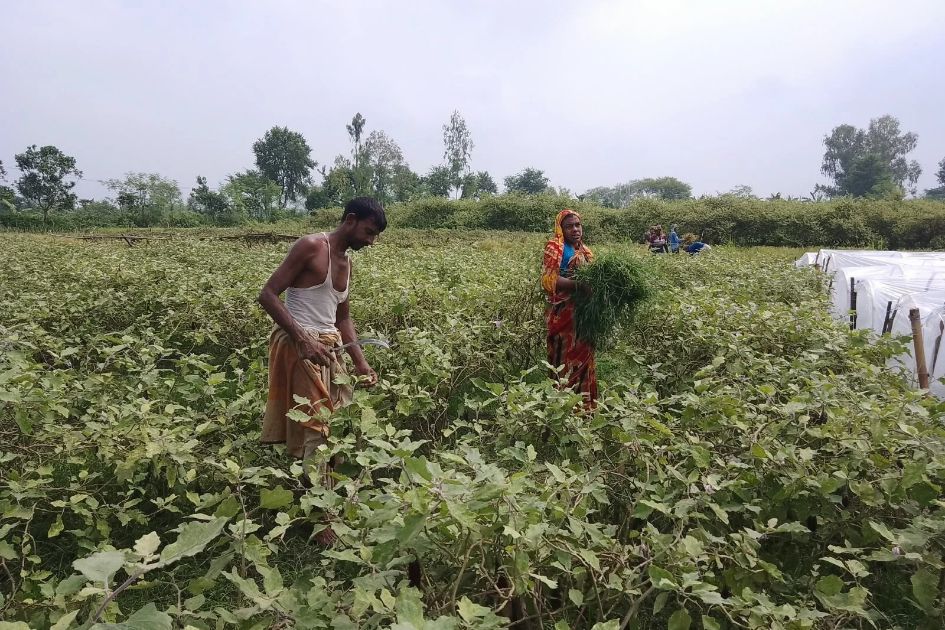
At Mohanpur upazila in Rajshahi, farmer Akhtar Hossain was picking eggplants from a field with his wife beside a solar panel. Akhtar Hossain said, “Now I am cultivating eggplant, bitter gourd and other crops.” In another nearby field, he is growing cauliflower seedlings at his own expense by covering the soil with polythene using the mulching method. In his words, the availability of water has now turned the dead and fallow land into a blessing for us.
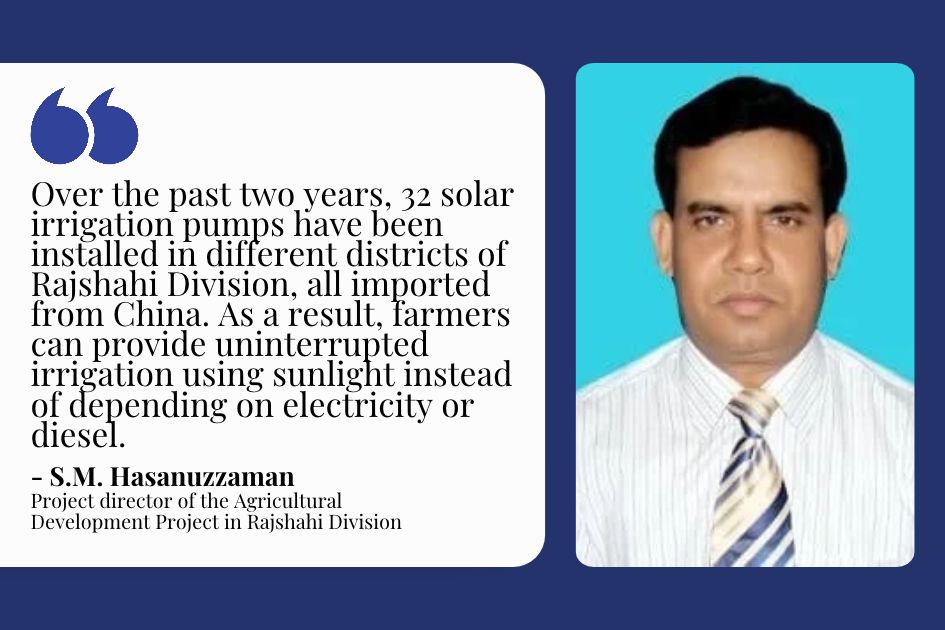
In this regard, agriculturist S.M. Hasanuzzaman, project director of the Agricultural Development Project in Rajshahi Division through the expansion of modern technology, said most of the polynet and solar panels used in modern agriculture are imported from China. China markets these products considering the weather and climate of Bangladesh as well as its economic capacity. The use of these relatively low-cost technologies is making a major contribution to the agricultural revolution in the country. In particular, polynet polythene used for greenhouses is imported from China. Various types of agricultural machinery are also imported from China. These include almost all types of technology used for power tillers, sowing, planting, harvesting, threshing and winnowing. China has created a major market in the agricultural sector. In that sense, we can acknowledge that China has made a significant contribution to agricultural production in Bangladesh.
Agriculturist S.M. Hasanuzzaman said 32 solar irrigation pumps had been installed in different districts of Rajshahi Division over the past two years, all imported from China. As a result, farmers can provide uninterrupted irrigation using sunlight instead of depending on electricity or diesel. On the one hand, this is helping to address the national electricity shortage while on the other it has brought farmers’ irrigation costs close to zero.
Farmers are now producing three rice crops a year along with other crops on uncultivated and fallow land. As a result, cropping intensity has increased by about 50%.
S.M. Hasanuzzaman said the pumps would last for 20 to 25 years if properly maintained. He said the government should consider a new project to install new solar pumps as well as convert existing diesel- and electricity-powered irrigation pumps to solar systems.
He said deep tube wells in the region cannot maintain the command area with which they initially began operating. A deep tube well may start with 150 bighas but after two years the area may fall to 100 or 80 bighas. Although the Rajshahi region is under the Barind area, there are no deep tube wells for 100 bighas of land.
He said a small part of their project involves solar pumps. The government also wants to increase the use of solar power. Therefore, they are planning to install solar pumps alongside existing electricity- and diesel-powered pumps in the field. This is because solar pumps can provide uninterrupted irrigation from 8am to 4pm.
He further said the tender value for installing these solar pumps was Tk 500,000. Each system has six panels. Each panel produces 550 watts, generating a total of 3,200 watts of electricity. The pump has a capacity of two horsepower. It can provide irrigation to 20 to 25 bighas of land.
Md Arifur Rahman, project director of the Exportable Mango Project, said efforts had been made since 2024 to export mangoes to China and a memorandum of understanding had been signed between the two countries. This year, approval has been received for the export of jackfruit. An agreement on the matter was reached during Prime Minister Tarek Rahman’s visit to China.
He said China wants to import many types of agricultural products from Bangladesh. Business communities in Bangladesh and China are working on this. Besides, many of Bangladesh’s processed foods are being exported to the Chinese market. Pran’s Mango Bar is being exported. Dried mangoes, mango jellies and various types of processed food have gained popularity in the Chinese market.
In particular, they are interested in importing products that are free from diseases and pests, attractive in appearance and durable for a long time. Packaging and branding are also important there. Besides, they want high-quality products at somewhat lower prices, which is the major obstacle. Negotiations are needed to determine these prices.
Chinese technology offers hope to fish farmers
Fish farming is increasing day by day in the country. Educated young people are creating employment through fish farming. Chinese technology, equipment, feed and medicines have emerged as a source of hope in this sector.
In this regard, Dr Md Motaleb Hossain, director of the Inland Fisheries Department of the Department of Fisheries, said many technologies and equipment used in fish farming are imported from China. These include aerators, oxygen meters, tennis meters, various types of water-testing meters and machines used for water treatment or aeration. He said there are expectations regarding technology transfer between the two countries. However, the Ministry of Commerce is mainly responsible for activities in this area. It is their responsibility to determine what kind of cooperation they will provide. Dr Md Motaleb Hossain said various types of feed and medicinal products are imported from China.
Chinese company earns dollars while protecting the environment
A Chinese company is producing gelatin and protein powder from solid and liquid waste discarded by tanneries and exporting them to China, Russia and Indonesia, generating foreign exchange. Solid and liquid waste discarded by tanneries has now become a resource. These wastes are being recycled to produce gelatin and protein powder. They are being transformed into various valuable products, including capsule covers, raw materials for cosmetics and bricks and tiles.
Experts say that proper management of tannery waste could generate Tk 20 billion a year. As a result, foreign exchange could be saved in the domestic pharmaceutical industry. Bangladesh JW Animal Protein Company Ltd, owned by China’s Wenzhou Yuanfei Pyeongyang, produces gelatin and protein powder from solid leather waste such as chrome shaving dust and exports them to Russia, China and Vietnam.
Gholam Shahnewaz, managing director of the Dhaka Tannery Industrial Estate Waste Treatment Plant (CETP), said 90,000 metric tonnes of solid waste are generated annually in the tannery city. Of this, 16,000 metric tonnes are raw leather scraps. Six companies have been authorised to work with them. They will recycle and export them to various countries including Vietnam and China. Among them, JW Animal Protein Company is using raw leather scraps to produce glow gelatin and capsule covers. This has made all 16,000 metric tonnes of raw leather scraps usable. Meanwhile, 8,700 metric tonnes of chrome shaving dust are generated. It is toxic. The company is also working with chrome shaving dust. They will turn it into industrial protein powder and export it to Russia, China and Indonesia. They will be able to take about 15,000 metric tonnes a year. We generate 8,700 metric tonnes there. That means the entire amount will go there. These materials were previously taken away illegally for use as poultry and fish feed. They will now be exported abroad as industrial protein powder. So far, the company has taken about 4,000 metric tonnes. A solution has been found for 24,000 metric tonnes of waste, including 16,000 metric tonnes of solid waste and 8,700 metric tonnes of chrome shaving dust.
He said 55,000 metric tonnes of fleshing waste are generated. These are being stored in two ponds. Tallow, fertiliser and biogas can be produced from these materials. Tiles have also been produced experimentally using ETP sludge and solid waste. Efforts are being made to market them. Four to five tonnes of tiles can be produced annually.
Recently, a visit to Bangladesh JW Animal Protein Company Ltd at Taksur in Mirzanagar, Savar, found solid tannery waste stored in several furnaces. These are mainly residues from salted hides. The hair has been removed from the waste, leaving it bright white. Parvez Khan, an official of Bangladesh JW Animal Protein Company Ltd, said the chrome shaving dust or solid waste is recycled and brought to this stage. It then goes through seven steps to make it suitable for export.
He said one type of tannery waste is wet blue shaving dust and wet blue trimmings. Another is raw hide trimmings, which are mainly salted parts. These include cut pieces of ears and legs. Another is fatty liquid waste. This is called fleshing. It cannot be processed outside. However, if land is available near the tannery, it can be processed there. These materials can be used as raw materials for soap.
Calling for export incentives, he said, we are turning discarded waste into export-oriented products. These materials previously caused environmental pollution, and the environment is now being protected from them. Therefore, if we receive the incentives the government provides to the export sector, we will benefit. Regarding the challenges, he said some dishonest people who previously used this waste as poultry, fish and other food products are conducting negative campaigns against us. They are issuing various threats and disrupting security. Administrative security assistance is needed in this regard. Besides, production activities remain suspended due to a lack of electricity. An uninterrupted power supply is needed here.
Lu Cheng Feng, head of JW Animal Protein Company Ltd, said, “We established the factory after receiving export approval. We will export all of the products.”
Chinese company Zhaofeng Gelatin Ltd is producing gelatin from tannery waste and using it to make capsule covers. A factory has been established for this purpose in Savar, Dhaka. The company received a licence from the Directorate General of Drug Administration of Bangladesh in 2022.
In this regard, Kawsar Ahmed, general manager of Zhaofeng Gelatin Ltd, said gelatin is used in cosmetics, the food industry and mainly for making capsule shells. Gelatin was previously imported from Pakistan, but now we are producing it ourselves. He said each of our machines has the capacity to produce 2 million capsule shells per day.
The monthly demand for capsules in Bangladesh is about 100 million pieces. Large companies such as Square and Incepta import capsule covers from India or China. As they are now produced domestically, many pharmaceutical companies are buying capsule covers. He said Zhaofeng Gelatin is meeting this demand and saving foreign exchange.
Expert advice
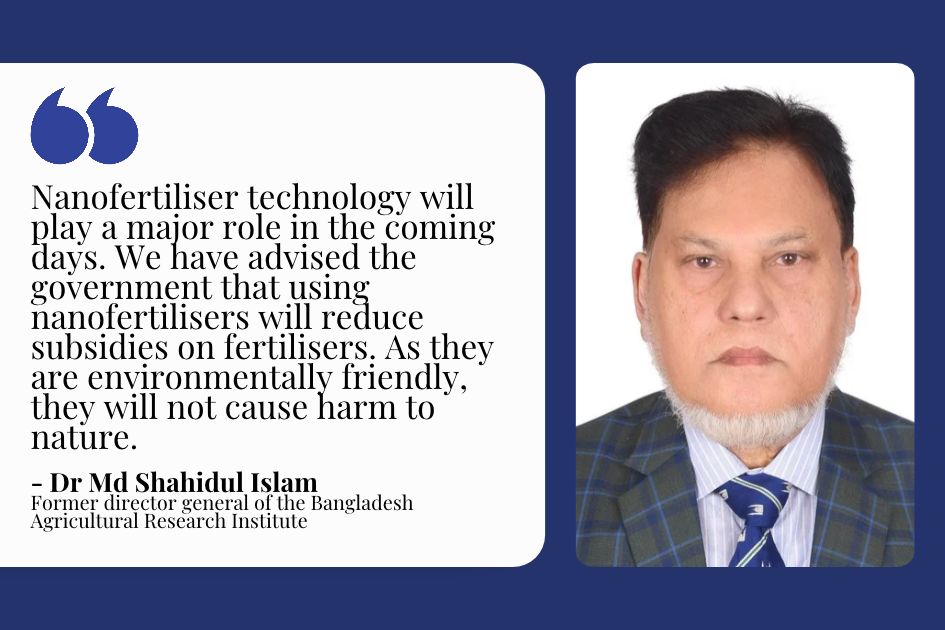
Dr Md Shahidul Islam, former director general of the Bangladesh Agricultural Research Institute, said China’s technology could be the most suitable and effective means of developing and improving Bangladesh’s agriculture, fisheries, livestock and horticulture sectors. I have been to China 40 to 50 times for seminars, symposiums and field demonstrations. Their technologies will enrich our agricultural sector. He said coordinated training and field visits involving scientists, producers, businesspeople and journalists from the two countries would open up new opportunities in the agricultural sector.
Regarding exports, he said, almost everything we have is in deficit. There are opportunities to export some products. However, ginger and garlic are imported from China. Many types and varieties of seeds, from hybrid rice to others, are imported from China. I myself have supplied seeds to many large companies.
He said urea is imported from China. Nano-fertiliser technology will play a major role in the coming days. We have advised the government that using nano-fertilisers will reduce subsidies on fertilisers. As they are environmentally friendly, they will not cause harm to nature. This is very appropriate for us. In the case of pesticides, most of the active ingredients are imported from China. Agricultural journalists should be invited to China. This would make the differences in agricultural production between the two countries apparent. It would change the way reports are produced. He said people in China eat very nutritious and high-quality food. As a result, they are able to work very hard.
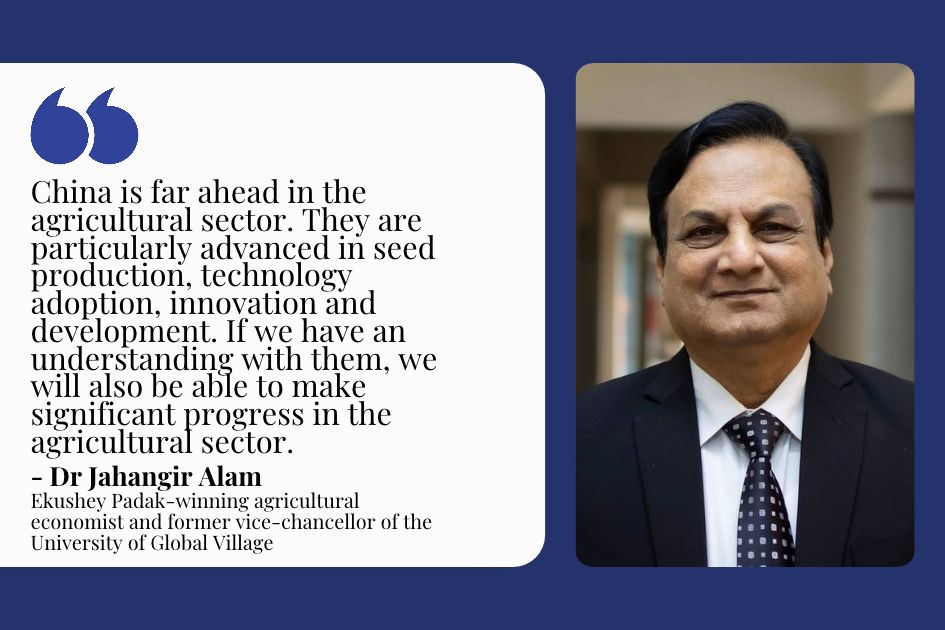
Dr Jahangir Alam, Ekushey Padak-winning agricultural economist and former vice-chancellor of the University of Global Village, said China is far ahead in the agricultural sector. They are particularly advanced in seed production, technology adoption, innovation and development. If we have an understanding with them, we will also be able to make significant progress in the agricultural sector. In particular, we can develop the seed sector by using their technology. Rice planting, harvesting, threshing and winnowing all use Chinese technology. Deep tube wells and shallow machines in irrigation systems depend on Chinese technology. We can establish joint venture companies with their cooperation. This will reduce production costs.
If we can establish pesticide factories, costs will also decrease in that sector. The government is adopting a policy to reduce imports. In this regard, pesticide companies should be established with China’s cooperation. If there is understanding and cooperation with China in this area, the agricultural sector will advance further. It will also help in adopting new technologies. Jute sticks and leather are exported to China to earn foreign exchange. If we can diversify our exports, we will be able to capture the Chinese market.




