

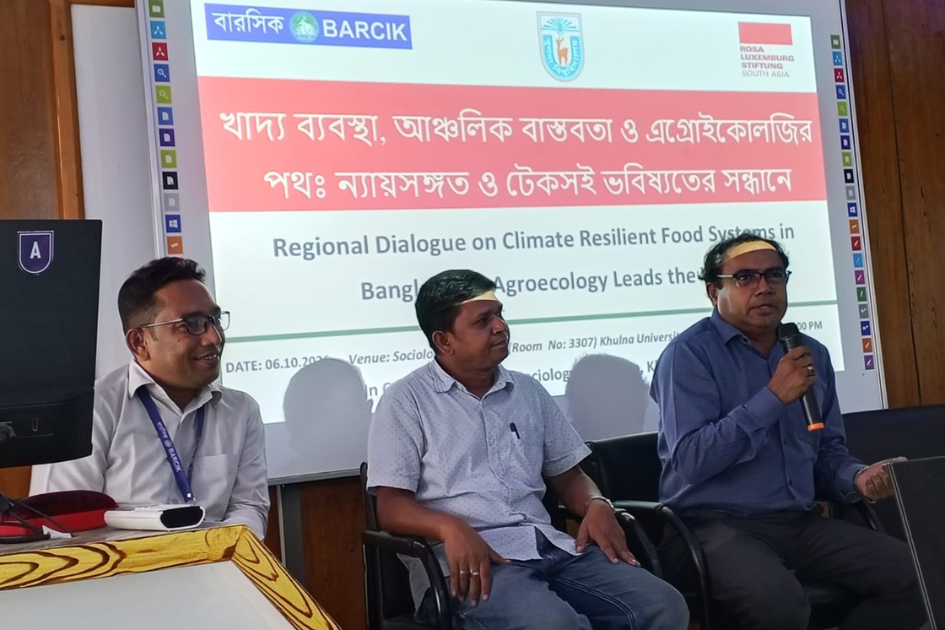



Participants highlighted women’s unpaid agricultural labour, persistent wage gaps and the need to integrate local knowledge with modern approaches to strengthen food systems.
Teachers, students and other participants at a dialogue at Khulna University in southwestern Bangladesh have called for greater agroecology practices, recognition of women as farmers, an end to wage discrimination against female agricultural workers and the inclusion of agroecology in national policy to build a climate-resilient food system.
The calls came at a regional dialogue titled “Climate-resilient food systems in Bangladesh: Agroecology shows the way” held at 2 pm on Tuesday, October 6, at the laboratory of the university’s Sociology Discipline. The event was chaired by Professor Dr Abdullah Abu Sayeed Khan, chairman of the Sociology Discipline, while Md Shaheen Islam, coastal regional coordinator of the Bangladesh-based development organisation BARSIK, delivered the keynote presentation.
After the presentation, teachers, students and other participants took part in an open discussion.
Professor Tanvir Hossain of the Sociology Discipline said that alongside teaching at the university, faculty members were involved in various research projects.
He said six of the 86 pages of his PhD research dealt with the lives and realities of people dependent on the Sundarbans in Shyamnagar, where BARSIK works.
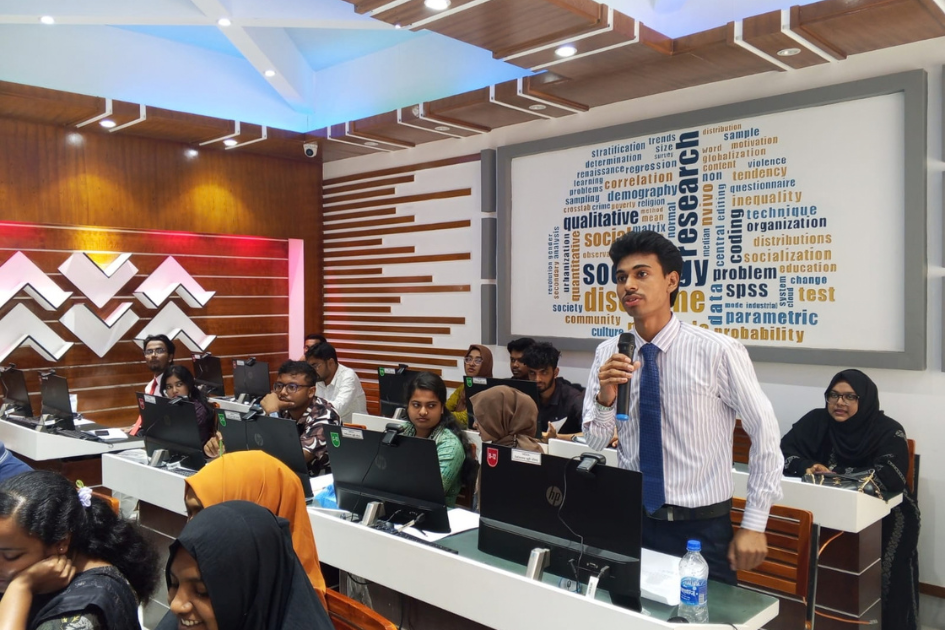
He also said that the Sundarbans remains closed for about five months each year, creating a major livelihood crisis for forest-dependent people. The limited assistance provided by the government during this period is far below their needs, he said.
Although demands and recommendations emerging from communities have been incorporated into research, there remain many questions over the extent to which they are reflected in government policymaking, he added.
Naushin Nowar Promi, a student of the Sociology Discipline, said women perform a huge amount of work in their families on a daily basis without receiving any wages for it.
She said expanding agroecology practices could increase women’s workload in areas including water collection, farming and seed preservation. Coordinated initiatives are therefore needed to make women’s areas of work more flexible and supportive, she said.
She added that government institutions, non-governmental organisations and public universities should play their respective roles in this regard.
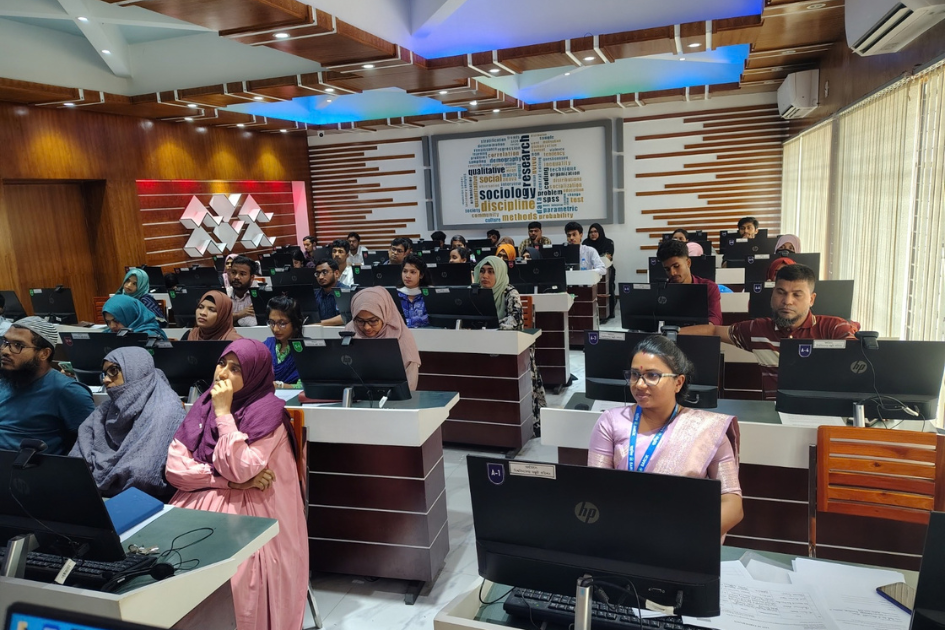
Professor Dr Mosammat Rowshan Ara said wage discrimination against female workers still exists in Bangladesh.
When people think of farmers, she said, they generally think of men, even though women have made important contributions to agriculture since its beginnings.
Women have also played a key role in the development of seed preservation and management alongside agriculture, she said.
She said food consumed by people should not be harmful to their health. Agroecology can provide an important pathway to ensuring safe and healthy food, she said, adding that agroecology should therefore be incorporated into the government’s existing policies.
Everyone should collectively raise their voices on the issue, she said.
During the discussion, Professor Dr Tuhin Ray said the extensive use of technology in agriculture around the middle of the 20th century created various crises in agriculture and food systems. The excessive use of chemical pesticides later increased those risks further, he said.
As a result, the food system is becoming increasingly vulnerable, he said.
“There is no alternative to agroecology” to overcome the situation, he said, adding that it could create a pathway towards sustainable agriculture, safe food and food sovereignty.
Professor Dr Selina Ahmed, Professor Mosammat Rowshan Ara, Professor Tanvir Hossain and Dr Tuhin Ray of the Sociology Discipline, along with other teachers, PhD researchers, master’s students, students from different batches and departmental officials, took part in the dialogue.
The discussion covered the impacts of climate change, resilience of food systems, recognition of farmers, valuation of women’s labour, elimination of wage discrimination against female workers, safe food and the need to include agroecology in national agricultural policies and plans.
In his closing remarks, Professor Dr Abdullah Abu Sayeed Khan, head of the Sociology Discipline, expressed gratitude to BARSIK for organising the initiative.




