

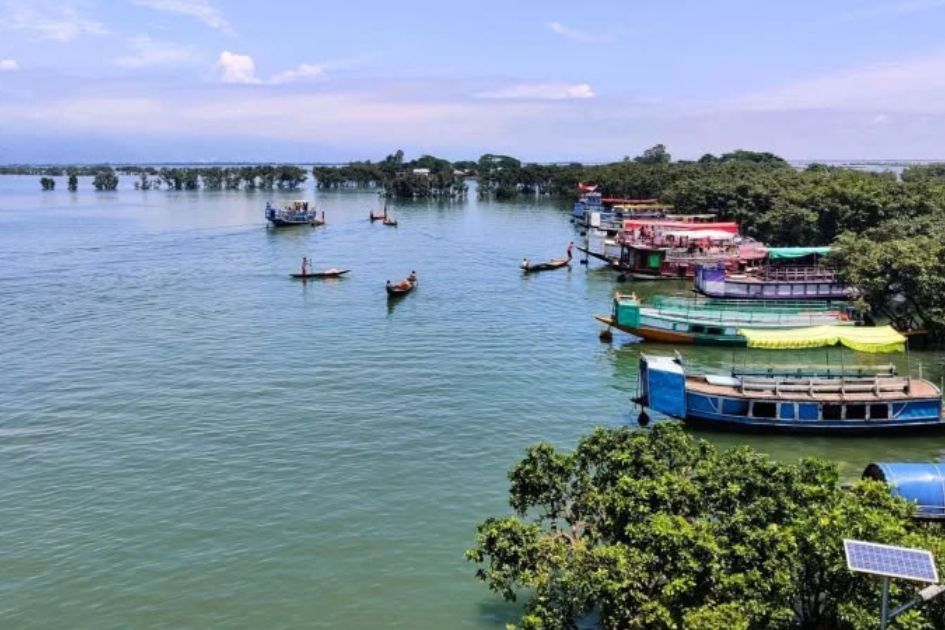



New environmental regulations require tourist boats to register, improve safety and waste management, and follow stricter operating standards as authorities seek to balance wetland conservation with local tourism-dependent livelihoods.
Bangladesh authorities have restricted tourist boat movement in the ecologically critical zone of Tanguar Haor in Sunamganj to protect the fragile wetland ecosystem from increasing pollution, unregulated tourism activities and threats to biodiversity.
The restriction, issued by the Sunamganj district administration, applies only to the protected Ecologically Critical Area (ECA) of the haor. Tourist boats and houseboats can continue operating in other designated areas, including routes up to the Watch Tower, Matian Haor and the Boulai River towards Tekerganj.
Officials said the decision was taken after growing concerns over waste pollution, uncontrolled movement of engine-powered boats and increasing pressure on the wetland’s natural resources.
“This does not mean tourism in Tanguar Haor has been stopped. Only boat movement in the ECA area has been restricted to protect the environment and biodiversity,” said Sunamganj Additional Deputy Commissioner Mohammad Matiur Rahman Khan.
Located in northeastern Bangladesh near the foothills of India’s Meghalaya, Tanguar Haor is one of the country’s most important freshwater wetlands. The area is recognised internationally for its rich biodiversity, including migratory birds, fish and aquatic species, while also supporting the livelihoods of thousands of local residents.
The wetland was declared an Ecologically Critical Area in 1999 due to growing threats from overfishing, habitat degradation, deforestation and pollution. Conservationists say protecting such wetlands is increasingly important as they help communities adapt to climate impacts by storing water, reducing flood risks and supporting local ecosystems.
Stricter rules for tourist boats
The latest restriction follows the Bangladesh government’s “Tanguar Haor and Hakaluki Haor Protection Order, 2025”, introduced to strengthen conservation efforts in two of the country’s important wetland areas.
Under a public notice issued by Sunamganj Deputy Commissioner Mohammad Minhajur Rahman, who chairs the Haor Protection Implementation and Monitoring Committee, all tourist boats operating in Tanguar Haor must be registered with the district administration.
Houseboats and passenger boats have been instructed to apply for registration by 10 August to continue their operations.
The new guidelines require operators to ensure both environmental protection and tourist safety. The measures include:
- Carrying sufficient life jackets, life buoy rings and fire extinguishers on every boat
- Ensuring the safe use and management of gas cylinders
- Installing water purification systems and septic tanks where required
- Keeping at least two dustbins on each boat
- Maintaining proper waste collection and disposal systems
- Avoiding single-use plastic items
- Preventing loud music, microphones and activities that disturb the natural environment
Boat operators must also display emergency contact numbers for the police, fire service, local administration and hospitals. Tourists must be informed about responsible travel practices before beginning their journeys.
Authorities warned that violations of the directives could result in legal action, including fines and imprisonment.
Tourism growth raises environmental concerns
Officials said tourism in Tanguar Haor has expanded rapidly in recent years, creating both economic opportunities and environmental challenges.
“Tourist arrivals have increased significantly and pollution has also risen, creating additional risks for biodiversity,” said Saiful Islam, an inspector at the Department of Environment in Sunamganj.
Environmental experts say uncontrolled tourism can damage wetlands through plastic waste, untreated sewage, noise pollution and disturbance to wildlife.
Previous conservation measures faced challenges due to limited monitoring capacity and non-compliance by some boat operators. The district administration said it will now strengthen surveillance to ensure the new rules are followed.
Boat operators support move, seek waste management facilities
Tourist boat owners have welcomed the conservation initiative but called for better infrastructure to help them comply with environmental requirements.
Mohammad Tajirul Islam, a leader of the Houseboat Owners Association Bangladesh, said many operators had already stopped taking tourists beyond the Watch Tower area.
“We have been following the restrictions since last year, so the new decision will not create major difficulties for responsible operators,” he said.
The association said more than 100 tourist boats currently operate in Tanguar Haor and many already provide drinking water facilities, dustbins and safety equipment.
However, operators said waste disposal, especially human waste management, remains a major challenge.
“We have arrangements on the boats, but we need a designated facility outside the haor where waste can be safely disposed of,” said Dip Banik, an executive committee member of the association.
District officials said they are working to secure land for waste management facilities and hope to address the issue in the coming months.
Balancing conservation and livelihoods
Local tourism workers and communities depend on Tanguar Haor for income, making sustainable management important for both environmental protection and economic stability.
Authorities said the objective of the restriction is not to stop tourism but to ensure responsible tourism that protects the wetland for future generations.
The administration said it will continue monitoring boat operations, enforcing registration requirements and developing waste management solutions to maintain a balance between conservation, tourism and local livelihoods.




