

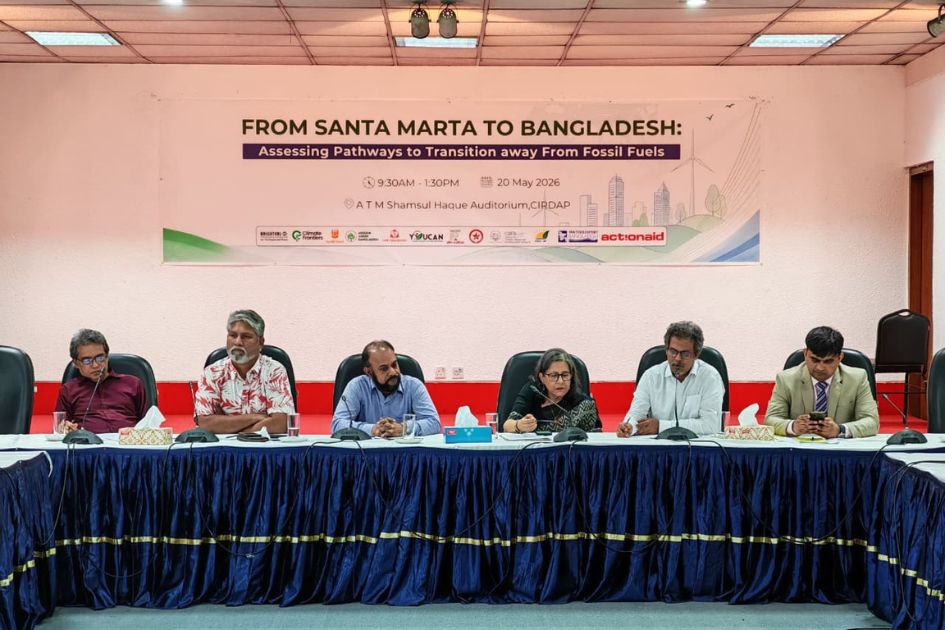

Climate experts and activists in Dhaka urged Bangladesh to accelerate a just energy transition through renewable investment, policy reforms, climate finance and stronger public participation ahead of COP31.
Bangladesh must accelerate a fair and sustainable transition away from fossil fuels through stronger policy support, renewable energy investment and active public participation, speakers said at a climate dialogue held in Dhaka on Tuesday.
The discussion, titled “From Santa Marta to Bangladesh: Assessing Pathways to Transitioning away From Fossil Fuels”, brought together climate experts, government officials, activists, researchers and youth leaders to examine pathways for a just energy transition in Bangladesh.
The event was jointly organised at the ATM Shamsul Haq Auditorium of CIRDAP in the capital by Waterkeepers Bangladesh, Brighters, Climate Frontier, Kathpencil, Mission Green Bangladesh, OAB Foundation, UCAN, Breaking the Silence, Bangladesh Krishok Federation, the Center for Climate Change and Environmental Research (C3ER) of BRAC University, Just Energy Transition Network Bangladesh and ActionAid Bangladesh.
At the opening session, Kathpencil co-founder Farzana Faruk Jhumu and Brighters Society chair Fariha S. Omi presented key outcomes and experiences from the global fossil fuel transition summit held in Santa Marta, Colombia, in April this year.
The programme was chaired by ActionAid Bangladesh Country Director Farah Kabir. Environment Department Additional Director General Md Ziaul Haque attended as chief guest, while special guests included Waterkeepers Bangladesh coordinator Sharif Jamil, Institute for Energy Economics and Financial Analysis (IEEFA) Bangladesh lead analyst Shafiqul Alam and Bangladesh Krishok Federation president Badrul Alam among other distinguished participants.
Speaking at the event, Md Ziaul Haque said Bangladesh’s participation in the Santa Marta summit reflected the country’s progressive position in the global effort to move away from fossil fuels.
He stressed the need for proper incentives in the upcoming national budget, effective implementation of net metering systems and increased private sector investment to support the transition. He also said unified youth movements and active civil society engagement could positively influence government policy implementation and accelerate the country’s transition toward clean energy.
Farah Kabir said the climate crisis and fossil fuel dependence were interconnected global challenges that required coordinated and justice-based responses. She said a just transition should not be viewed solely as a technological shift but as a broader process requiring the removal of institutional, financial, legal, political and social barriers.
She also highlighted the importance of ensuring participation by women, youth, workers and local communities, alongside gender-responsive planning and adequate climate financing.
Sharif Jamil described the Santa Marta summit as a significant international initiative that could complement the limitations of the COP process. He said developing countries needed sufficient climate financing, technology transfer and protections for workers and vulnerable communities to ensure a fair transition away from fossil fuels.
Jamil noted that Bangladesh was still expanding coal-based power generation, making the country’s active engagement in global discussions on fossil fuel transition increasingly important. He also called for coordinated participation by government institutions, researchers, civil society and youth groups to build a meaningful and effective energy transition movement.
He further urged the government to withdraw all taxes and duties imposed on equipment and machinery used in solar power generation to make renewable energy more affordable and accessible for ordinary people.
IEEFA Bangladesh lead analyst Shafiqul Alam said Bangladesh’s dependence on imported fossil fuels was increasing subsidy pressure and widening fiscal deficits, leaving the country’s energy sector economically vulnerable.
He said redirecting the large annual subsidies currently spent on the power and energy sector toward renewable energy investment would strengthen the national economy and improve electricity access and production systems in rural areas.
Bangladesh Krishok Federation president Badrul Alam said the Santa Marta summit represented an important and growing international process for a just transition away from fossil fuels. Speaking on behalf of farmers, he called for a shift from chemical fertiliser and pesticide-dependent agriculture toward agroecological and environmentally friendly farming practices.
Sadia Jahan Rothy of the Center for Climate Change and Environmental Research at BRAC University said the Santa Marta summit marked a shift from climate commitments toward realistic pathways for phasing out fossil fuels.
She said Bangladesh’s transition would need support through climate financing, technology transfer and stronger international cooperation.
Speakers at the event said the global fossil fuel transition summit in Santa Marta had become an important milestone in the worldwide push for energy transformation.
For climate-vulnerable countries like Bangladesh, they said, it was now urgent to increase investment in renewable energy, adopt fair and practical policies and implement sustainable energy strategies.
They warned that fossil fuel-dependent development was having long-term negative impacts on agriculture, public health, the environment and coastal communities.
The speakers also emphasised the need to ensure participation by youth groups, researchers, civil society and affected communities in shaping Bangladesh’s renewable energy transition ahead of COP31.
The event was moderated by Md Abul Kalam Azad, manager of ActionAid Bangladesh’s Just Energy Transition team and member secretary of JETNET-BD. Climate Frontier Operations Lead Zubayer Islam delivered the welcome speech at the beginning of the programme.
Representatives from youth organisations, climate activists, researchers, farmer groups and civil society organisations attended the discussion.




