

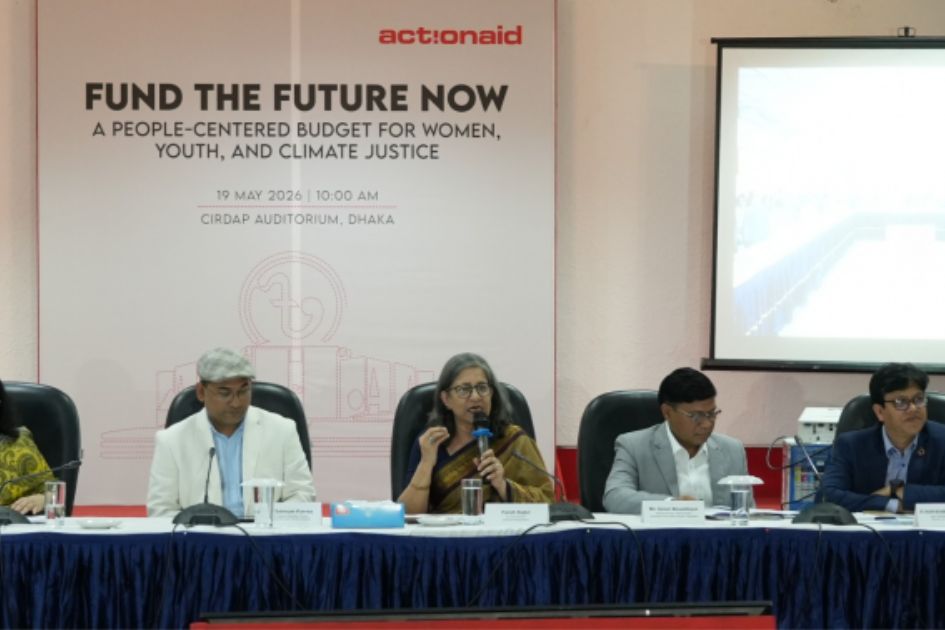

Economists and policymakers urged Bangladesh to prioritise women, youth employment and climate resilience in the 2026-27 budget amid inflation, inequality and growing climate risks facing vulnerable communities.
Bangladesh should adopt a people-focused national budget that prioritises women, youth employment and climate protection as the country prepares to unveil its first budget for the 2026-27 fiscal year under the new government, economists, researchers and policymakers said at a discussion in Dhaka on Tuesday.
The upcoming budget is expected to serve as the government’s first major step toward implementing its election pledges on inclusive growth, job creation, youth skills development, gender equality and climate resilience.
Speakers at the event warned that mounting global and domestic economic pressures, persistent inflation and worsening climate risks are leaving marginalised communities increasingly vulnerable, particularly women, young people and climate-affected populations.
The discussion, titled “Now is the Time to Invest in the Future: A People-Centred Budget for Women, Youth and Climate Protection”, was organised by ActionAid Bangladesh at the CIRDAP auditorium in the capital.
Participants including leading economists, climate experts, academics, government officials and representatives from grassroots communities across the country stressed the need for a forward-looking macroeconomic framework that balances policy ambitions with realities on the ground.
ActionAid Bangladesh presented a data-driven review of the last five national budgets from fiscal years 2021-22 to 2025-26, showing that while the overall size of the budget has steadily increased, allocations for sectors linked to sustainable development such as education, health and gender programmes have remained stagnant or declined relative to need.
The organisation also highlighted concerns over the quality of budget implementation and the lack of stronger results-based initiatives.
According to the analysis, education spending declined from 2.08 percent of GDP five years ago to 1.72 percent in the current fiscal year.
Although gender budgeting has been institutionalised across 44 ministries, the report said there remains significant room to expand social protection and public services for women at the grassroots level. Gender-related budget allocations have fallen from 5.7 percent of GDP to 4.2 percent over the same period.
The report added that reduced funding for services directly linked to women’s safety and public support programmes has weakened institutional capacity to prevent violence and provide legal assistance at the local level.
Climate financing was also identified as a major concern. Despite Bangladesh being among the countries most vulnerable to climate change, only 2.89 percent of the Annual Development Programme (ADP) has been allocated to renewable energy projects.
Speakers said substantial funding gaps remain in implementing the National Adaptation Plan (NAP) and Nationally Determined Contributions (NDC), both from domestic and international sources.
Prime Minister’s Special Assistant on Forests, Environment and Climate Change Dr Saimum Parvez said policymaking in Bangladesh is becoming increasingly “people-centred”.
“Compared to the past, public participation in policy formulation and implementation has increased significantly,” he said.
He added that the government’s election commitments on climate and development were now visibly taking shape through policy implementation.
“Climate financing, debt management, international funding and inter-ministerial coordination are now receiving the highest priority,” he said.
Planning Division Additional Secretary Golam Mosaddek supported the idea of incentives for green initiatives and said the government’s primary focus was creating jobs and reducing income inequality.
He said climate justice considerations had already been integrated into 15 sectors and a fully digital real-time dashboard had been introduced to improve transparency.
Dhaka University sociology professor Samina Luthfa said increasing budget allocations alone would not ensure development.
“If young people cannot access education, skills training and employment opportunities, the benefits of development will not reach them,” she said.
She also expressed concern over the declining trend in gender budgeting, warning that it could undermine women’s access to education and healthcare.
To break the “glass ceiling”, she proposed bold reforms including state financial support for female candidates’ election expenses.
Youth and Sports Ministry Joint Secretary Dr Sheikh Mohammad Jobayed Hossain said the youth development budget was now operating as a year-round programme.
He said young entrepreneurs were being offered SME loans of up to 500,000 taka along with special allocations for outsourcing initiatives, while emphasising the need for a more participatory budgeting process.
Economist and Dhaka University professor Dr Sayma Haque Bidisha said gender budgeting should not be viewed as a separate allocation exclusively for women, but rather as an integrated framework involving all ministries.
She noted that a large share of allocations is often absorbed at the administrative level and called for recognition of unpaid labour, safer public transport and expansion of employment opportunities beyond the ready-made garments sector.




