

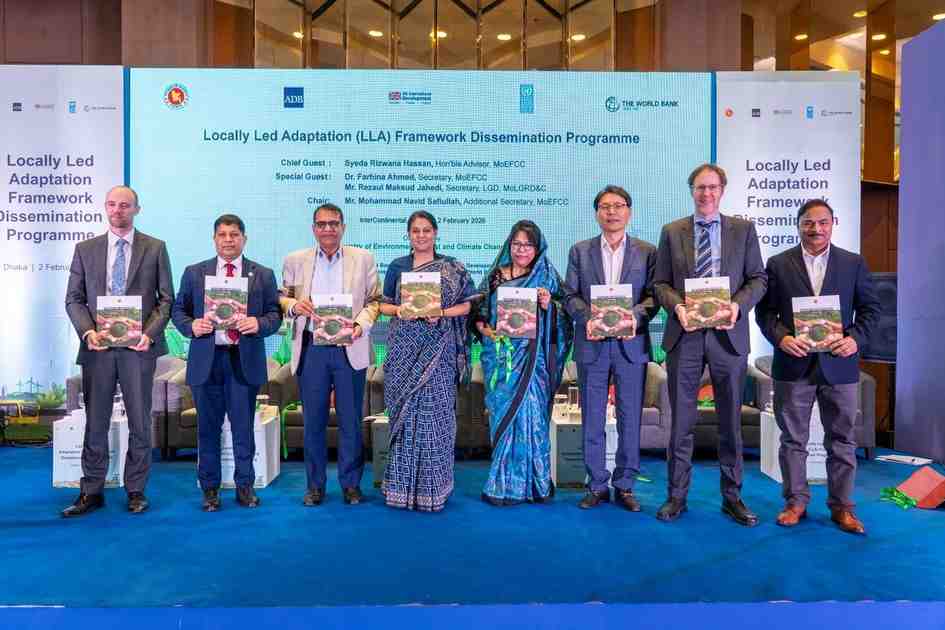



Bangladesh has unveiled a pioneering locally led adaptation framework, aligning national climate plans with community priorities to strengthen resilience, improve coordination, and mobilise climate finance for vulnerable people nationwide efforts.
Bangladesh has taken a groundbreaking step in global climate action by launching a national framework for adaptation rooted in locally led adaptation (LLA) principles, marking a major milestone in strengthening climate resilience through community-driven solutions.
The Ministry of Environment, Forest and Climate Change (MoEFCC) officially disseminated the National Framework and Action Plan for Locally Led Adaptation on February 2, making Bangladesh one of the first countries in the world to adopt a nationwide policy framework dedicated to locally driven climate adaptation. The framework is designed to turn national climate commitments into practical, locally tailored solutions that respond to community priorities.
Speaking at the dissemination programme, Syeda Rizwana Hasan, Adviser to the Ministries of Water Resources and Environment, Forest and Climate Change, said, “This framework connects policy with action. It ensures that plans are translated into real adaptation measures implemented by ministries and local government institutions on the ground.”
Experts note that this marks a crucial step toward raising awareness, identifying implementation opportunities and mobilising investments in line with locally led adaptation principles. By emphasising community participation, the framework ensures adaptation strategies are context-specific, inclusive and resilient.
Bangladesh, one of the world’s most climate-vulnerable countries, has increasingly prioritised adaptation strategies as climate change threatens livelihoods, ecosystems and national development gains. The new framework is expected to improve coordination among stakeholders and strengthen the country’s capacity to respond to climate challenges from the grassroots to the national level.
Officials say the framework aligns with Bangladesh’s National Adaptation Plan (NAP) 2023–2050, which envisions a climate-resilient nation by empowering communities, strengthening ecosystems and promoting sustainable economic growth. The plan identifies 113 locally relevant interventions that allow communities to implement solutions based on their priorities while linking local actions with national climate strategies. Examples include community-based flood management projects, climate-resilient farming for smallholder farmers and initiatives supporting women entrepreneurs and urban poor communities.
MoEFCC Secretary Dr Farhina Ahmad highlighted the need for efficient climate financing, noting that resources are limited and highly competitive globally. She explained that the framework would help ensure coordinated use of climate funds to maximise adaptation outcomes and suggested that the Bangladesh Climate Development Partnership could serve as a platform for effective implementation.
Rezaul Maqsood Jahedi, Secretary of the Local Government Division, emphasised that while the framework provides a strong foundation, translating it into tangible results requires collective commitment from government institutions, civil society and development partners.
ADB Country Director Hoe Yun Jeong called the framework a significant step toward integrating adaptation into national systems while keeping solutions grounded in local realities. He added that ADB would support efforts to strengthen financial mechanisms to channel climate funding to vulnerable households, smallholder farmers, women entrepreneurs and the urban poor.
UNDP Resident Representative Stefan Liller noted that UNDP would provide technical support for the framework’s development and implementation. He said it would guide the scaling up of locally led adaptation initiatives nationwide, particularly under the second phase of the Local Government Initiative on Climate Change (LoGIC).
The framework, approved by Bangladesh’s Cabinet in May 2025, was developed through extensive consultations at national and local levels, reflecting community priorities and local knowledge in adaptation planning.
Developed with support from the Asian Development Bank, the World Bank, UNDP and the UK’s Foreign, Commonwealth and Development Office, the initiative aims to turn Bangladesh’s climate commitments into practical, locally driven adaptation measures. By focusing on inclusive community participation, efficient use of climate finance and strong partnerships, the framework sets an example for other climate-vulnerable countries seeking to empower communities to lead adaptation efforts.




