

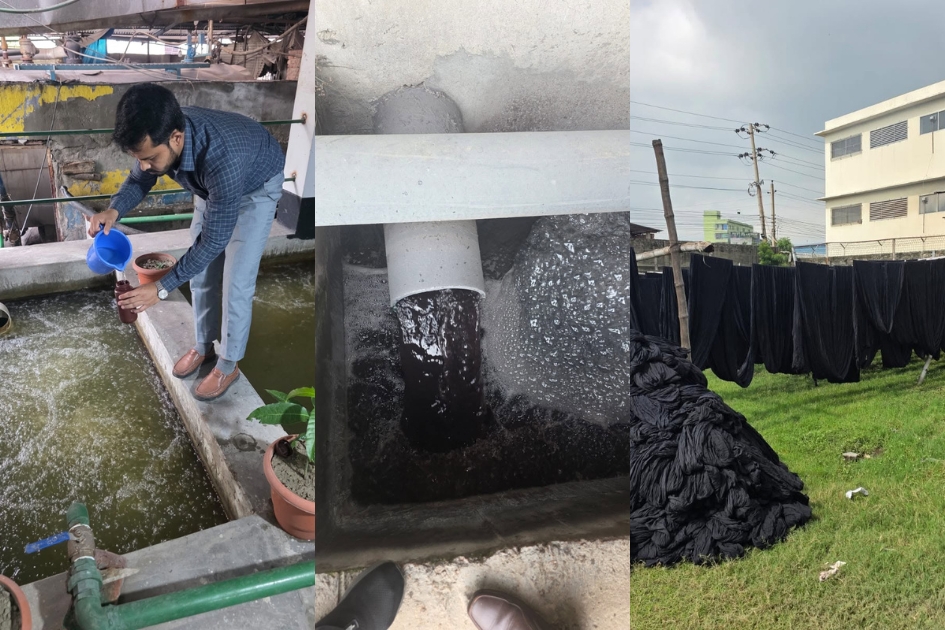



Laboratory tests will determine whether legal action follows, while two South Keraniganj washing factories were found operating without environmental clearance or effluent treatment plants.
Bangladesh’s Department of Environment inspected eight factories in Narayanganj and South Keraniganj on Tuesday and collected liquid waste samples as part of efforts to prevent river pollution and protect the environment.
The inspections were carried out as part of efforts to implement Prime Minister’s instructions to keep waterways around Dhaka operational, according to a press release from the Ministry of Environment, Forest and Climate Change.
The department’s Dhaka regional office inspected six industrial establishments in the Fatullah, Namapara, Sastapur and Kutubpur areas of Narayanganj district on Aug 4.
The factories were Eurotex Knitwear Limited, Karnaphuli Textile Mill, Dhaka Textile Mills, M M Dyeing, Messrs Shaheen Textile Mill and I F S Texwear.
Officials collected samples of liquid waste discharged by the factories during the inspections. The samples will be sent to the Department of Environment’s laboratory for testing.
If the tests find evidence of pollution, necessary legal action will be taken against the establishments concerned in accordance with environmental conservation laws and regulations, the ministry said.
Separately, an inspection team from the department’s Dhaka district office, which operates under its Dhaka regional office, inspected two factories, Azan Washing and Al Amin Washing, in South Keraniganj.
The inspection found that the two factories had been conducting washing operations without obtaining environmental clearance or installing effluent treatment plants, or ETPs.
Liquid waste samples were collected from both factories.
Other washing factories in the same area were found closed when officials went to inspect them.
The Department of Environment said inspections, monitoring and legal action would continue regularly to prevent pollution of rivers and water bodies, protect the environment and safeguard public health.




