

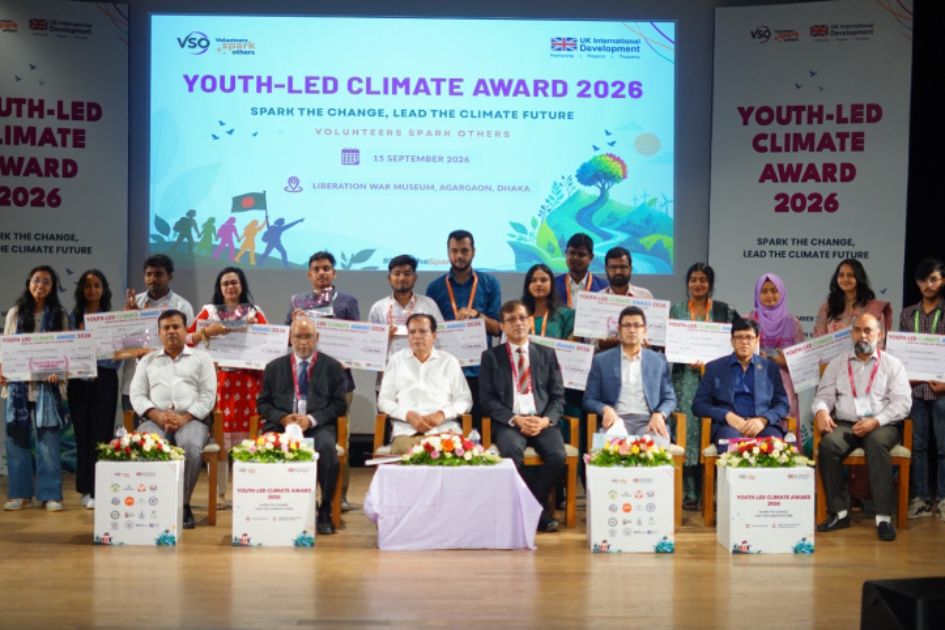



Ten youth organisations are being backed to turn community knowledge into practical climate solutions, highlighting the role of locally led action in Bangladesh.
In the salt-scarred villages of Khulna, safe drinking water has become a daily challenge. Several hundred kilometres north, in Dinajpur, longer and hotter dry seasons are putting pressure on farming households. In the haor basin of Sunamganj, where seasonal wetlands flood each monsoon and drain into farmland each winter, farmers face the opposite threat: water arriving too fast and too early.
Three regions, three climate realities and one response increasingly shaped by the same force: young people who live with these risks themselves.
Ten youth organisations from across the country were recognised with the Youth-Led Climate Action Award 2026 for precisely that work at a ceremony held at the Liberation War Museum in Dhaka’s Agargaon area on September 15. Their projects span safe drinking water, household resilience, climate-smart livelihoods, environmental education and the protection of rivers and wetlands.
VSO Bangladesh organised the award. Disaster Management and Relief Minister Asadul Habib Dulu attended as chief guest.
Each winning organisation will receive a grant of Tk 150,000, along with technical support to carry out its proposed initiative. This year’s theme was “Spark the Change, Lead the Climate Future.”
Many hazards, no single formula
Bangladesh is a densely populated, low-lying delta, home to more than 170 million people and exposed to cyclones, floods, drought, heat and sea-level rise. But those hazards do not affect every community in the same way.
In the southwest, cyclones, storm surges, riverbank erosion and creeping salinity are reshaping settlements, farmland, freshwater sources and livelihoods. In the north, heatwaves, drought and erratic rainfall are squeezing farming communities. In the haors, a few days of heavy rain upstream can destroy a crop, damage fisheries and cut off transport.
That variation makes adaptation a local task. Rainwater storage may be the priority in one union, while changing production practices matters more in another and protecting natural waterways matters most in a third.
The climate challenge is national. The response usually has to begin locally.
On the coast, the fight is over water
For coastal families, climate change is not a distant forecast. It already shapes decisions about farming, housing and drinking water.
Salinity intrusion reduces agricultural productivity and puts increasing pressure on freshwater sources. Cyclones and storm surges damage homes and infrastructure. Erosion and repeated disasters can push families away from places their families have occupied for generations.
In Khulna, the organisation APOS has been drawing young people into that challenge since 2017 through climate camps, tree plantation, renewable energy awareness, disaster preparedness and conservation work, with water security and coastal livelihoods at the centre.
“This award is not only recognition for us. It is also recognition of youth-led climate action at the local level,” said APOS founder Redwanul Ruhan, adding that the recognition would encourage young people to design more effective and sustainable initiatives.
Organisation Director Nazmus Sakib said the group would continue working with climate-vulnerable communities while bringing more young people into leadership roles.
The coastal experience also shows why adaptation and loss and damage cannot be treated as separate agendas. Communities can prepare for disasters and improve water security and still lose homes, land and income as climate pressures intensify.
In the north, resilience begins at the root
The picture changes in the Barind tract and surrounding districts, where heat, drought and water shortages are putting pressure on household food security and rural livelihoods.
In Dinajpur, the Muktachinta Youth Service Association, founded only in 2023, won for its initiative “Resilience from the Roots”, built around household nutrition gardens, rainwater harvesting and organic fertiliser.
The interventions are deliberately small. Their value lies in strengthening a household before a climate shock becomes a crisis.
“We cannot look at local people only as recipients of assistance. Their knowledge and experience must also be part of the solution,” said the organisation’s president, Zilhozz Sarker.
General Secretary Laboni Debnath said the group also works with Santal communities on environmental and climate education. Its activities include “Mushcycle”, a mushroom-based livelihood project designed to create local income while easing pressure on the environment.
These initiatives show how adaptation can also strengthen livelihoods. New skills, diversified income and locally designed solutions can help households respond to changing conditions while reducing their dependence on a single source of income.
For communities facing repeated climate pressures, resilience is not simply about surviving the next disaster. It is also about having more secure ways to live through a changing climate.
In the haors, water gives and water takes
In the haor wetlands, water underwrites everything: agriculture, fishing, transport and the local economy. Then flash floods arrive, and the same water can become a destructive force for the people who depend on it.
That is why haor adaptation cannot rest on embankments alone. The health of rivers and wetlands is tied directly to crops, fisheries, biodiversity and household income.
In Sunamganj, the Environment and Haor Development Organisation works on crop protection, maintaining natural river flows, conserving fish and aquatic life, and improving wetland management, including at Tanguar Haor, a Ramsar-listed wetland of international importance.
“When the natural flow of rivers and wetlands is maintained, agriculture, fishing and local livelihoods also benefit,” said its president, Kasmir Reza. The organisation is also working to protect the rights and improve the quality of life of haor communities, he said.
For those living around the wetlands, these ecosystems are not simply environmental assets. They are food, income, transport and community life.
Ten organisations, ten entry points
The same locally led approach is taking different forms across the country.
Purnima Organisation of Khulna and Agragami of Barguna focus on youth climate leadership, environmental awareness and local risk. In Cox’s Bazar, We Can is mobilising communities in Pokkhali Union, while Jagoroni Youth Development Association works on youth leadership and environmental action.
Protigga Youth Organisation of Mymensingh brings gender into its environmental work. In Dhaka, the Youth Environment Development Organisation engages young people in climate advocacy. Palli Ekota Unnayan Sangstha of Pabna works around the needs of local communities and their environment.
Together, the ten awardees reflect a wide range of entry points into climate action: water, agriculture, food security, wetlands, environmental education, community participation, advocacy and leadership.
The range reflects a straightforward reality: Bangladesh does not have one climate problem, and it will not be served by one solution.
The local test of a global promise
The 1.5°C target is negotiated in conference halls. It is tested in villages.
It is tested in whether a coastal family can secure safe drinking water, whether a farmer can keep producing through drought, whether a haor household can protect its crop and whether a family that loses its home, livelihood or assets can recover.
For communities already living with climate impacts, climate finance is not a headline figure. It is a tubewell, a rainwater tank, a resilient livelihood, a stronger house, skills for a changing economy or support after a loss that adaptation could not prevent.
The award offers a modest but practical example. For small youth-led organisations, Tk 150,000 and technical assistance can provide the initial resources needed to turn a locally identified problem into a working community solution.
The wider flow of funding, however, remains limited compared with the scale of youth-led climate action. Youth-led climate initiatives received just 0.96 percent of total grant funding from the world’s major climate foundations between 2022 and 2024, according to the Youth Climate Funding Study by the Youth Climate Justice Fund and ClimateWorks Foundation.
That gap matters because locally led action depends not only on ideas and commitment, but on whether young organisations have the resources to sustain their work.
Recognition cannot substitute for resourcing. Youth organisations need flexible, long-term finance, meaningful participation in policymaking and decision-making and room to grow beyond short project cycles. Local knowledge needs to be valued alongside technical expertise.
VSO Bangladesh Country Director Khabirul Haque Kamal said the award was intended to highlight locally led development, youth leadership and volunteerism, while creating more opportunities for young people to participate in climate leadership and decision-making.
The ten organisations honoured this year show what becomes possible when young people are trusted to define the problems in their own communities and lead the response.
They are not only volunteers or beneficiaries. They are organisers, innovators, advocates and community leaders.
The future of climate leadership will not be shaped only at the UN Climate Summit COP. It is already taking shape in Bangladesh’s coasts, fields and haors, led by a generation that knows the risks firsthand and is choosing to act where it lives.




