

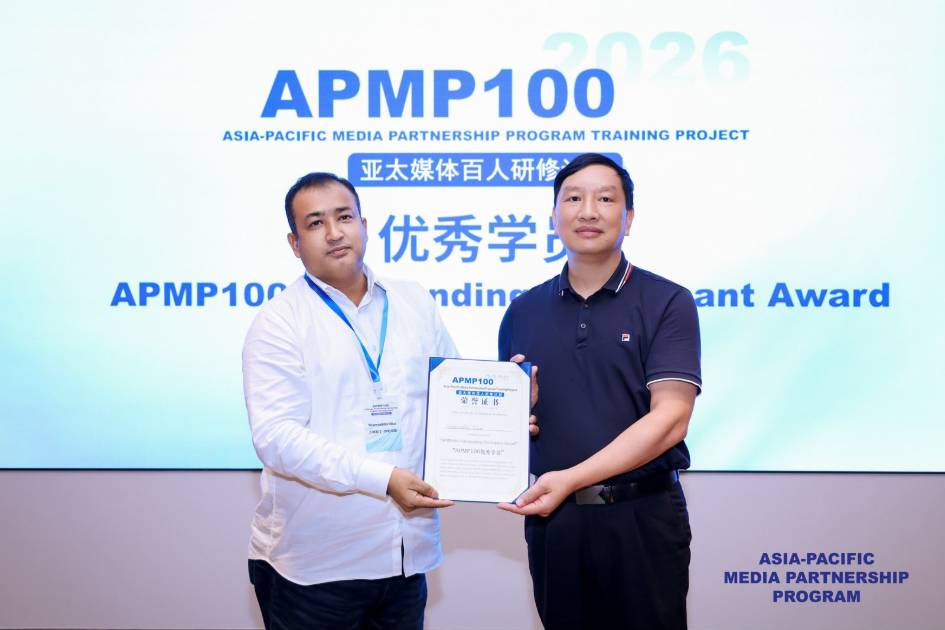



The recognition in Shenzhen adds to a career built from Chittagong around climate investigations, cross-border reporting and environmental accountability, with several of Illius’s stories followed by public protests, policy scrutiny and court action.
Bangladeshi investigative journalist Shamsuddin Illius has received the “APMP100 Outstanding Participant Award” at the 2026 Asia-Pacific Media Partnership Program Training Project in Shenzhen, China, adding another international recognition to a career focused increasingly on climate change, environment and accountability journalism.
The APMP100 Organizing Committee presented Illius with a Certificate of Honor for his “exceptional diligence, active engagement and outstanding overall performance” during Session 2 of the programme, held in Shenzhen from September 6 to 8.
The programme brought together journalists and media professionals from across the Asia-Pacific region for training, professional exchanges, field visits and discussions on journalism, technological innovation, regional cooperation and emerging development challenges.
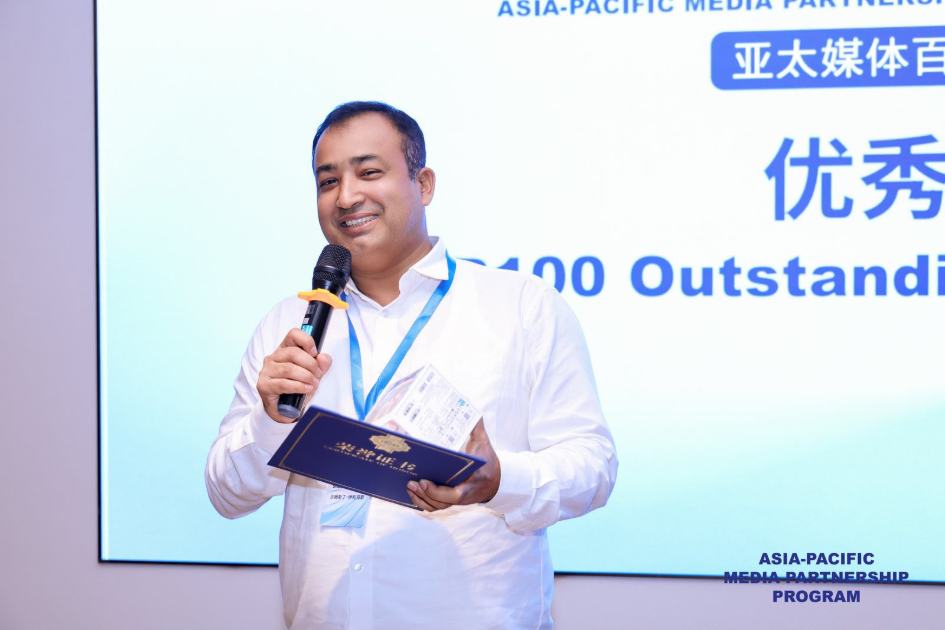
Illius said the recognition was meaningful not simply as an award but as encouragement to remain curious and continue adapting to a media landscape being reshaped by technology, climate change and new forms of storytelling.
“I see this award not simply as a certificate of achievement but as an encouragement to keep learning, exploring new ideas and telling stories with greater depth and confidence,” he said.
For Illius, one of the strengths of the programme was that learning extended beyond the classroom. Field visits exposed participants to technological innovation, sustainability, clean energy and corporate environmental practices in Shenzhen, while exchanges among journalists opened possibilities for future cross-border collaboration.
“Ideas matter, innovation matters and collaboration matters,” Illius said. “Journalists need to think boldly, question established narratives and tell their own stories boldly.”
Alongside the certificate, he received an Insta360 camera, which he said he hopes to use to experiment with immersive and visual storytelling.
A career shaped by climate, accountability and regional journalism
Illius has built much of his journalism career from Chittagong, outside Bangladesh’s Dhaka-centred national media establishment, developing a reporting portfolio spanning climate change, environment, biodiversity, business, corruption, migration, Rohingya People and institutional accountability.
He has worked as a journalist since 2010 and currently serves as Chattogram Bureau Chief of The Business Standard. He previously headed the Chittagong bureau of The Independent.
His work has also appeared through Agence France-Presse, The Third Pole, now Dialogue Earth, The Scotsman, Unbias The News, Scroll.in and other international outlets.
At The Business Standard, his reporting has ranged from UN climate negotiations and adaptation finance to forests, industrialisation, ports and ship recycling.
Shipbreaking has been a recurring strand of his reporting from the Sitakunda coast, where he has followed Bangladesh’s efforts to shift from hazardous beach-based dismantling towards safer and more environmentally compliant ship recycling. His reporting has also examined whether growing “green” certification is translating into meaningful improvements in worker safety and environmental performance.
Industrial development and its environmental costs have become another major area of focus. His reporting has examined how large-scale projects can affect forests, water, biodiversity, livelihoods and communities, particularly where rapid economic expansion is reshaping landscapes.
Climate migration has also been a defining strand of his journalism. For the international Sinking Cities Project, Illius reported on Dhaka as a destination for people displaced by floods, river erosion and environmental pressures, while examining the paradox of migrants seeking refuge in a city that is itself increasingly exposed to climate risks.
His reporting has frequently taken him to remote coastal areas, islands and communities on the front lines of environmental change.
Illius has also covered the Rohingya refugee crisis since 2016, witnessing refugees fleeing persecution in Myanmar and crossing the Naf River into Bangladesh. His reporting has examined shelter, food, healthcare, education, trafficking risks and refugee management.
He also serves as General Secretary of the Bangladesh chapter of the South Asian Climate Change Journalists Forum, promoting cooperation among journalists covering shared climate challenges across the region.
International awards and fellowships
The APMP100 honour follows a series of international awards, fellowships and professional recognitions.
In 2026, Illius contributed the Bangladesh investigation “Digital Dreams, Parched Reality: The Hidden Cost of Bangladesh’s Data Industry Gold Rush” to the Earth Journalism Network-supported Dark Side of the Boom project.
The wider collaboration received a SOPA Award for environmental reporting and recognition connected with the Osborn Elliott Prize, adding international recognition to reporting examining the environmental footprint of Asia’s rapidly expanding digital infrastructure.
In 2023, Illius was jointly awarded the Climate Journalism Award by the European Journalism Centre and Google News Initiative for his contribution to The Sinking Cities Project.
An earlier climate story received an Honorable Mention at the 2022 Covering Climate Now Journalism Awards.
Illius was selected as a 2022 World Press Institute Fellow, spending about two months in the United States and visiting leading institutions and universities, including Stanford University. He was later named a 2023 Diversity Fellow of the Society of Environmental Journalists and attended its conference at Boise State University.
In 2021, he became a Climate Change Media Partnership Fellow, supported by the Earth Journalism Network and Stanley Center for Peace and Security, enabling him to report from COP26 in Glasgow.
Earlier, he spent two months at Hong Kong Baptist University under its Journalism Fellowship Scheme in 2018, conducting research on undocumented births of Rohingya children in Bangladesh and the role of ASEAN.
His professional development has also included refugee and advocacy training at Jain University in Bangalore and a Thomson Reuters Foundation programme on reporting migration. He has collaborated on multimedia reporting supported by the Pulitzer Center and received Earth Journalism Network story grants covering zoonotic diseases and One Health, biodiversity and climate adaptation in the Bay of Bengal.
Journalism that makes an impact
For Illius, some of the most meaningful recognition has come from what happens after a story is published. One of the strongest examples came from his report “Cops ‘label’ teenage boy as sister’s violator,” involving a poor family and the sexual assault of a teenage girl.
Following a writ petition by Supreme Court lawyer Barrister Jyotirmoy Barua, the Bangladesh High Court treated the newspaper report as a First Information Report. Barua has said it was the first such instance he was aware of in Bangladesh and that the court intervention helped move the case towards legal action and justice for the vulnerable family.
The case reinforced a philosophy that has followed Illius throughout his career: journalism should not merely document suffering but should expose institutional failures, scrutinise power and, where possible, contribute to meaningful change.
His environmental reporting has pursued the same approach. Reporting from Moheshkhali and Sonadia explored how the disappearance of marine resources was affecting livelihoods, culture and even traditional naming practices linked to pearls, shells, oysters and coral.
An investigation into commercial cassava cultivation in the Chattogram Hill Tracts documented forest destruction, biodiversity loss and threats to Indigenous communities. The investigation was later followed by public demonstrations and a symbolic tiger procession protesting the environmental consequences of commercial cultivation and corporate expansion.
His investigation into tree cutting and forest loss in the Mirsarai Economic Zone also reached the courts. A writ petition cited the reporting, and the High Court subsequently issued a rule questioning the legality of development activities in the area.
More recently, Illius’s investigation for The Climate Watch into Bangladesh’s expanding data-centre industry examined hidden pressures on electricity, groundwater and climate-vulnerable communities. The investigation became part of the EJN-supported Dark Side of the Boom collaboration that later received international recognition.
Across these stories, the subjects differ, but the reporting principle remains consistent: identify overlooked consequences, document evidence from the field, question those exercising power and create space for public scrutiny.
From reporter to trainer and mentor
Illius’s professional role has increasingly extended beyond producing his own journalism. He has trained at least 500 journalists and journalism teachers in Bangladesh and abroad, with training and mentoring covering climate journalism, environmental reporting, investigative techniques and international storytelling.
He has also participated as a speaker in major international journalism gatherings. At the Global Investigative Journalism Conference 2023 in Gothenburg, Sweden, Illius spoke in sessions on “The Investigative Agenda for Climate Change Journalism” and “Climate: Investigating Impacts.”
In 2026, he was a speaker at the Society of Environmental Journalists Conference at the University of Illinois.
His climate work has also crossed into scientific forums. Illius presented on climate impacts affecting Bangladesh’s indigenous buffalo at the Annual Scientific Conference in 2023 and the 11th Asian Buffalo Congress in Dhaka in 2024.




