

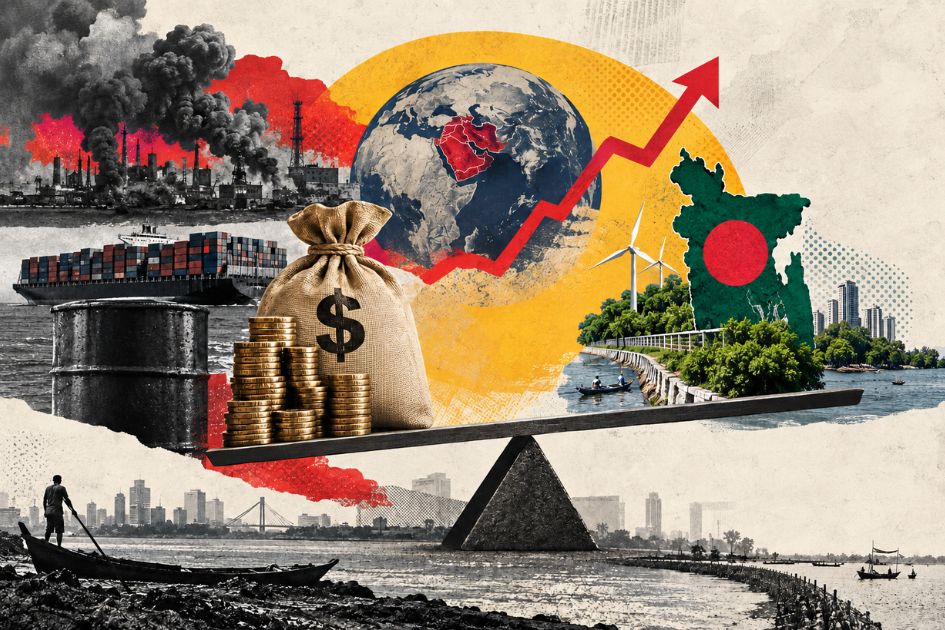



Global growth has slowed to its weakest pace since the pandemic, driven largely by conflict in the Middle East. In Bangladesh, the fallout is showing up in stalled trade, costlier shipping and a food supply chain that swallows farmers’ earnings, just as the government tries to find room in the budget for rivers, renewable energy and flood defences.
In June, the World Bank cut its global growth forecast to the lowest rate since Covid-19, blaming the conflict in the Middle East for higher energy prices, steeper inflation and rising borrowing costs. The Bank now expects the world economy to grow just 2.5 percent in 2026, down from 2.9 percent last year, with developing economies collectively facing their weakest expansion since the pandemic. That single data point, decided in Washington, will shape how much money is left over in Dhaka for the things Bangladesh says it most needs: dredged rivers, renewable power, and protection for a coastline already living with climate change.
Bangladesh is not facing a crisis of collapse. Remittances hit a record high this past fiscal year and reserves have climbed. But the country’s economic and climate ambitions are colliding with a year in which global capital has become more expensive, shipping lanes have become fewer and less predictable, and the domestic food supply chain is taking a larger cut of what families pay for dinner. This is an attempt to trace how those pressures connect, and what it means for a country trying to fund its own climate transition while the world’s debt architecture strains to keep up with everyone else’s.
A SLOWDOWN MADE IN A WAR ROOM, FELT AT A MARKET STALL
The World Bank’s Global Economic Prospects report, released on 11 June 2026, points squarely at the Middle East conflict and the closure of the Strait of Hormuz as the trigger for this year’s downgrade. Brent crude is projected to average $94 a barrel in 2026, more than a third above last year’s level, and global inflation is expected to rise to 4.0 percent from 3.3 percent. The Bank warned that if the disruption proves worse than assumed, global growth could fall to just 1.3 percent this year. South Asia is still expected to be the world’s fastest-growing region, but even here growth is projected to slow, from 7 percent in 2025 to 6.3 percent in 2026, according to the same report.
Trade tells a slightly less bleak story than is sometimes assumed. The World Trade Organization’s March 2026 outlook found that world merchandise trade volume actually grew 4.6 percent in 2025, far above earlier forecasts, driven by demand for AI-related goods and a rush to beat new tariffs. The WTO expects that pace to slow sharply to 1.9 percent in 2026, and has warned that a prolonged Middle East conflict could shave a further half a percentage point off that figure by pushing up fuel and shipping costs, the same channel through which Bangladesh, a heavy net importer of fuel, is already feeling the pinch.
Rising debt levels are compounding the squeeze. The World Bank’s June report notes that aggregate government debt in developing economies has climbed from under 40 percent of GDP in 2010 to more than 70 percent today, and that the more indebted a country already is, the more sharply its borrowing costs rise with each additional dollar it borrows. For a country like Bangladesh, now trying to finance a costly transition to renewable energy and climate-resilient infrastructure, that dynamic matters: money spent servicing existing debt is money not available for adaptation.
BANGLADESH’S OWN NUMBERS WOBBLE
Domestically, growth has been inconsistent rather than uniformly weak. According to Bangladesh Bureau of Statistics data reported by The Business Standard, the economy grew 4.96 percent year-on-year in the first quarter of FY2025-26 (July-September 2025), up from 3.91 percent a year earlier. It then slowed to 3.03 percent in the second quarter and to 2.22 percent in the third quarter (January-March 2026), down from 4.53 percent in the same quarter the previous year. The industrial sector actually contracted by 0.28 percent in the third quarter, a reversal from 3.33 percent growth a year earlier, even though it had expanded strongly in the first quarter.
Sayema Haque Bidisha, professor of economics at the University of Dhaka, told The Business Standard that base effects and the disruption caused by national elections held during the quarter made it inappropriate to draw firm conclusions from a single quarter’s data. She did, however, call the industrial contraction “a warning signal for the economy” that calls for prompt policy attention, given how closely factory output is tied to jobs.
Inflation, meanwhile, has been easing rather than stuck. Bangladesh’s headline inflation fell to 8.32 percent in July 2026, its lowest level in eight months, down from 9.16 percent in June, according to Bangladesh Bureau of Statistics data reported by BSS. Food inflation dropped even further, to 7.16 percent from 8.60 percent. That is real relief, even if prices remain high enough to strain household budgets built around a shrinking taka.
THE COST OF GETTING FOOD TO THE TABLE
Easing headline inflation does not mean food is cheap, and a big part of the reason lies in how far it travels between the field and the plate. A Centre for Policy Dialogue study, covered by The Business Standard in July, surveyed roughly 1,000 market participants across ten major commodities and found that green chilli prices rose 116 percent between farm gate and retail, the widest gap of any commodity studied, followed by onion at 87 percent, pulses at 78 percent and brinjal at 72 percent. Medium-quality rice rose by around 100 percent. Commodities that moved through shorter supply chains fared far better: eggs, chicken, beef and fish all saw markups of 25 percent or less.
CPD Executive Director Fahmida Khatun, presenting the findings, argued that the more intermediaries a product passes through on its way to market, the higher the price the final consumer ends up paying, pointing to a heavy reliance on urban wholesalers as a source of market concentration. Commerce Minister Khandakar Abdul Muktadir, addressing a separate CPD dialogue on the same subject later that month, said Bangladesh’s logistics costs run to around 16 percent of GDP against a global average closer to 10 percent, and cited rising production costs and market irregularities as key factors behind elevated food prices, according to a report by the state news agency BSS.
TRADE CAUGHT BETWEEN TWO FIRES
Bangladesh’s trade figures for the fiscal year just ended show an economy holding its breath rather than growing. Import settlements rose just 0.09 percent to $70.4 billion in FY26, even as businesses opened letters of credit worth 7 percent more than the year before, a sign of expected future demand that has not yet translated into actual imports, The Business Standard reported, citing Bangladesh Bank data. Imports of capital machinery, a proxy for new investment, fell 10.68 percent, while industrial raw material imports fell 3.33 percent.
Mustafizur Rahman, distinguished fellow at the CPD, told the newspaper that stagnant trade reflected both global conflict and uncertainty tied to the national election, and warned that Bangladesh’s upcoming graduation from least-developed-country status would add further pressure in the year ahead. The same report cited an unnamed deputy managing director at a private bank as saying that several major business groups had closed factories and that many others were running at only 30 to 40 percent of capacity; that claim rests on a single anonymous source and has not been independently corroborated for this piece, so it is presented here as a claim reported elsewhere rather than as an established fact, and the companies in question have not had an opportunity to respond to it directly in this article.
Exports told a similar story: merchandise exports slipped 0.58 percent to $48 billion, weighed down by the ready-made garment sector, which makes up more than 80 percent of goods exports. Mahmud Hasan Khan Babu, president of the Bangladesh Garment Manufacturers and Exporters Association, pointed to high interest rates, energy shortages and logistics bottlenecks as the main drags on competitiveness, and warned that European Union trade deals with India and Vietnam would sharpen the pressure ahead, according to the same Business Standard report. It is worth noting that this $48 billion merchandise figure is not directly comparable to the government’s newer $63.4 billion export target for FY27, which includes both goods and services.
SHIPPING LANES AS A CLIMATE AND ENERGY FAULT LINE
Some of the clearest evidence of how a distant conflict reaches Bangladeshi shores comes from its shipping routes. The Business Standard reported that a crude oil tanker chartered by the state-run Bangladesh Shipping Corporation, the MT Ninemia, was rerouted around Africa’s Cape of Good Hope in late July to avoid security risks near the Bab el-Mandeb Strait, nearly tripling the length of its voyage and adding an estimated $5.4 million in costs. Separately, the paper reported that container freight rates to the United States more than doubled within a month, and that Chattogram Port is dealing with a widening gap between the containers arriving full of imports and those leaving full of exports, with private depots holding tens of thousands of empty containers. These are the kinds of costs that get passed on to consumers and exporters alike, and they illustrate a point the WTO itself has made: that a prolonged energy-security crisis anywhere can quietly raise the cost of trade everywhere, hitting importers of fuel and shippers of low-margin goods hardest.
CHASING INVESTMENT, CHASING A BIGGER EXPORT NUMBER
Alongside these pressures, Bangladesh is trying to attract far more foreign investment than it currently receives. A Ficci report, covered by The Business Standard, argued the country needs to raise annual foreign direct investment to $15 billion by 2030, roughly seven times current levels, citing bureaucratic delays, in which official approval windows of 76 days can stretch into six months to a year in practice, and a fragmented system that requires investors to deal with 23 separate agencies.
The government, meanwhile, has set a goal of growing exports by 15 percent in FY27, to $63.4 billion combined for goods and services, after missing a more modest target the year before. Mustafizur Rahman called the new target “highly ambitious” given US tariffs and continuing uncertainty, according to The Business Standard, while Shehab Udduza Chowdhury of the garment manufacturers’ association was more blunt, telling the paper that mounting domestic and external challenges were making the target unrealistic.
WHERE THE CLIMATE MONEY IS SUPPOSED TO COME FROM
This is where Bangladesh’s climate ambitions enter the picture most directly. Speaking at the UN’s High-Level Political Forum in New York in July, Planning State Minister Zonayed Abdur Rahim Saki said Bangladesh faces an annual financing gap of more than $132 billion through 2030 to meet its Sustainable Development Goals, a figure specific to Bangladesh rather than a global total, according to the state news agency BSS. He appealed for more grants, concessional financing and technology transfer, and outlined the government’s “3R” strategy, Recovery, Restoration and Reconstruction, under which public spending on education and health combined is meant to rise to 5 percent of GDP over the next five years, alongside plans to dredge 20,000 kilometres of rivers and canals, plant 250 million saplings, and expand renewable energy and green transport.
Internationally, the debate over how to make that kind of financing more available is real but still largely aspirational rather than settled policy. Proposals tied to the Sevilla Commitment and a UN expert group on debt call for a Borrowers’ Platform, a voluntary forum intended to help indebted countries coordinate and share experience, not a collective bargaining or debt-restructuring body, alongside recommendations, not yet adopted rules, for automatic debt-service standstills during restructuring talks and firmer requirements that all creditors share losses fairly. Separately, UNCTAD’s own debt-management software, DMFAS 7, launched in March 2025 and had been installed in Rwanda, South Sudan and Zambia by the end of that year, part of a broader push to give heavily indebted countries better visibility into their own books, according to UNCTAD’s 2025 annual report.
WHAT THIS ADDS UP TO
None of these threads is decisive on its own. A single quarter of weak industrial output is not a collapse; a single supply chain study is not the whole food system; a single rerouted tanker is not a national energy crisis. But taken together, they describe a country trying to fund a climate transition at the exact moment that global capital has become more expensive, its own trade engine has stalled, and a war on the other side of the world is adding cost to every container it ships and every barrel of fuel it imports. The reforms being discussed in Seville and New York, and the ones being attempted in Dhaka, from a national single window for investors to a food-supply traceability system, will only matter if they arrive before the financing gap does.




