

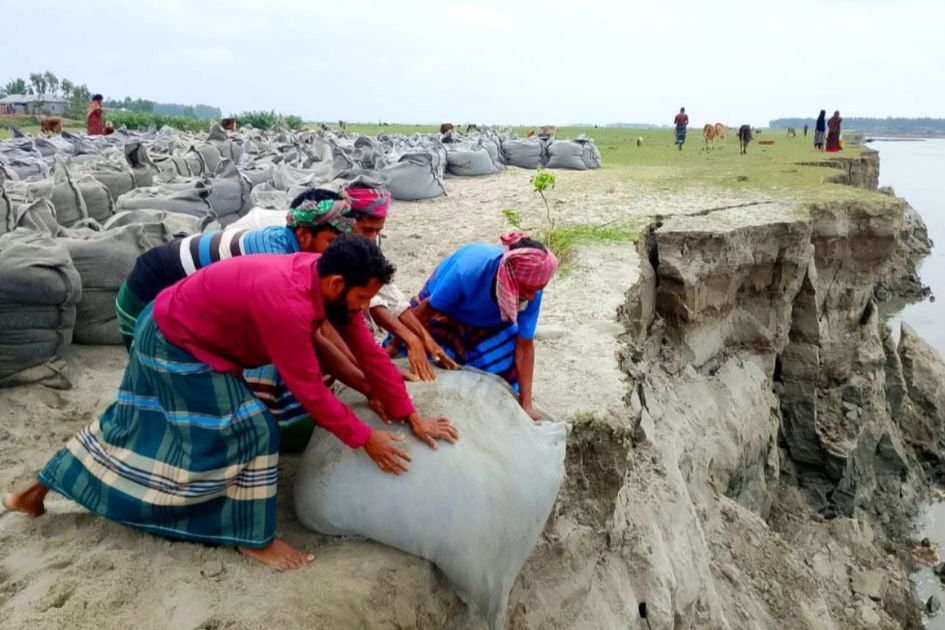



As COP31 approaches, the assessment points to finance, measurable targets and local decision-making as decisive tests for turning regional adaptation plans into protection for vulnerable communities.
Countries across Asia and the Pacific are giving greater prominence to climate adaptation in their national climate plans, but implementation remains weak, with fewer than half setting specific and time-bound adaptation targets, according to a new Asian Development Bank (ADB) assessment.
The ADB reviewed 21 updated national climate plans, known as NDC 3.0 submissions, and found that 19 include an adaptation vision or goal. But fewer than half set adaptation targets with defined, time-bound outcomes, highlighting a persistent gap between climate commitments and measurable action.
For Bangladesh, the findings underscore an urgent challenge: the country has developed major adaptation policies, but climate protection will depend on whether those plans are backed by adequate, predictable and accessible finance.
Money remains the missing piece
Finance is one of the biggest weaknesses identified by the ADB. Fewer than 30 percent of the 21 plans reviewed quantify their adaptation finance needs through total cost estimates for the NDC 3.0 implementation period.
Most countries have therefore identified major climate risks, including floods, droughts, extreme heat and rising seas, without clearly establishing what it will cost to address them.
Bangladesh has developed important policy frameworks, including the National Adaptation Plan 2023-2050 and its updated NDC. But policy commitments alone cannot protect communities on the ground without resources that are predictable, accessible and delivered at the scale required.
This finance gap will be a major test at COP31 in Türkiye. Following the COP30 call for efforts to at least triple adaptation finance for developing countries by 2035, attention will now turn to implementation, including how finance is mobilised, tracked and made accessible to climate-exposed countries and communities.
For Bangladesh, the issue is direct. Whether adaptation finance becomes real investment will shape the country’s ability to respond to floods, cyclones, salinity, river erosion, drought and extreme heat.
Small fixes, not big changes
The ADB also identified a deeper structural weakness: adaptation across the region remains largely incremental.
None of the 21 NDC 3.0 submissions explicitly frames transformational adaptation, which seeks to address the underlying systems and development patterns that create or reinforce climate risks rather than simply strengthening existing ones.
For Bangladesh, embankments, cyclone shelters and early warning systems remain essential. But lasting resilience also requires better land-use planning, climate-resilient urban development, water management and agricultural practices.
Adaptation must go beyond making existing systems stronger. It must also reduce the conditions that leave people exposed to growing climate risks.
Inclusion still falls short
Gender equality and social inclusion are referenced in 20 of the 21 plans, but the ADB found that links between differentiated climate impacts and adaptation responses remain uneven, while intersectionality receives limited attention.
Climate impacts are not experienced equally.
Women, children, older people, persons with disabilities, low-income households and people living in climate-exposed areas can face very different levels of exposure, resources and decision-making power.
In Bangladesh, these differences are visible in coastal communities facing salinity and cyclones, char areas exposed to floods and erosion, drought-prone parts of the north-west and densely populated cities facing intensifying heat.
Identifying affected groups is not enough. Their needs must influence adaptation priorities, investment decisions and the use of climate finance.
Communities still need power
Locally led adaptation remains another weak point.
Only four of the 21 NDC submissions explicitly use the term “locally led adaptation”, while the devolution of finance, authority and decision-making remains limited.
Bangladesh has taken steps in this direction. With support from the ADB’s Community Resilience Partnership Program, the country has developed a national framework for advancing investments in local-level adaptation, aimed at mobilising finance, strengthening monitoring and expanding local adaptation investment.
But consultation is not the same as local decision-making.
Communities and local institutions need meaningful authority, capacity and accessible finance to determine and implement adaptation priorities.
Loss and damage remains fragmented
The ADB also found no consistent approach across the 21 plans for identifying, assessing and reporting the scale of loss and damage.
For Bangladesh, where climate impacts are already damaging homes, infrastructure, agriculture, ecosystems and livelihoods, stronger systems for documenting these losses are essential for planning, accountability and access to appropriate support and finance.
The road to COP31
The ADB found that adaptation priorities across the reviewed NDCs broadly align with the thematic targets of the UAE Framework for Global Climate Resilience.
The UAE Framework for Global Climate Resilience is a landmark global framework adopted by Parties at COP28 in Dubai in December 2023 as part of the UAE Consensus. It was designed to guide achievement of the Paris Agreement’s Global Goal on Adaptation and strengthen adaptation action and support, with thematic and dimensional targets providing a framework for tracking progress on climate resilience.
The unfinished task is implementation.
Governments need measurable adaptation targets, realistic cost estimates, stronger institutions and reliable finance. Developed countries and multilateral development banks also need to help close the adaptation finance gap and improve access to resources for climate-exposed countries and local institutions.
For Bangladesh, COP31 is therefore more than another round of climate negotiations. It is a test of whether international adaptation commitments can translate into investment and protection on the ground.
Bangladesh cannot afford another decade of delay. Its adaptation frameworks are already in place. What is needed now is the finance, measurable targets, institutional capacity and local decision-making power required to turn those frameworks into action.
Climate plans are improving across the region. But without adequate finance, measurable outcomes and meaningful local power, the region’s rising adaptation ambition risks remaining largely on paper while climate risks continue to grow.




