

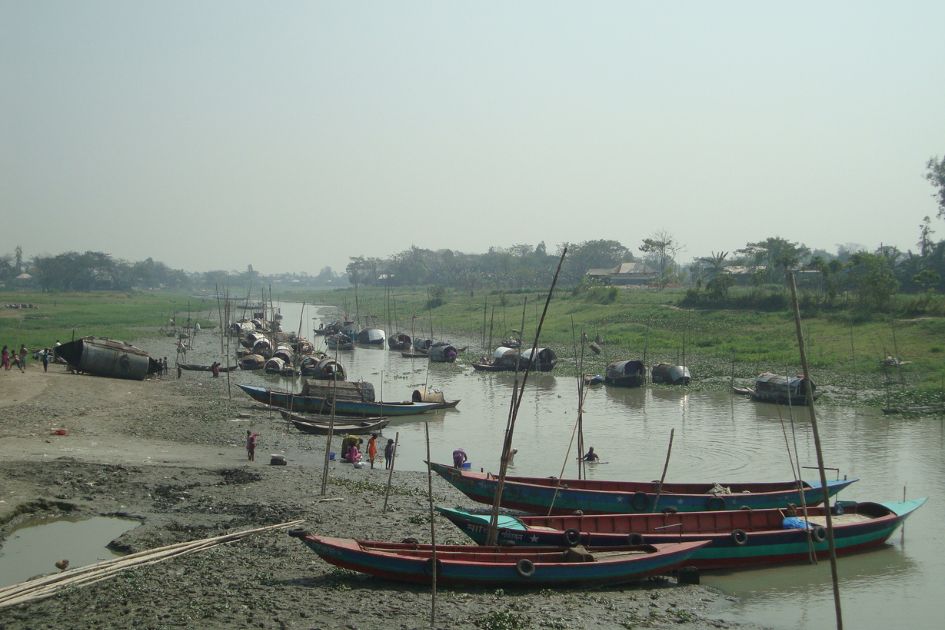



As rivers shrink and traditional trades lose ground, the Bede community faces deeper insecurity while seeking education, rehabilitation and recognition within mainstream society without losing its river-based heritage.
Blessed with the inexhaustible bounty of nature, Bangladesh has long been home to people of diverse faiths, ethnicities, races and Indigenous communities who have lived together as an integral part of the country’s social fabric for centuries. Among these communities, Bede people are the highly familiar marginalised. Their active participation in diversifying the strong cultural heritage of this country is undeniable. The Bede are also known by various names, including Baidya, Manta and Man-Tang. They are an Indo-Aryan people, also known as “river nomads” or “water nomads”, much like European gypsies. Traditionally, the Bede live on rivers and earn their livelihoods by travelling from one place to another. In a literal sense, they are born on the river and die on the river. Estimates of the Bede population vary considerably. While some sources put their number at around eight lakhs, figures from the Department of Social Services have placed the population at approximately seventy-five thousand.
A Community of Uncertain Origins
Reliable historical information about the origins of the Bede community is scarce. The Bede generally have medium-sized, sturdy and distinctive physiques. They tend to have dark complexions, broad foreheads and coarse, tightly curled hair. Based on their physical features, some researchers have suggested links with Mongoloid populations, as the shape of their heads and general physical structure bear certain similarities. Other theories, however, point to possible connections with the Negroid and Australo-Melanesian populations. Genetic research has identified links between the Bede and certain Australo-Melanesian groups, including Indigenous Australians. These groups share certain physical characteristics and genetic markers, including a high percentage of agglutinogen “A” in their blood, which has also been observed among Indigenous Australian communities in the Indian subcontinent and Australia.
There are several theories about the historical origins of the Bede. According to one account, a group of an exiled Arakan king, Ballalraj, arrived in Dhaka in 1638. They subsequently converted to Islam. Although they initially settled in Bikrampur, they later spread across Bangladesh and into West Bengal and Assam in India. Another theory suggests that the word “Bede” may have originated from “Bedouin” or that the community may have ancient Egyptian roots. Folk traditions claim that the Bede established a kingdom in Pandua in Hooghly district of West Bengal. Another popular belief identifies them as descendants of the Malla royal family of Bishnupur in Bankura district. Some also argue that the Bede originated from the Man-Tang community of the Arakan Kingdom and that many members have traditionally been comfortable identifying themselves as Man-Tang.
Traditional Healers and Practitioners of Folk Medicine
The Bede are also known as Badia, Baidya or Baidani. The term Baidya means healer or physician and is associated with the word for medicine and healing. Traditionally, Bede believe in various types of nature-based treatments, including herbal solutions and spiritual healing practices. They sell lucky herbs and herbal medicines. In the field of medicine, they use herbal ointments, wild plants, tree roots as well as various mantras. Rural people are seen trusting Bedes in the treatment of rheumatism, teeth and children. They believe that it has magical properties. They also believe that Bede practitioners can drive away evil spirits through supernatural powers. Entertainment has also traditionally been part of their livelihood. Bede performers organise monkey shows, magic acts, snake shows and other forms of popular entertainment. Since most of the life of the Bede is river-centred, one of the main ways of earning a living is through snake-related businesses, such as snake catching, snake charmer training, snake play, snake selling and snake venom treatment.
They also sell necklaces and other ornaments made from animal bones and other materials, which are traditionally believed to have therapeutic properties. Items made from jackal bones, tiger teeth and bird bones, as well as aromatic spices, amulets, opium, pearl ornaments, bangles and crescent-shaped necklaces, have also formed part of their traditional trade. They make weaving sticks for weavers and sometimes recover lost gold and silver ornaments from rivers, ponds and other bodies of water. Bede people traditionally consume the meat of various animals, including cattle, pigs and snakes.
A River-Based Social Organisation
Traditionally, Bede families travel in groups and rarely remain in one place for long. Each family generally owns its own boat. Several families and boats form a group, while several groups together constitute a larger unit known as a fleet or bahar. A leader of a fleet or bahar is traditionally known as a sardar, who supervises the affairs of the community. The sardar divides the group into smaller units and appoints leaders to oversee each section. He helps determine commercial routes and areas of operation and maintains communication among members. He is also responsible for resolving internal disputes and maintaining discipline.
If a group fails to return to its designated location within the agreed period, the sardar may demand an explanation and impose a fine. He may also receive fees during weddings and gifts during special ceremonies. The Bede social structure includes not only bahar sardars but also sub-clan and clan-level leaders. At predetermined times and places, these leaders traditionally gather to elect higher-level sardars. Historically, such elections were reportedly held at the Baruni fair during the month of Kartik near the confluence of the Ganges and Brahmaputra rivers in the Munshiganj area. Currently, they gather in Munshiganj and Chittagong every year between the 5th of the month of Kartik and the 15th of the month of Agrahayan to settle unresolved issues, including the election of sardars.
Faith, Belief and Social Customs
The Bede largely live within a community-based social system and adhere to many of their historical customs and traditions. Although most Bede identify as Muslim, their religious practices often incorporate elements of Hinduism, spiritualism, Shamanism and animistic traditions. Many Bede follow pirs, while others are devotees of Manasa, the snake goddess, or Bisha Hari. They praise Ram and Lakshman while also celebrating the valour of Ravana and the devotion of Hanuman. The Bede are believed to maintain close cultural relationships with other South Asian itinerant communities, including the Dom and Buno.
Although the Bede social structure is largely patriarchal, women play an important role in community life. Traditionally, Bede men are often perceived as less industrious, while women undertake much of the hard work required to sustain their families. The community generally establishes temporary platforms near rivers and low-lying areas and lives aboard boats. The boat is an exceptionally valuable resource for the Bede. They travel through rural areas for commercial purposes, particularly during the harvest season, which they traditionally refer to as Gaoyal. Women usually travel by boat or on foot during these journeys, carrying baskets of snakes and herbal medicines. The Bede typically set out for their Gaoyal journeys toward the end of Agrahayan and around the middle of Ashar. After completing their commercial travels between mid-Chaitra and mid-Ashwin, they return to predetermined locations. During these journeys, they may live in local boats, temporary shelters or even school verandas. The Bede community in Bangladesh is divided into nine distinct branches or subgroups: Lauya, Chapailya, Bajikar, Bej, Gayen, Mella, Bandaira, Mal and Shapuriya, also known as snake charmers.
The Secret Language of the Bede
Theth or Ther is a distinct language used by the Bede when communicating among themselves. When interacting with Bengali-speaking people, however, they generally speak Bengali. The Bede language has considerable similarities with the language of the Rakhine people. It has no independent written script. Many words used in the language are believed to have evolved from older forms of Bengali. During British rule, some small nomadic communities were categorised as “criminal”, and the Bede were among those affected by such colonial classifications. Their language was consequently regarded as a secret code or “criminal language”. Although journalists, spies, police and other intelligence agencies around the world use code languages, portraying a specific community as a criminal community for using code languages is a violation of human rights. Linguistic observations of Theth suggest that the language contains an unusually large number of synonyms. This indicates a sophisticated and expressive linguistic system. It is believed that it is not possible for any code language to have so many synonyms.
An Ancient Cultural Heritage
The Bede have been present in the cultural and literary history of Bengal since prehistoric times and are deeply rooted in the region’s cultural heritage. Historical evidence suggests that they once enjoyed a higher social status and were even regarded as belonging to the royal class in ancient times. The community possesses a rich oral tradition as well as distinctive material and social cultures, marriage customs, songs, folk literature and traditional healing practices. The classical musical raga Malkauns is also believed by some to have evolved from the musical traditions associated with the Bede.
Dress and Traditional Lifestyle
Bede men traditionally wear lungis. Women’s traditional clothing consists of two pieces of fabric, each approximately ten cubits long. One piece is wrapped around the waist with a knot, while the other is draped over the shoulder like a scarf. They traditionally wear loose-fitting shirts or fatua over the upper body. However, with social and economic changes, members of the Bede community are increasingly adopting clothing styles similar to those of the wider Bengali population.
Marriage, Family and Women’s Rights
The Bede regularly organise a variety of social and cultural festivals. Marriage traditionally takes place with the consent of both families and the mutual agreement of the bride and groom. Young men and women enjoy considerable freedom in choosing their life partners. After marriage, the husband moves to the wife’s house and the wife has to commit to taking responsibility for her husband and children. If a person from another community is present during social functions, he is encouraged to marry into the Bede community. If someone marries, he has to blend into the Bede. If someone marries through fraud, suitable compensation has to be paid to the victim.
Polygamy and joint-family practices are generally absent from Bede society. Widowed women may remarry without significant social restrictions. Although many Bede women identify as Muslim, they do not generally follow strict purdah practices. Women traditionally enjoy substantial autonomy. In cases of divorce, property and even responsibility for children are divided between the spouses, while women sometimes take a larger share of responsibility. Some Bede groups also follow distinctive marriage rituals found among certain Indigenous communities. In one such custom, the groom climbs to the top of a tall tree and sits there. Standing below, the bride promises to support the groom’s parents, care for his family, raise their children, avoid complaints against him, remain loyal and provide lifelong financial assistance. Only after these promises does the groom climb down, after which the marriage is completed. In another tradition, the bride’s family is required to provide a dowry depending on its financial capacity. Responsibility for arranging this dowry traditionally rests with the senior woman of the clan.
Access to Fundamental Rights
A large proportion of the Bede population has historically lacked access to formal education. Some estimates suggest that as many as 95 percent of Bede children do not attend school, while approximately 98 percent of the community lives below the poverty line. They have little interest in receiving any kind of state or institutional medical services. In this case, they are completely dependent on their traditional medical system. If they do not work, death is the inevitable outcome for them. Historically, the Bedes were not eligible to vote because they did not own land or have permanent residence. As a result, they were not only deprived of their voting rights but also could not apply for small loans or bank loans. They gained voting rights in Bangladesh in 2008. Subsequently, under government rehabilitation initiatives, permanent housing has been provided to some Bede families. However, the number of beneficiaries remains very small compared with the size of the community.
The Disappearing River and a Community at Risk
Over time, the rivers of Bangladesh have almost disappeared. Those that survive in a narrow and dilapidated state due to illegal filling, encroachment, pollution and siltation are also in danger of extinction today. At the same time, the Bede community, an authentic part of Bengal’s traditional cultural heritage, is struggling to survive. They are constantly losing out in the struggle to survive in a threatened environment. Our biodiversity, ecosystem and cultural interaction are being affected. In order to save their lives, the Bede community is leaving the rivers and moving to the coast and the land. They are getting involved in various anti-social activities, including crime, and the social balance is being affected. Meanwhile, many fears, uncertainties and challenges have increased in the lives of the Bede after coming to the land. On the one hand, they do not have a safe place or address to lay their heads. On the other hand, there is great uncertainty in the maintenance and livelihood of family members. As a result, the Bedes are now seen engaging in begging in different parts of the country.
Bede in Literature, Film and Popular Culture
The Bede community has also left a significant mark on the literature, culture and cinema of Bengal. The community’s way of life and social realities gained wider literary attention following the publication of Nagini Kanyar Kahini, a novel written by Tarashankar Bandyopadhyay in 1952.
The 1989 film Bedey Meyey Josna remains an enduring cultural landmark in the history of Bangladeshi cinema and continues to resonate with audiences. More recently, the mystery drama film Hawa, released on 29 July 2022, received widespread acclaim at home and abroad. Centred on a mute Bede woman, the film premiered in 73 cinemas in the United States and 13 cinemas in Canada. It also became the first Bangladeshi film to enter the top 30 at the US box office.
Preserving a Community and Its Heritage
In an era of globalisation, rapid technological advancement, infrastructural development and major breakthroughs in medical science, many traditional Bede practices, including spiritual healing, snake charming, snake performances and magic shows, are gradually losing their relevance. Entertainment has increasingly shifted towards smartphones and digital devices. At the same time, younger generations of the Bede community are losing interest in the professions and lifestyles of their forefathers. Instead, they are increasingly seeking social recognition and integration into mainstream society. They are moving away from the poverty-stricken, boat-based existence of the past and aspiring to stable, land-based lives with access to modern facilities and opportunities. Education is increasingly becoming the pathway through which young Bede people seek a better future. For this reason, proper rehabilitation and sustainable integration of the Bede community into a rapidly changing world are now urgent priorities. At the same time, the rivers that have historically sustained both nature and the Bede way of life must be restored and protected from destructive activities such as illegal sand extraction and indiscriminate riverbank exploitation. The rivers must be scientifically restored, re-excavated where necessary and protected from pollution. Only through such integrated measures can Bangladesh safeguard its biodiversity, ecosystems and cultural heritage and ensure a more sustainable and inclusive future for generations to come.
The Author is a a Media worker and article writer.




