




Scarce fire-resistant dhalu bamboo and fading binni rice are pushing Sylhet’s centuries-old Chungapura pitha toward extinction today, as deforestation and climate volatility rapidly erode ecosystems, livelihoods and winter-night communal traditions.
On cold winter nights in Sylhet, straw fires once burned until dawn, illuminating courtyards where families gathered around slanted bamboo tubes slowly roasting over glowing embers. Inside these bamboo chambers, rice batter steamed patiently, transforming into Chungapura pitha, one of the region’s most ancient and cherished winter delicacies. Today, that familiar sight has nearly vanished.
Chungapura pitha, also known locally as chungapitha, is more than a cake or food. For centuries, it symbolised hospitality, family honour and seasonal celebration across greater Sylhet and neighbouring Moulvibazar. No guest or newlywed son-in-law would leave a home without tasting Chungapura pitha alongside coconut pitha and maas biran, a lightly spiced fried river fish. Rui, katla, chital, boal, koi and magur once elevated the meal into a cultural ritual rather than a simple dish. Those customs are now fading fast.
This disappearance is a stark example of what climate experts describe as non-economic loss and damage. While climate impacts are often measured in monetary terms, the decline of Chungapura pitha represents the erosion of identity, memory, cultural practice and intergenerational knowledge.
The pitha is made by pouring ground binni rice, sometimes mixed with milk, coconut or sugar, into specially cut bamboo tubes called chunga. These tubes are placed over straw fires that burn for hours. Instead of burning away, the bamboo allows heat to gently steam the batter inside. When cooked, the pitha slides out whole and white, separating from the bamboo like a candle released from its mould.
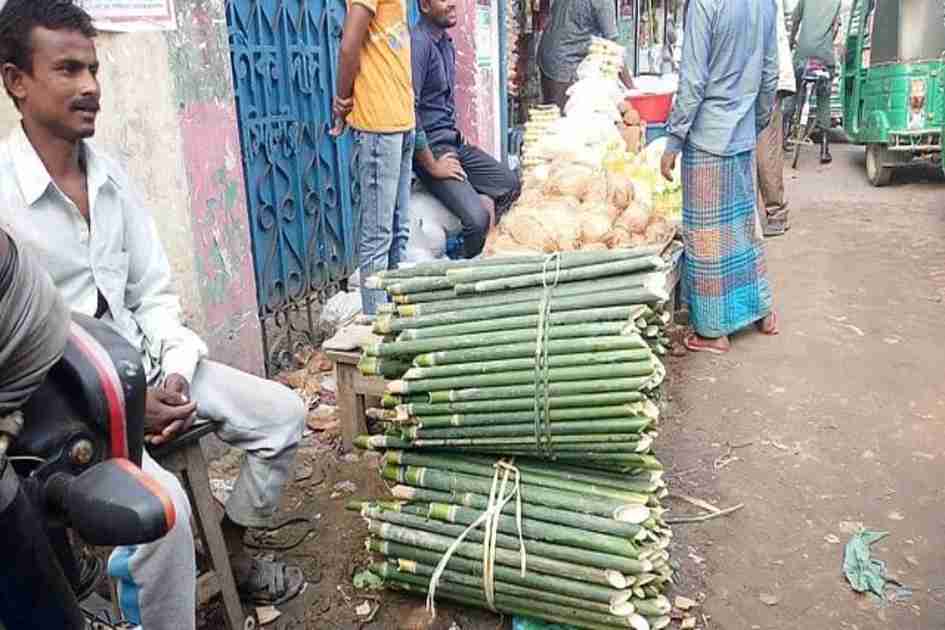
This process depends entirely on a rare bamboo species locally known as dhalu. Rich in natural oily compounds, dhalu bamboo resists fire. Even after hours over open flame, the bamboo often remains green, releasing a slow oily liquid that protects it from charring while the heat cooks the pitha inside. Without dhalu bamboo, Chungapura pitha cannot be made properly.
Until recently, dhalu bamboo was abundant across the Patharia Hills, Latitila, Rajnagar, Kamalganj and the tea gardens and hillocks of greater Sylhet and Moulvibazar. Today, it has become scarce and increasingly expensive. Rampant deforestation, illegal logging and hill destruction have wiped out most bamboo groves, leaving only small and fragmented patches.
Climate change has further accelerated this decline. Erratic rainfall, longer dry spells and rising temperatures have disrupted forest regeneration, while heavy downpours and hill erosion have damaged remaining bamboo habitats. Prolonged dry seasons weaken young shoots, making it harder for communities to source bamboo for traditional pitha-making. The combined impact of environmental degradation and climate stress threatens both the resource and the cultural practice built around it.
Local journalist Salahuddin Subho said bamboo scarcity is the main reason the tradition is disappearing. He explained that bamboo once grew freely across the hills and forest edges, but uncontrolled tree felling and changing weather patterns have nearly erased it. Without this bamboo, the straw fire method that defines Chungapura pitha no longer works.
For many families, finding bamboo has become a struggle. Praneet Debnath, who recently travelled to Munshibazar in Kamalganj to buy bamboo for Paush Sankranti, said that a decade ago bamboo sticks were available everywhere. Now they appear briefly during winter festivals and in very limited quantities. He had to search several markets before finding a small supply.
Bamboo sellers at Munshibazar echo the concern. Nidhi and Nipai Shabdakar, both long-time traders, said they once collected ten to fifteen bundles of dhalu bamboo in a day from nearby hills. Now they manage only two or three bundles at best. Each bamboo stick sells for around five taka and is usually available only during Paush Sankranti.
The decline of Chungapura pitha is also linked to the disappearance of binni rice. Climate change has affected traditional cropping calendars, water availability and soil conditions, discouraging farmers from cultivating indigenous rice varieties that are more sensitive but culturally significant. As farmers shift to climate-resilient but commercially dominant crops, binni rice is steadily disappearing from fields and memories.
Writer and researcher Ahmad Siraj said that dhalu bamboo once grew near almost every household in rural Sylhet. Today that bamboo is rarely seen. As the bamboo disappears, the tradition of making Chungapura pitha is fading with it, marking a quiet but profound cultural loss.
For local poet Sajjadul Haque Swapan, the loss goes beyond taste. He said that inside the bamboo lies a hidden delicacy rich in tradition and memory. Chungapura pitha is an ancient heritage of Sylhet where patience, fire and time create the flavour. What once flourished across villages is now disappearing quietly.
In earlier times, the making of Chungapura pitha was a communal event. Winter nights were filled with folk songs, poetry recitations, storytelling and humour as families gathered around the straw fires. Although some households still prepare the pitha in silence, the lively cultural performances have largely vanished.
As bamboo groves shrink, traditional rice varieties disappear and climate pressures intensify, Sylhet risks losing a culinary heritage deeply connected to its landscape and climate. The decline of Chungapura pitha is a reminder that when ecosystems are damaged by climate change, the losses extend far beyond economics, quietly erasing cultures, traditions and ways of life. Communities that protect bamboo groves, revive traditional rice cultivation and document cultural practices may still have a chance to keep this heritage alive for future generations.
Sohanur Rahman, Executive Coordinator of YouthNet Global, explained, “When cultural traditions vanish due to environmental and climate pressures, the loss is not just economic. It is the disappearance of community memory, identity and ways of life that cannot be replaced with money.”




