




Armenia will use COP17 to spotlight science, innovation and culture as countries review progress on the Kunming-Montreal Global Biodiversity Framework’s 23 targets.
A Green Zone at COP17 in Yerevan will host hundreds of scientific, cultural and environmental initiatives from October 19 to 30, bringing together civil society, researchers, businesses and international partners alongside the global biodiversity conference.
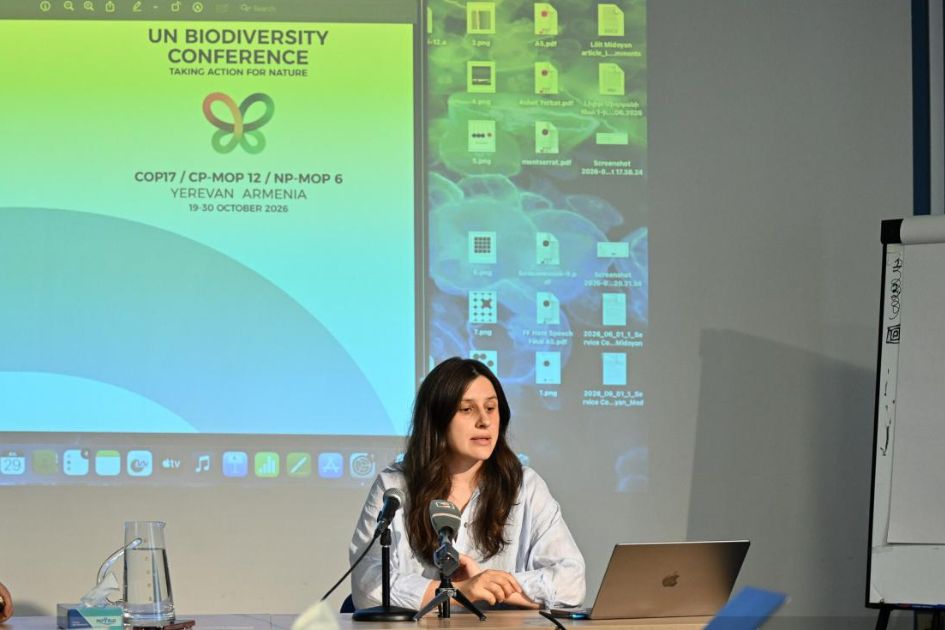
The Green Zone will operate at the Karen Demirchyan Sports and Concert Complex during the Seventeenth Meeting of the Conference of the Parties to the Convention on Biological Diversity (CBD), according to Lilit Midoyan, Chief Coordinator of the COP17 Green Zone.
Speaking to reporters, Midoyan said COP17 will be held across two main venues. The Blue Zone, managed by the Secretariat of the Convention on Biological Diversity, will be located at the Meridian Expo Center, while the Green Zone will be based at the Karen Demirchyan Sports and Concert Complex.
“Shuttle services will operate between the two zones. The Green Zone will be open daily from 10:00 a.m. to 6:00 p.m. It will feature several thematic areas, including a Science and Innovation Zone, where scientific and innovative projects related to biodiversity and environmental protection will be showcased, as well as a Cultural Zone, where visitors will be introduced to Armenia’s cultural heritage through a variety of events,” Midoyan said.
The Ministry of Environment will draw up the agenda for the Green Zone’s 12-day program, while partner organizations will also be able to organize their own events and initiatives at the venue. The deadline for submitting session proposals is September 15.
“Applications will be evaluated based on three main criteria: scientific merit, alignment with environmental policy objectives, and technical feasibility. Individuals may not apply as session organizers, but organizations may host both public and closed events. Sessions may last 30, 60, or 90 minutes,” Midoyan said.
She added that all materials must be submitted electronically in advance because storage devices will not be accepted at the venue.
Speakers will also be able to participate online, Midoyan said.
Simultaneous Armenian-English and English-Armenian interpretation will be available for Green Zone events. Organizers requiring interpretation into other languages will be responsible for making their own arrangements.
A press center with capacity for approximately 90 media representatives will also operate in the Green Zone.
Around 100 exhibition booths will be installed in the grandstand area of the Sports and Concert Complex.
“The rental fee for each booth is AMD 1.44 million, including taxes, for the entire 12-day period. Organizers will also encourage environmentally responsible practices throughout the venue, including minimizing the use of plastic and other materials that may harm the environment,” Midoyan said.
COP17 will bring together representatives of the Parties to the Convention as well as Indigenous peoples and local communities, civil society, scientists, youth, businesses and other stakeholders to advance global action on biodiversity.
The conference will take place at a key stage in the implementation of the Kunming-Montreal Global Biodiversity Framework (KMGBF).
For the first time since the Framework was adopted in 2022, countries will collectively review progress towards its 23 targets, shifting attention from commitments to evidence and from what was agreed to what has been achieved.
COP17 will provide an opportunity to assess collective progress, strengthen cooperation and accelerate action towards global biodiversity goals for 2030.
Hosting the conference will place Armenia at the center of the global discussion on biodiversity. Although the country represents only 6.7% of the Caucasus by area, it contains approximately 60% of the region’s biodiversity and is home to diverse ecosystems and thousands of plant and animal species.
As host, Armenia will welcome the international community to Yerevan, providing a platform for dialogue, cooperation and collective action while linking global biodiversity priorities with the country’s rich natural heritage.
This post is republished from Armenpress.




