

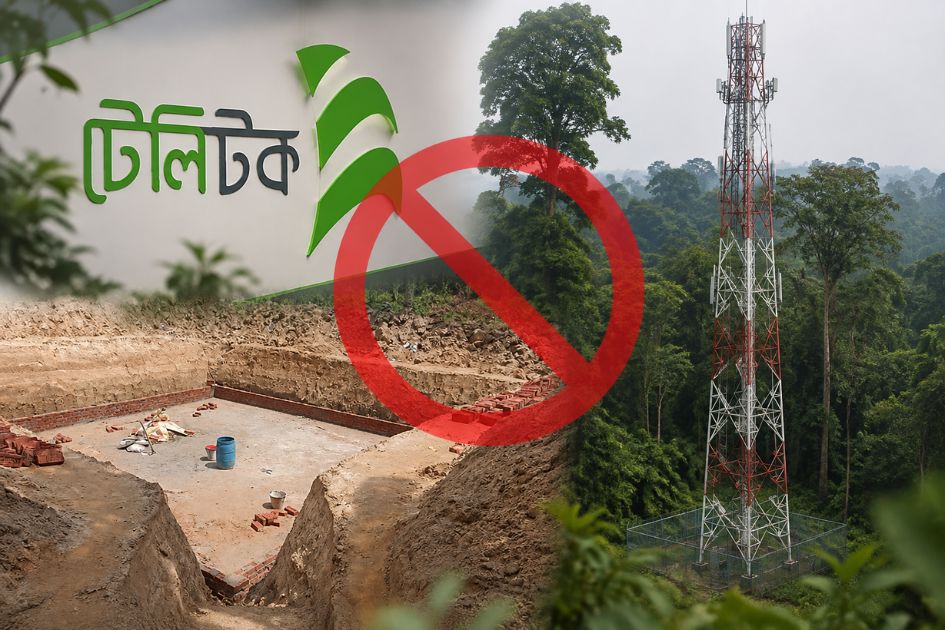



Forest officials halted Teletalk’s tower project after discovering construction inside protected forestland, prompting concerns over land verification, regulatory compliance and risks of further ecological encroachment.
Construction begins in Ramgarh-Sitakunda Reserved Forest in Bangladesh without clearance; Forest Department stops work after unauthorised excavation by the state telecom operator.
Despite the legal protection of a century-old reserved forest, state-owned telecom operator Teletalk has come under scrutiny for starting construction of a mobile network tower inside Chattogram’s Ramgarh-Sitakunda Reserved Forest without mandatory approval from forestry authorities.
The Forest Department halted the work after discovering the unauthorised construction, but not before the company completed the foundation of the proposed tower inside the ecologically sensitive forest area.
The incident has raised serious questions over how a government-owned organisation proceeded with a permanent infrastructure project inside reserved forestland without properly verifying the legal status of the site or securing clearance from the competent authorities.
The disputed site is located near Jhiltali Bazar Mosque under Heyako Beat of the Korerhat Range in Bhujpur, Fatikchhari upazila. Forest records confirm that the land falls within the boundaries of the Ramgarh-Sitakunda Reserved Forest, which was declared a protected forest through a gazette notification more than a century ago during the British colonial period.
Under existing forest regulations, no individual, company or institution can enter reserved forest areas, excavate land or establish permanent structures without prior approval from the relevant government authorities. Any change in land use inside reserved forests requires approval from the competent ministry.
Despite these legal requirements, excavation and foundation work for the Teletalk tower reportedly continued for several days before forest officials intervened.
The incident has raised further questions over the project approval process, including whether Teletalk conducted a proper land verification, checked official forest records, consulted the Forest Department before leasing the site or obtained any no-objection certificate before beginning construction.
Forest officials intervene
The Forest Department stepped in after receiving information about the construction and sent a patrol team to inspect the site.
Md Mahdi Hasan, assistant conservator of forests at the Chattogram North Forest Division, confirmed that the work was being carried out without permission.
“Construction had started without approval. A Forest Department patrol team visited the site and ordered the work to stop,” he told reporters.
Mohammad Hossain, divisional forest officer of the Chattogram North Forest Division, said only the central ministry has the authority to approve any land-use change or construction inside a reserved forest.
“We have instructed the company to stop construction. If the directive is ignored, legal action will be taken,” he warned.
Forest officials said private ownership claims cannot override the legal status of reserved forestland.
Teletalk points to landowner
Teletalk defended its action, saying the company had leased the land from local private landowners before starting the project.
AM Akhtarul Islam, project director of Teletalk, said the company was unaware that the leased land was located inside a reserved forest.
“It is possible that the landowner concealed the fact that the site falls within a reserved forest. Otherwise, we would not have undertaken the project there,” he said.
He added that Teletalk would review the legal status of the land and take necessary steps according to government rules, including seeking approval from relevant authorities if required.
Experts warn of ecological threats
Forestry experts and environmentalists have warned that permanent infrastructure inside protected forest areas could create a precedent for further encroachment and increased human activity in fragile ecosystems.
The Ramgarh-Sitakunda Reserved Forest, spread over more than 84,000 acres across northern Chattogram and parts of the Chattogram Hill Tracts, serves as a critical ecological buffer, watershed and biodiversity refuge.
The forest supports diverse wildlife, including around 25 species of mammals, 123 species of birds and various reptiles. Experts say infrastructure development, access routes and increased human movement can fragment habitats, disturb wildlife corridors and intensify pressure on forest resources.
Dr Kamal Hossain, supernumerary professor at the Institute of Forestry and Environmental Sciences of the University of Chittagong, said the forest was already under severe pressure from encroachment and settlements.
“Construction and maintenance activities, along with expanded mobile network access, could encourage further settlements and human interference. This would increase pressure on wildlife habitats and damage the ecosystem,” he said.
Environmentalists said reserved forests cannot be treated as ordinary land banks for infrastructure projects, particularly when Bangladesh is facing growing biodiversity loss and climate-related challenges.
Conservationists demand stronger safeguards
Sohanur Rahman, executive coordinator of YouthNet Global, said development initiatives must follow environmental laws and respect the ecological importance of protected forests.
“Connectivity and digital infrastructure are important for communities, but development cannot come at the cost of destroying natural ecosystems. Reserved forests are not empty lands; they are critical safeguards for biodiversity, climate resilience and the livelihoods of present and future generations. State institutions must lead by example by ensuring that every project follows environmental regulations and protects nature,” he said.
The Teletalk project now stands as a test of whether Bangladesh’s forest protection rules apply equally to private actors and state institutions and whether stronger safeguards are needed to prevent future encroachment in protected areas.




