

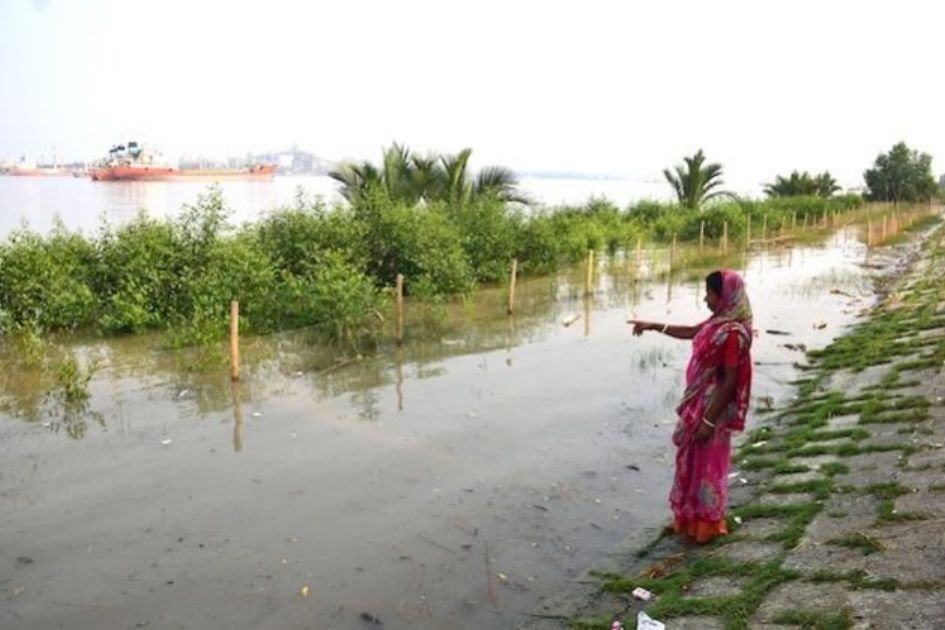



Community-led mangrove restoration in southwestern Bangladesh is strengthening coastal protection while creating safer livelihoods for women and families living near the Sundarbans.
Women in Bangladesh’s cyclone-prone southwest are planting mangroves to protect their homes and livelihoods from tidal surges, salinity and increasingly severe climate impacts, while creating new sources of income for communities living near the Sundarbans.
For Golenur Begum, 48, of Sinharatoli village, the mangrove barrier now growing beside her community stands where storm surges once swept into her home.
Golenur has faced 12 cyclones in her lifetime. As a child, she saw her father’s house destroyed and as an adult, she watched her own home smashed. Tidal surges brought saltwater that damaged farms and livelihoods, impacts that are becoming more intense and frequent with climate change.
“Sixteen years ago, in 2009, my house was washed away by Cyclone Aila. At first, we sheltered on a raised dirt road near our house. After the road was submerged, we rushed to a shelter two kilometers from the village to save our lives. The next day, when we returned to the village, we saw that many more houses had been destroyed. Shrimp farms, vegetable fields, chicken farms, and ponds submerged in salt water,” Golenur remembers.
Other women from the village, including Sahara Begum, 32, Rokeya Begum, 45, and Anguri Bibi, 44, described the same crisis.
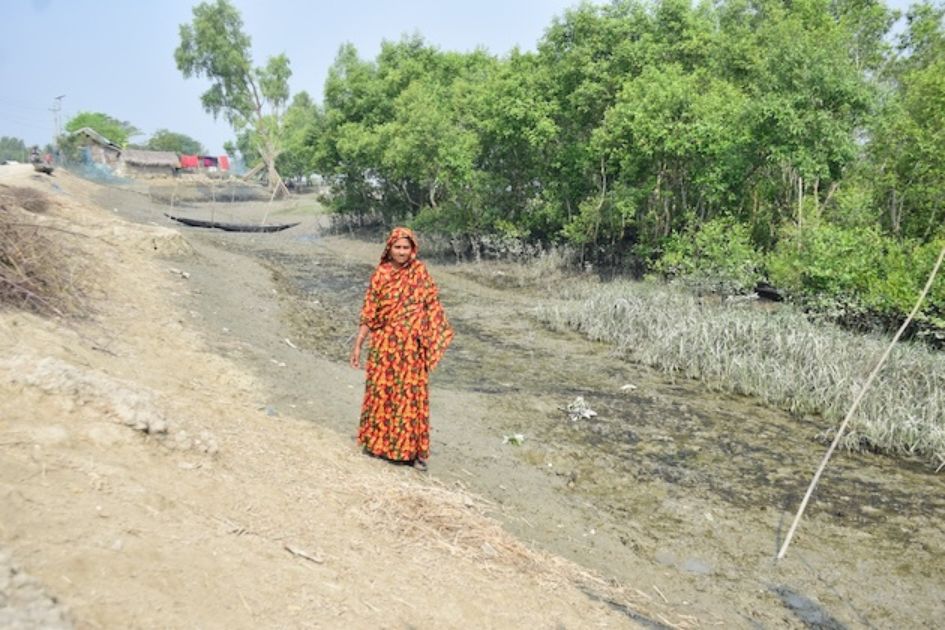
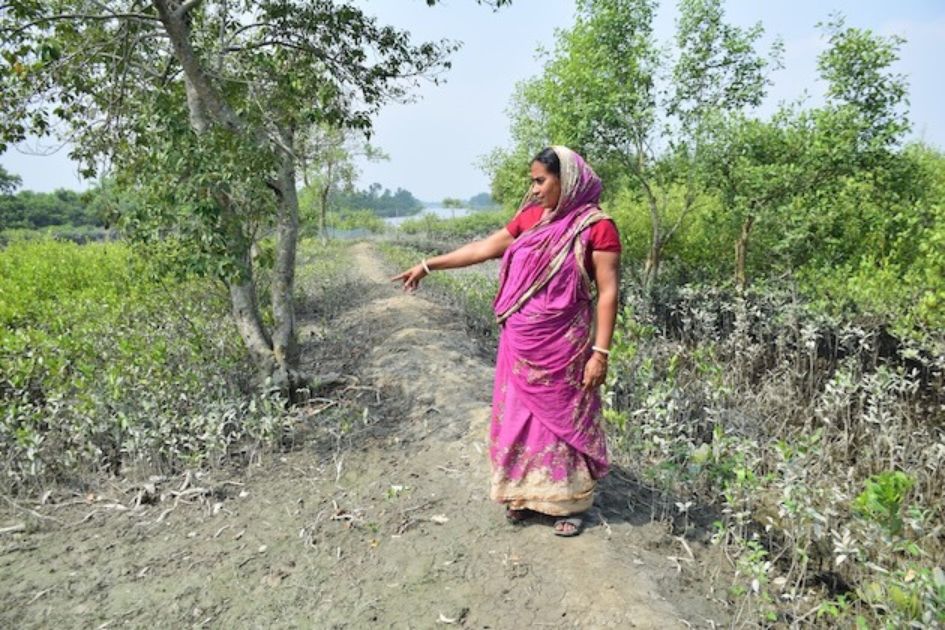
Sinharatoli is a climate-vulnerable village in Munshiganj Union of Shyamnagar Upazila, a sub-district of Satkhira district in southwestern Bangladesh. The Malanch River flows past the village.
Across the river lies the World Heritage Sundarbans, a mangrove forest in the Ganges Delta formed by the confluence of the Ganges, Brahmaputra and Meghna rivers in the Bay of Bengal.
Most people living in villages along the Malanch River lost their homes and livelihoods because of Cyclone Aila. But Aila was only one of the 12 cyclones Golenur has experienced.
Neelima Mandal, 40, from Chunkuri, another village adjacent to the Sundarbans, recalled how repeated storms left communities exposed to tidal water.
“Due to frequent cyclones, the embankments on the riverbank collapsed. The tidal water of the Malanch River used to enter our houses directly. As a result, both our livelihoods and lives were in crisis,” she said.
Bangladesh’s southwestern coast faces multiple pressures from climate change. Communities in the region are accustomed to tides, cyclones and salinity and have survived by adapting to those hazards.
Despite their resilience, however, the region does not have enough strong embankments. Although embankments were constructed in the 1960s, most are weak. If cyclones become more intense as the climate changes, people’s lives will be even more affected.
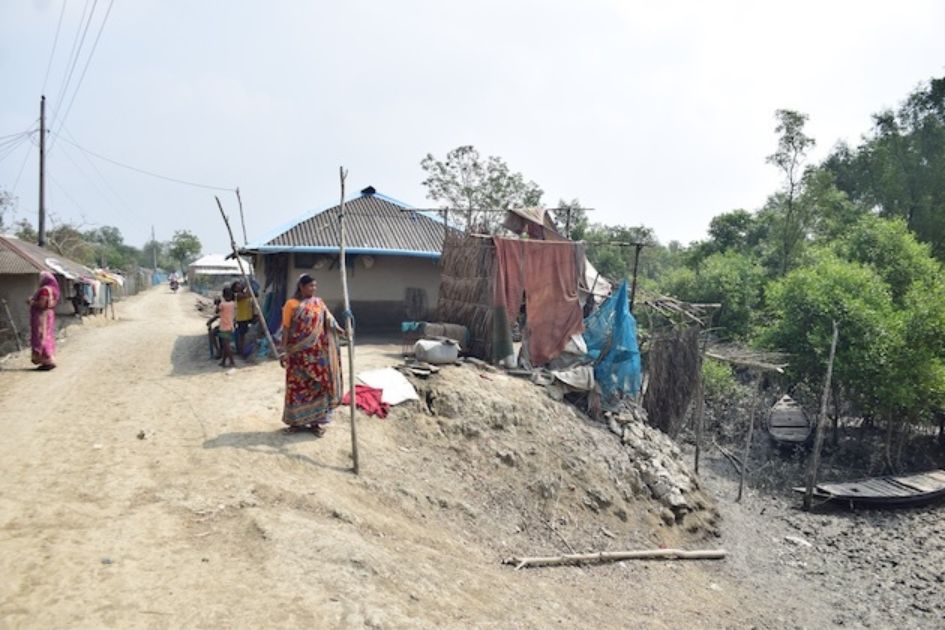
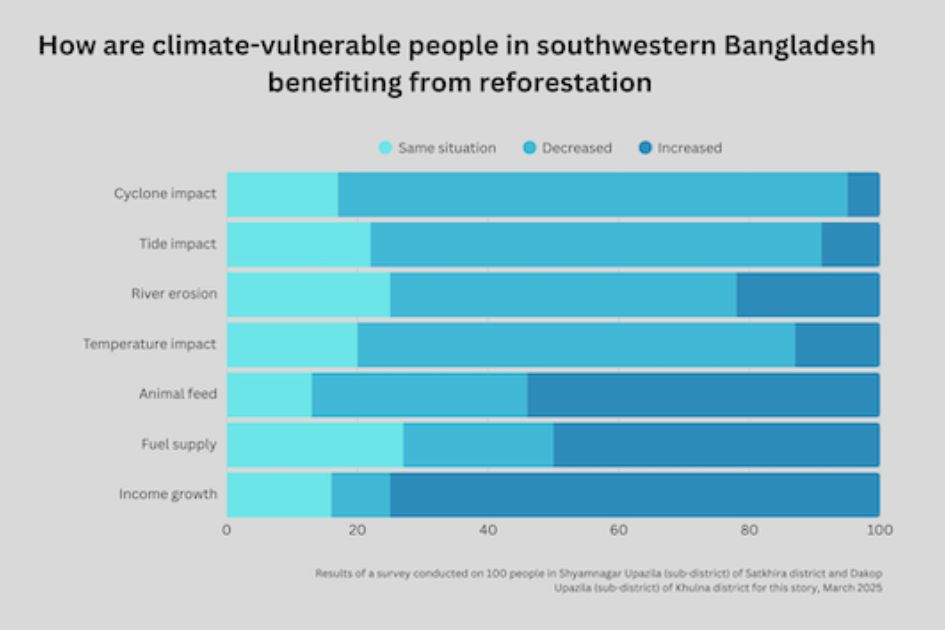
The Sundarbans, which include four areas enlisted and protected by UNESCO, provide protection to Bangladesh’s southwestern coastal districts, but the mangrove forest itself is also under pressure from frequent cyclones.
Cyclone Sidr caused extensive damage to the Sundarbans in 2007, with recovery taking several years.
According to a study by the Change Initiative, dense forest covered 94.2 percent of the Sundarbans in 1973. By 2024, that figure had fallen to 91.5 percent.
Communities in the region also face extreme conditions during cyclone season, when tides can reach heights of up to three metres, or 10 feet.
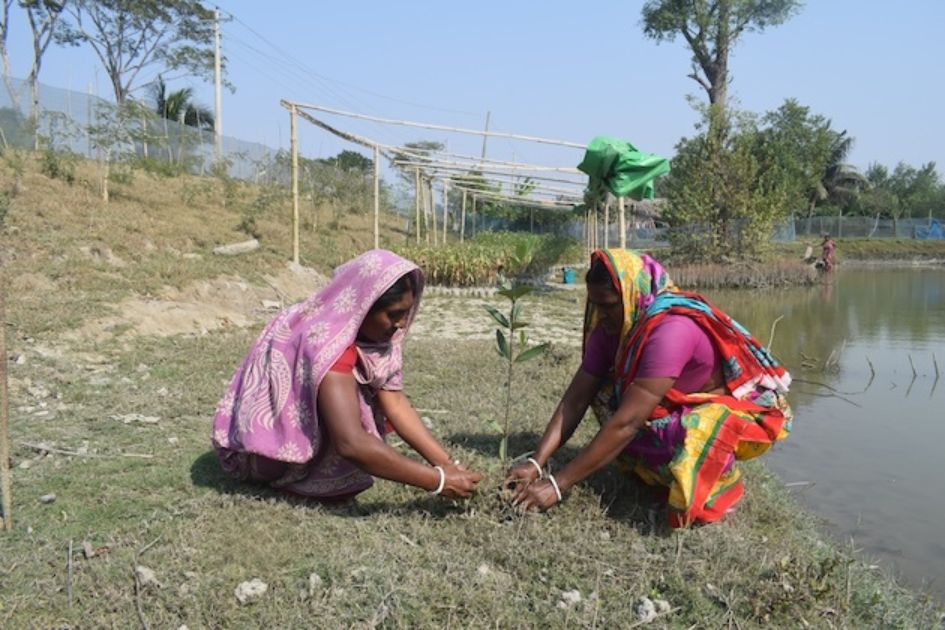
In 2013, women in Sinharatoli began creating a mangrove wall, seeking to prevent climate hazards from determining the future of their community.
The barrier now stands where storm-surge water entered Golenur’s home during Cyclone Sidr in 2007 and Cyclone Aila in 2009. She now worries less about her home and livelihood, while the mangrove forest also provides other economic benefits.
“When we started planting mangrove seedlings here, the entire area was devoid of trees. Tidal water once submerged the area. In a few years, a mangrove forest has formed in the vacant space. More than 500 people from about 100 houses in the village are now free from natural hazards,” Golenur said.
A similar mangrove safety wall now protects Chunkuri village, which had faced comparable vulnerabilities. Residents care for the mangroves and also benefit from the forest.
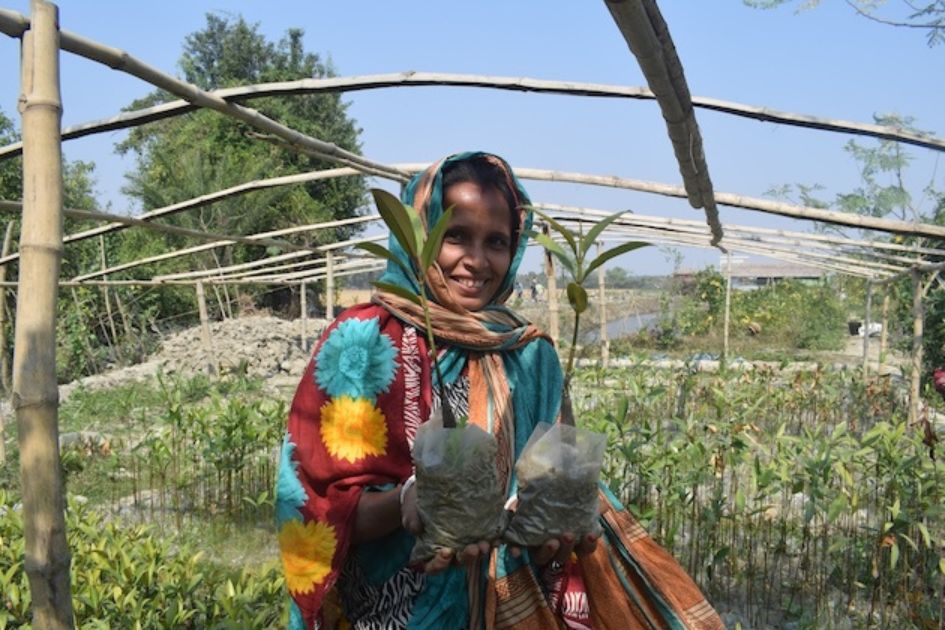
“Mangroves help us secure our livelihood. We can collect fodder for our cattle from the forest. Mangroves help us reduce heat,” said Sabitri Mondal, a Chunkuri resident.
Several organizations, including the Bangladesh Resource Council of Indigenous Knowledge, known as BARCIK, the Bangladesh Environment and Development Society, or BEDS, and Friendship are working to restore mangroves in parts of Khulna, Satkhira and Bagerhat districts.
Since 2008, BARCIK has planted 1,800 mangrove trees in coastal villages including Koikhali, Burigoalini, Munshiganj, Gabura, Padmapukur and Atulia in Shyamnagar Upazila of Satkhira.
BEDS has planted more than one million mangrove saplings across 146.55 hectares of land in Shyamnagar, Satkhira and Dakop, Khulna, since 2013.
Maksudur Rahman, chief executive officer of BEDS, said involving local communities was essential to protecting the mangroves.
“To save mangroves, we need to involve the local community. If we can provide alternative livelihoods to the local community, the mangroves will also be saved and the people will be protected. The initiative that we have been continuing since 2013 is already reaping the benefits of the community,” Rahman said.
Mangrove seeds that once went largely unused have also become a source of income for women in villages near the Sundarbans.
Namita Mandal of Dhangmari village in Dakop Upazila of Khulna district said a mangrove nursery has transformed her family’s livelihood and reduced their need to enter the Sundarbans to catch fish and crabs.
“The mangrove nursery is now the driving force of my family. The income from the nursery is what keeps my family going. My husband and I no longer have to go to the risky Sundarbans to catch fish and crabs. Alternative livelihoods have made my life safer,” she said.
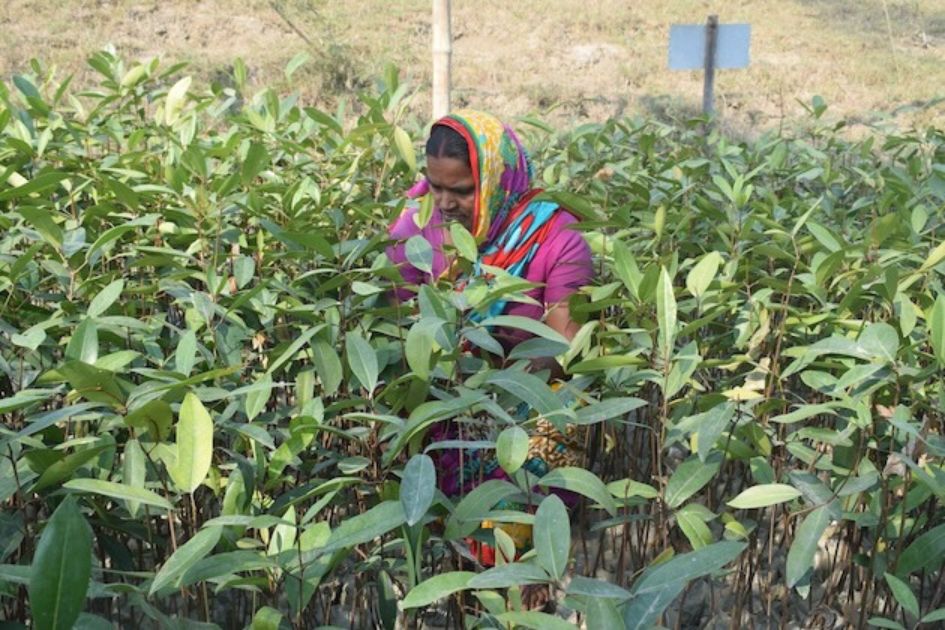
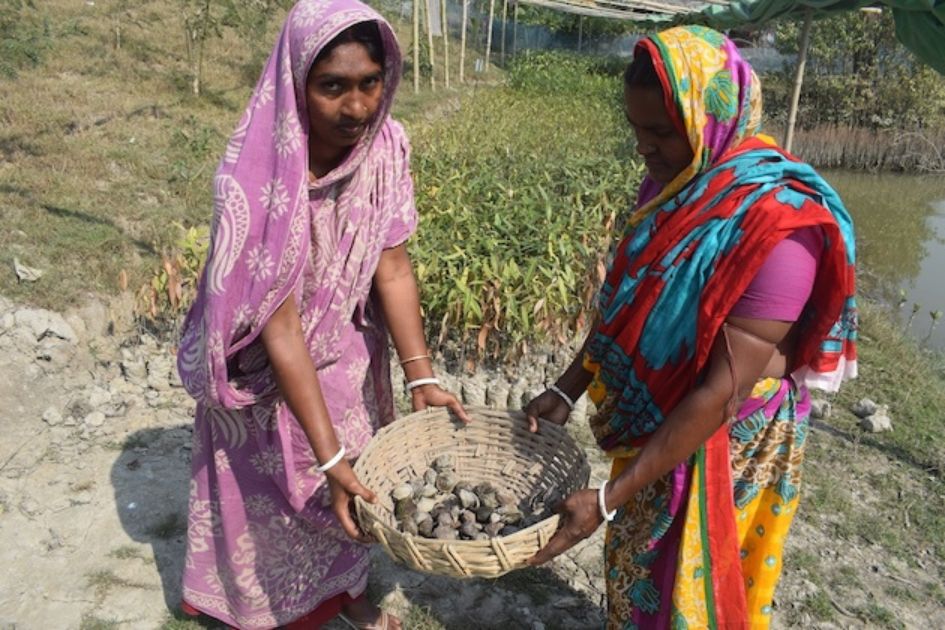
Families once collected seeds and leaves floating from the Sundarbans, dried them and stored them for cooking. Women including Namita have since begun using those abandoned seeds to establish nurseries.
The seeds are grown into seedlings that are then used to create new mangrove areas. Many other women in villages near the Sundarbans have also turned to mangrove nurseries as a source of livelihood.
Species raised in the nurseries include keora (Sonneratia apetala), baen (Avicennia alba), gewa (Excoecaria agallocha), khulshi (Aegiceras corniculatum), kankra (Bruguiera gymnorrhiza), golpata (Nypa fruticans) and goran (Ceriops decandra). Their seeds float down from the Sundarbans.
Namita said her nursery income had increased significantly in recent years.
“I sold seedlings worth 50,000 taka ($426) in a year. My nursery has expanded. The number of employees has increased. In 2023, I sold seedlings worth about 4 lakh taka ($3,407) from my nursery to some clients, including the Bangladesh Forest Department, international NGO BRAC, and BEDS,” she said.
Rakibul Hasan Siddiqui, associate professor at the Institute of Integrated Studies on Sundarbans Coastal Ecosystem at Khulna University, said restoration of the mangrove forest was helping protect communities threatened by climate-related hazards.
“The Sundarbans and its surrounding settlements are severely affected by rising sea levels and frequent cyclones in the Bay of Bengal. Sundarbans Restoration is helping to protect coastal residents from any kind of natural disaster,” Siddiqui said.
This feature is published with the support of Open Society Foundations.
This post is republished from IPS UN Bureau Report.




