

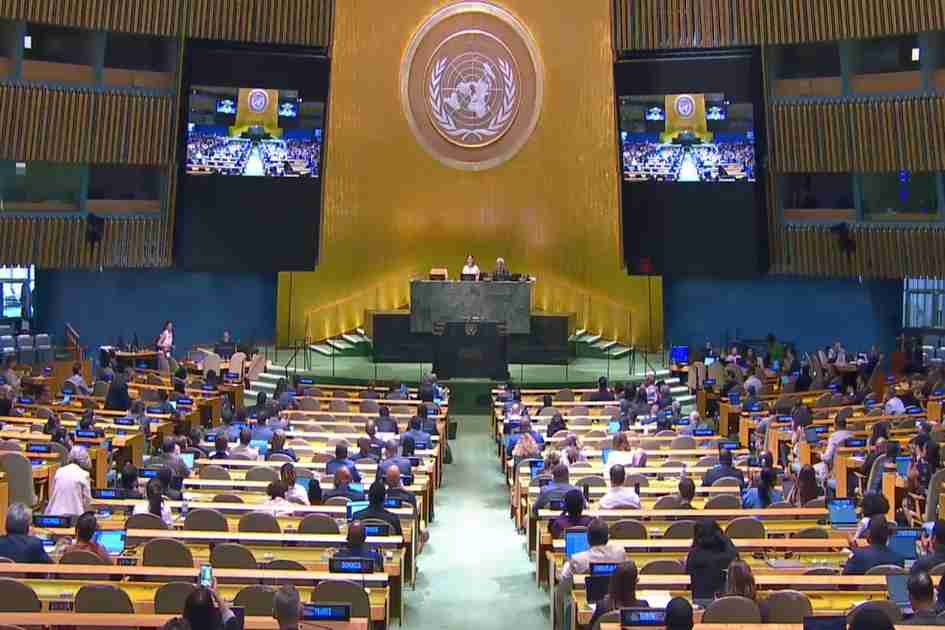

Backing from 141 countries for the ICJ climate opinion reflects a widening global shift toward treating climate change as a matter of legal responsibility, deepening divisions over fossil fuels and expanding the role of international law in climate governance.
The overwhelming endorsement of a landmark climate justice resolution at the United Nations General Assembly marks a significant moment in global climate governance, reflecting an accelerating shift from voluntary political commitments toward expectations of legal accountability for climate inaction.
With support from 141 countries, the resolution backing the 2025 advisory opinion of the International Court of Justice signals widening acceptance that climate change is not only a policy challenge but increasingly a matter of international legal obligation, judicial interpretation and human rights responsibility.
As the world moves toward COP31 in Turkey, the convergence of ICJ legal reasoning and UNGA political endorsement may mark a shift in how climate responsibility is interpreted, not only as a matter of negotiation but increasingly as a matter of legal accountability and evolving international norms.
A Geopolitical Split Over Climate Responsibility
The vote exposed deep geopolitical divisions over the future of fossil fuels. While the resolution passed with overwhelming support, eight countries opposed it, including the United States, Saudi Arabia, Russia and other major energy producers, underscoring continued resistance to interpretations of climate obligations that could accelerate fossil fuel phase-down commitments or open pathways to legal liability debates.
Analysts say this split reflects a broader structural tension in global climate politics between countries pushing for legally reinforced climate action and those seeking to preserve policy flexibility around fossil fuel production.
At the same time, the scale of support suggests that a large majority of states are increasingly willing to align climate policy with emerging legal and scientific consensus.
From Political Pledges to Legal Expectations
For decades, global climate governance has been anchored in voluntary frameworks under the United Nations Framework Convention on Climate Change and subsequent agreements. The ICJ advisory opinion marked a turning point by clarifying that states’ climate obligations already exist within international law.
The UNGA resolution strengthens this interpretation politically, reinforcing the idea that climate action is not discretionary but tied to evolving legal expectations under international law.
It calls for a transition away from fossil fuels in a just, orderly and equitable manner and urges the phase-out of inefficient fossil fuel subsidies that do not address energy access or just transitions.
For vulnerable countries, particularly small island states such as Vanuatu and Tuvalu, the resolution represents both recognition and urgency as rising seas threaten territorial survival.
Jotham Napat called the outcome a new chapter in international climate action, reflecting years of sustained diplomatic pressure by Pacific nations and allied civil society actors.
Litigation and National Climate Policy Impact
Legal experts say one of the most immediate impacts of the ICJ advisory opinion has been its growing influence on climate litigation worldwide. Courts are increasingly being asked to assess whether governments are meeting adequate climate obligations under international law.
Harj Narulla, counsel for the Solomon Islands during the ICJ proceedings, said judges are attentive to broad international consensus, even in non-binding resolutions, which can shape reasoning in domestic and international cases involving emissions targets, fossil fuel approvals and environmental rights.
The resolution also interacts with national climate planning processes.
Joie Chowdhury noted that the ICJ advisory opinion is already being reflected in nationally determined contributions under the Paris framework.
“One of the important spaces where we have already seen uptake of the ICJ’s legal conclusions is in nationally determined contributions. The resolution can further encourage national climate plans to integrate the advisory opinion’s findings,” she said.
This suggests a gradual integration of international legal reasoning into domestic climate policy frameworks, particularly as countries revise emissions targets and implementation strategies.
Climate Diplomacy Beyond COP Negotiations
Beyond litigation and national policy, experts argue that the resolution may have its most significant impact on the architecture of climate diplomacy itself.
Narulla said the vote reflects a growing recognition that global climate governance is no longer confined to annual COP negotiations.
“The international community is showing that COP is not the only forum that matters and if progress stalls there then climate action will be pursued through the General Assembly and in other multilateral spaces,” he said.
This signals a potential diversification of climate governance, where legal institutions, UN bodies and multilateral forums outside the UNFCCC increasingly shape global expectations.
Youth and Frontline Climate Leadership
The resolution reflects the sustained influence of youth movements and frontline states in reshaping climate discourse toward justice and intergenerational equity.
Sohanur Rahman, who has been engaged in global climate justice advocacy since COP26 in Glasgow, described the vote as a shift from moral advocacy toward legal recognition.
“This vote shows climate justice is now moving from moral demand to international legal expectation,” he said.
“Young people, small island states and frontline communities have kept this issue alive in global negotiations. The message now is clear: climate inaction is no longer politically or legally neutral.”
His remarks reflect a broader pattern in which youth-led movements are increasingly influencing not only public discourse but also legal and institutional interpretations of climate responsibility.
From Symbolism to Institutional Pressure
Despite its overwhelming support, the resolution does not assign liability to specific states or create enforcement mechanisms. Several supporting countries also continue to expand fossil fuel infrastructure domestically, highlighting the gap between global commitments and national energy strategies.
However, analysts argue the significance lies in institutional momentum rather than immediate enforcement.
The resolution further requests the UN secretary-general to prepare a report outlining ways to strengthen compliance with climate obligations and improve coordination with the Paris Agreement framework.




