

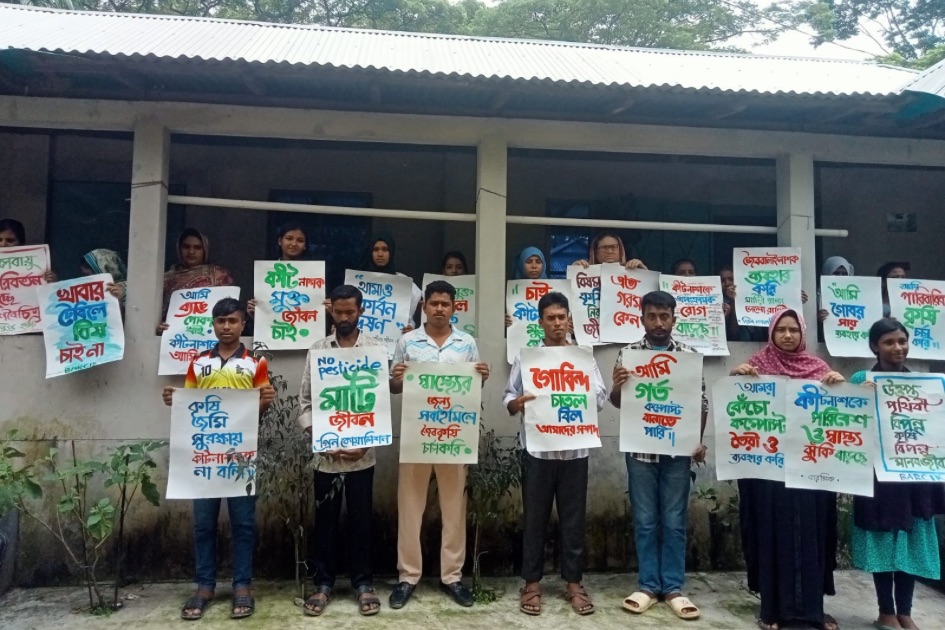



Young participants from 20 organisations explored locally rooted farming approaches, biodiversity conservation and climate resilience, ending the workshop with action plans and a village awareness campaign promoting sustainable agriculture.
A youth workshop on agroecology, climate justice and food sovereignty was held at the Agrojatra Kishori Organisation and the Fochika Agroecology Learning Centre in Fochika village of Kailati Union under Netrakona Sadar Upazila with support from the private research organisation BARCIK.
Farmer researcher Golam Mostafa served as the trainer at the workshop, which brought together 20 young people and adolescent girls representing 20 youth organisations from Kailati Union. The event was chaired by Priti Akter, president of the Agrojatra Kishori Organisation.
BARCIK Programme Officer Khadija Akter Lita outlined the objectives of the workshop at the opening session.
She said addressing the climate crisis requires building food systems based on local knowledge, biodiversity, low-cost farming and farmers’ control over food production. She added that agroecology is not only an agricultural practice but also an effective pathway to achieving environmental and social justice.
During an open discussion, participants shared their views on the agricultural ecosystem of the Netrakona region and measures needed to establish a climate-resilient food system. The discussion concluded with a call for coordinated efforts to develop a climate-resilient, farmer-friendly and sustainable food system.
The workshop included discussions on development, people-led development, agroecology, climate justice, food sovereignty, the environment, ecosystems, weather, climate, the climate crisis, disasters, organisations, people’s movements, public planning, Bangladesh’s agricultural ecosystem, animal resources, biodiversity, ecosystems, food chains, food, environmental pollution, ecological crises and perspectives on haor wetlands, hills and plains. Participants also discussed the protection of nature and biodiversity.
Through group work, participants developed plans and pledged to promote year-round vegetable cultivation around homesteads, establish nutrition plots, practise pesticide-free farming, preserve uncultivated food resources, conserve local seeds, promote sustainable farming practices and strengthen family-based agriculture.
Farmer researcher Golam Mostafa said the use of toxic pesticides in agriculture must be reduced. He said women’s contributions to agriculture are not properly recognised or valued and called for separate allocations for young farmers and adolescent girls.
In the closing session, BARCIK Regional Coordinator Md Ahidur Rahman shared his experience of practising agroecology.
He said, “The more the environment is destroyed and ecosystems are damaged in the name of development, the more agroecological practices face crisis. Let the haors and hills remain as they are. Reduce the use of pesticides and protect biodiversity.”
The programme concluded with participants carrying placards bearing collective messages and conducting an awareness campaign in the village.




