

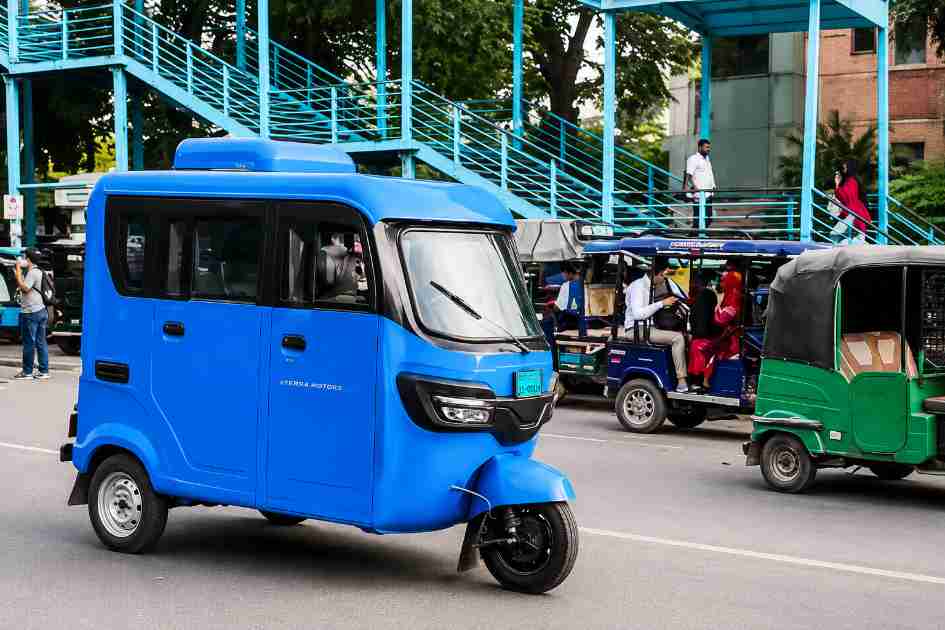



A viral air-conditioned auto rickshaw in Gurugram showcases grassroots adaptation to extreme heat while raising questions about climate resilience, public transport design and the limits of individual solutions.
As parts of South Asia continue to endure increasingly intense heatwaves, a modified auto rickshaw equipped with a functional air-conditioning unit has gone viral, drawing attention not only for its novelty but also for what it reveals about urban climate stress and everyday adaptation.
The three-wheeler was recently spotted in Gurugram, on the outskirts of India’s capital New Delhi, where temperatures have repeatedly crossed 40 degrees Celsius during peak summer days. In a region where millions depend on semi-open public transport, such conditions make daily commuting physically exhausting and, at times, hazardous.
A small innovation in a high-heat city
At first glance, the vehicle appears to be a standard auto rickshaw. However, a rear-mounted air-conditioning unit, reportedly fully functional, has transformed it into a mobile pocket of cooling comfort for passengers navigating congested, sun-scorched roads.
The modification gained widespread attention after a video posted on Instagram by user Dipanshi circulated widely, quickly accumulating thousands of views and sparking debate about urban transport innovation in extreme climates.
While many initially assumed the setup was merely decorative, riders and viewers familiar with the vehicle said it provides noticeable cooling inside the passenger area, offering rare relief in a city where heat exposure is becoming a growing public health concern.
The driver’s perspective and practical realities
The innovation has also raised practical questions that go beyond social media attention. The driver behind the modification reportedly installed the system independently, though details about the total cost, energy consumption and maintenance remain limited.
Such adaptations often come with trade-offs, including higher fuel use or electricity demand, increased upkeep costs and uncertainty about long-term financial sustainability for drivers who already operate on narrow margins. Whether this model can be replicated at scale in a way that benefits both passengers and drivers remains unclear.
Jugaad innovation and its limits
Online users quickly framed the vehicle as an example of India’s well-known “jugaad” culture, a form of resourceful, low-cost problem-solving that produces creative solutions in constrained environments.
While widely celebrated, this type of improvisational innovation also reflects deeper structural gaps in urban infrastructure. In cities facing escalating heat stress, reliance on individual ingenuity often highlights the absence of systematic solutions in public transport planning.
Experts and commentators increasingly caution that such innovations, while impressive, should not distract from the need for long-term investments in climate-resilient infrastructure, including shaded transit stops, heat-safe vehicle design and electrified public transport systems.
A symptom of a larger climate crisis
The viral attention surrounding the air-conditioned rickshaw also underscores a broader regional reality. South Asian cities are experiencing more frequent, prolonged and intense heatwaves due in part to climate change and rapid urbanization.
Open and semi-open transport systems such as auto rickshaws are among the most vulnerable in these conditions, exposing both drivers and passengers to dangerous levels of heat stress during peak hours.
Public health experts have warned that without adaptation measures, heat-related illnesses among outdoor workers and commuters could rise significantly in the coming decades.
Beyond novelty, rethinking urban mobility
The rickshaw’s popularity on social media has sparked admiration, humour and calls for similar innovations in other cities. Yet it also raises a more fundamental question: can urban transport systems in South Asia continue to rely on informal adaptation, or is a structural redesign urgently needed?
As temperatures continue to rise across the region, the viral vehicle stands as both a symbol of human ingenuity and a reminder of the limits of piecemeal solutions in the face of a deepening climate crisis.




