

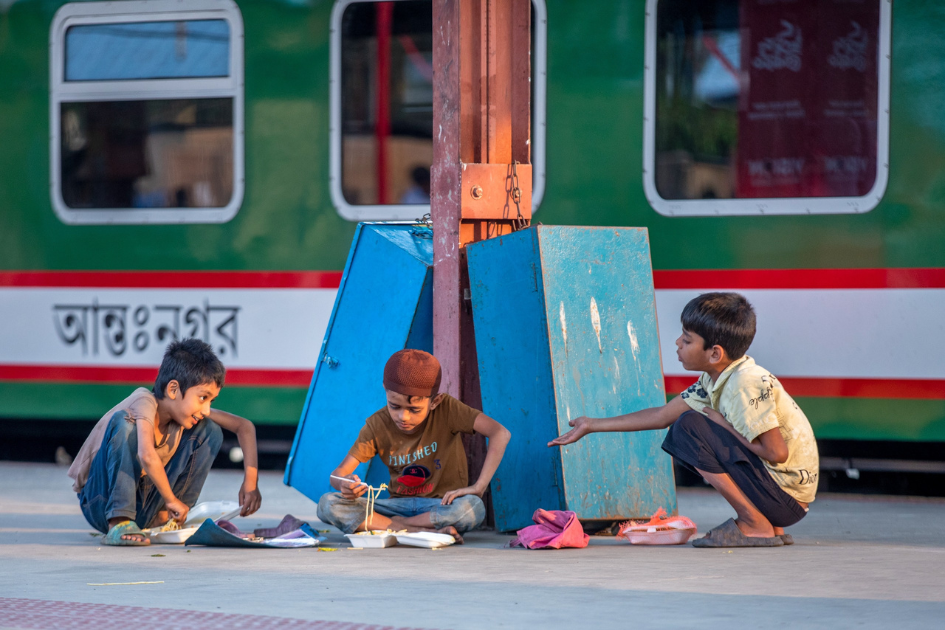



A train has left the station. Passengers have gone on with their journeys, but discarded food packets remain on the platform. Three children search through them for something to eat.
Two children find some food. The packet of the third child, Ratan, is empty.
Ratan lives with his six-member family in a settlement near Chattogram Railway Station. His family came from Bhola after river erosion destroyed their home and land, forcing them to move to Chattogram.
Now, the family lives in a slum, facing poverty and uncertainty. For Ratan, the struggle for food has become part of childhood.
On the day the photograph was taken, Ratan had found nothing to eat. Hungry, he reached out his hand towards another child, hoping to get some food.
Ratan is not alone. Many families displaced by climate-related disasters have moved to Chattogram and other cities in search of shelter and livelihoods.
According to a 2026 study by YPSA, around 30–40% of slum residents in Chattogram are climate migrants. Among them, 70.4% were displaced because of river erosion.
For children like Ratan, displacement can mean losing not only their homes but also the ordinary experiences of childhood. Instead of books, toys and games, some are forced to search for food among discarded leftovers.
The train moves towards its destination, but for Ratan, the destination remains uncertain.
Photo is Recently taken by Mohammad Minhaj Uddin at Chattogram Railway Station on 3 March 2026.




